The tracking site for all things viral, Buzzfeed, has just picked up on something that we here at Lost in the Cloud pointed out like MONTHS ago*, namely, the ridiculously lame choice of a cover image for the “Hipster Faith” article in Christianity Today. The more I think about it, the more I detest this book/article/subcultural label (while remaining ignorant of the whole argument, since I haven’t read the book, and with a big “no offense” to the author of said materials).
*Ok, it was less than one month, but in terms of the attention span of today’s kids, that’s like YEARS!
The same website also posted on the Calvin College decision to uninvite The New Pornographers to play at their school (a topic which my friend Rob Kirkendall thoughtfully comments upon here). I give props to whomever at Calvin invited them to come in the first place, but this decision feels like it’s just feeding the public perception of evangelical ignorance and presumptuousness. I’m sure there are so many students & faculty/staff at Calvin that hate this decision as well, so it shouldn’t reflect poorly on them (we’ll let their soteriology do that! heh-heh, um, J/K?), but really the more Christians cave in to the conservative power-brokers, the more we taint the image of what it means to follow Christ in the world…it’s time for a revolution. Perhaps, a SECOND Reformation anyone?
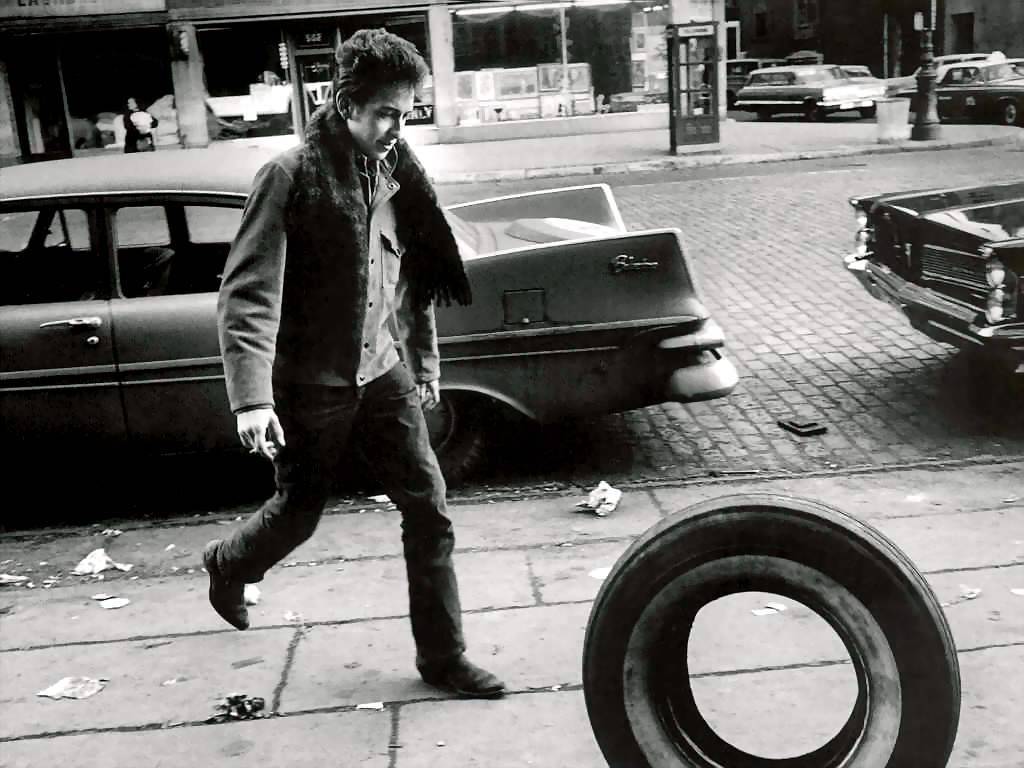
Surprise, surprise – Bob Dylan is my favourite ‘band’. From a critical perspective, Dylan’s monumental place in the history of popular music is indisputable, yet despite his massive popularity and critical enshrinement, he is and has ever been elusive, in a constant state of artistic evolution. In Martin Scorsese’s 2005 documentary No Direction Home, Dylan states, ‘I had ambitions to set out to find…this home that I’d left a while back. … I was born very far from where I’m supposed to be so I’m on my way home.’
In Greenwich Village, the epicentre of the post-McCarthy folk revival in the early sixties, Dylan would pick out which performers were ‘doing it for real’ and then pick up how they were doing it. Dylan states regarding performers he admired, ‘[There] was something in their eyes that said “I know something you don’t know” and I wanted to be that kind of performer.’ He describes the folk scene in the early 60s as divided into two camps: pop music for college kids and intellectual folk music – Dylan considered himself neither. In his 2006 autobiography Chronicles, Volume One he writes,’ There were a lot better singers and musicians around [Greenwich Village] but there wasn’t anybody close in nature to what I was doing.’ (London: Pocket Books, 18)
Eventually Dylan’s uniqueness brought him to the attention of Columbia Records’ John Hammond and although Dylan’s voice was not the standard at Columbia—home to the beautiful voices of those like Tony Bennett and Johnny Mathis—Hammond’s track record for sales convinced the executives at Columbia that Dylan would be worth their investment. It was with Columbia that Dylan’s massive repertoire (over 600 original compositions) would take off and progress over the course of the last half-century.
Throughout his career Dylan’s music has undergone several significant shifts. In 1965 he ‘went electric’ with Bringing It All Back Home. This transition brought about accusations of ‘going commercial’ for money and fame. Famously, one audience member criticised Dylan, exclaiming ‘Judas!’ during a now-infamous performance at Royal Albert Hall in 1966.
In a 1965 interview with the Chicago Daily News, Dylan stated, ‘I’ve never followed any trend, I just haven’t the time to follow a trend. It’s useless to even try.’ Instead, Dylan saw his ‘going electric’ as a natural progression from his earlier style. In No Direction Home, he states, ‘An artist has got to be careful never really to arrive at a place where he thinks he’s at somewhere. … You’re constantly in a state of becoming.’
In 1966, not long after the release of his third electric record, Blonde on Blonde, Dylan was injured badly in a motorcycle accident. ‘Truth was that I wanted to get out of the rat race,’ Dylan writes. ‘Having children changed my life and segregated me from just about everybody and everything that was going on.’ (Chronicles, 114) He refrained from touring for the next eight years, but still wrote and recorded prolifically. During this time he returned to more traditional roots and explored country music with several excellent pieces such as ‘I Dreamed I Saw St Augustine’, ‘Lay, Lady, Lay’, ‘If Not For You’ and ‘Knockin’ on Heaven’s Door’, but had not achieved a significant amount of critical or commercial success—at least anything that could be likened to the success of his earlier material—until the release of Blood on the Tracks in 1975.
Dylan describes Blood on the Tracks as a product of his ‘painting period’ in which the songs were more ‘like a painter would paint’ rather than those a musician would compose. In The Cambridge Companion to Bob Dylan, Carrie Brownstein writes, ‘By examining music from a visual perspective, with colours and lines instead of notes and chords, Dylan laid out on the canvas what would be Blood on the Tracks.’ (Kevin J. H. Dettmar, ed., The Cambridge Companion to Bob Dylan, Part I [Cambridge: Cambridge, 2009], 157).
As can be observed from many of his early influences such as Hank Williams’ ‘When God Comes and Gathers His Jewels’ and Woody Guthrie’s ‘Jesus Christ’, Dylan was not unfamiliar with the usage of religious motifs. He employed them in his own work on a regular basis, as is the case with ‘Masters of War’, ‘With God on Our Side’, ‘All Along the Watchtower’, etc. At the time, these expressions were not so much a matter of Dylan’s personal faith as they were the custom of the tradition he was drawing from and his employment of the language of a largely ‘Christian’-literate American society. But by the mid-seventies Dylan began to gain greater interest in religion and God. In a 1975 interview for People magazine Dylan expressed, ‘I’m doing God’s work. That’s all I know.’ Dylan’s interest in faith continued to grow in the late 70s and he converted to Christianity in 1978. Not long after this he began work on his first ‘born-again’ record, Slow Train Coming. Regardless of however outspoken and off-putting Dylan’s conversion might have been to many fans at the time, the single ‘Gotta Serve Somebody’ earned him his first Grammy Award for ‘Best Vocal Performance’ in 1979.
As Dylan had unwittingly become the spokesperson for the folk elitists in the early sixties, he found himself in a similar predicament with regard to the religious community in the eighties. With his 1983 release, Infidels, Dylan began distancing himself from any explicit avowal of faith and the institutions to which he was inevitably linked. After Infidels, Dylan experienced what may be considered a creative, critical and commercial lull. In 1997 he released his ‘comeback’ album Time Out of Mind, which was followed by a string of successes: “Love and Theft” (2001), Modern Times (2006) and Together Through Life (2009). In No Direction Home, artist, musician and friend of Dylan, Bob Neuwirth comments, ‘I think [Dylan] always made exactly the work he wanted to make at the time he wanted to make it. The audience came to Bob.’
While I can’t deny that his work from the mid-eighties through the early-nineties is not my favourite, the magic of Dylan’s music and his ability to constantly reinvent himself en route to ‘becoming’ have significantly shaped the way I see music and how I both personally and creatively interact with the world. Because of this profound and unparalleled impact in my life he belongs nowhere but in this number one slot.
Tarantula, an experimental novel written by Bob Dylan from 1965-6 (New York: Harper Perennial, 2005)
Dont Look Back, documentary covering Dylan’s 1965 tour of the UK, directed by D.A. Pennebaker (1967)
Festival!, documentary of the Newport Film Festival from 1963-5, directed by Murray Lenner (1967)
I’m Not There, semi-biographical film, ‘Inspired by the music and the many lives of Bob Dylan’, directed by Todd Haynes (2007)
No Direction Home, documentary on Dylan’s early life and his career prior to his touring hiatus in 1966 following his motorcycle accident, directed by Martin Scorsese (2005)
This one should be no shock to my readers. Creed is undeniably the best band in history. Why? There are countless reasons, but I need point you no further than the phenomenal 1999 song ‘What If’:
I’ve said it before and I’ll say it again: any song that repeats its own title 53 times is absolutely brilliant in my book.
No, not really – Creed is wretched. Number one will be published tomorrow and it will most likely be no surprise to faithful LITC readers…
This is worth watching (but I apologise beforehand for some of the language):
For anyone familiar with this blog, these last few rankings should come as no surprise. Elliott Smith has been the subject of two posts in the past (‘Elliott Smith, Intercessory Psalmist‘ and ‘Happy 41st, Elliott’) and is deserving of many more, including this one. Elliott’s music is extremely well-crafted, revealing a genius of a high order. His musical abilities are only overshadowed by his profoundly intimate songwriting.
In addition to his inclusion here at number two in my Top 20 Bands, I’ve also committed myself to an obsessive Top 50 Elliott Smith Songs list. His 2000 record Figure 8 was ranked as my third favourite record released between 2000 and 2009. Along with Figure 8, two more of his records can be found on my Top 50 Albums list: Elliott Smith (1995) and Either/Or (1997).
‘Between the Bars’ from the album Either/Or, live recording from the 1997 short film Lucky Three:
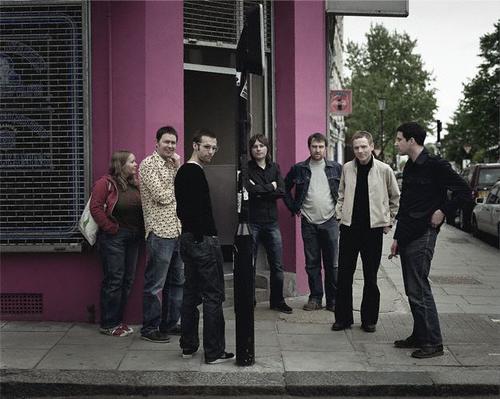
This tender Glaswegian troupe (with the exception of Richard, who still technically lives in Perth) has released some of what I consider to be the best pop music in history throughout their 1.5 decades. They are deserving of far more praise that I am able to adequately express. Although I might have been initially reluctant toward some, I have yet to ultimately be disappointed by a Belle & Sebastian release. While their latest records have generally stepped up a notch in tempo and production (leaving some ‘purist’ fans with a feeling of alienation), their exceptional songwriting remains.
Be a child, be an adult, go to college, get a job, fall in love, fall out of love, lose your faith just to gain it back – Belle & Sebastian suits all of life’s circumstances. Two of their records can be found on my Top 50 Albums list: Tigermilk (1996) and the greatly underrated Fold Your Hands Child, You Walk Like A Peasant (2000).
Make sure to keep your eyes and ears open for their upcoming release, Belle and Sebastian Write About Love, which will be available on 11 October in the UK and the following day in North America.
‘The Boy With the Arab Strap’ from the 1998 album of the same name, live on Later…with Jools Holland in 2001:
‘I Want the World to Stop’ from the forthcoming Belle and Sebastian Write About Love:
(I must brag that I was actually present at this video recording.)
Now that we’re into the last four of my Top 20 Bands list I figured I’d share each band individually.
4. Radiohead (UPDATE: moved to number 5)
It feels incredibly cheap to write about most of the bands in my Top 20 list because they’ve been written about so many times before (though to my fault I don’t often feel such trepidation when approaching talk of the Almighty…). My number four pick, Radiohead, is probably one of the more difficult of all to actually write about because I suspect—without having done any formal research—that it is the most widely commented about band on the internet, ever. I will state that while I am not especially thrilled by the solo projects that various members of the band have embarked upon in recent years, Radiohead is an absolutely amazing group, constantly pushing the boundaries and reshaping the landscape of popular music and how that music is experienced, whether that be through innovative packaging, the way that music is exchanged, brilliant music videos, phenomenal live performances, etc. I love every Radiohead song released since their 1997 album OK Computer, which along with Kid A/Amnesiac (2000/1) can be found on my Top 50 Albums list. The grouping of Kid A/Amnesiac was also my favourite album released in the previous decade.
In a recent essay published here, bassist Colin Greenwood reveals that the band has finished recording their newest record and is in the process of deciding how exactly to release it after their groundbreaking self-release of In Rainbows in 2007 (which the band initially sold the record in digital form at a price determined by the customer).
I remember exactly where I was ‘when it happened’. Whilst many other major American tragedies like the assassination of John F. Kennedy and the Space Shuttle Challenger disaster happened before I was born, I was in my second year of high school on 11 September 2001. The 1995 Oklahoma City bombing was the only thing that compared in my lifetime, but it is all but forgotten in the shadow of ‘September Eleventh’.
My older sister came into my room that morning to wake me up as she normally did, but this time she added, ‘An aeroplane crashed into the World Trade Center.’ ‘What?’ She was just as confused as I was and had merely heard the headline on her alarm clock radio. I thought at first, ‘The World Trade Center [near our home] in Long Beach?!’
We went into the family room and turned on the television. We saw live feed of the first tower, billowing smoke, then suddenly another jetliner appeared on screen. My first thought was, ‘Oh God, they actually got video of the crash.’ We knew nothing of a terrorist plot — at this point we assumed it was merely a single tragic aviation accident. But then I realised that we were still watching the live feed; a second plane had hit the second tower of the World Trade Center just after 6 AM, Pacific Standard Time. We watched in horror as reporters pointed out that what appeared to be small pieces of the building falling to the ground were not actually small pieces of the building, but were people. Before we had to leave for school the first tower collapsed.
I would find out later that the second tower collapsed, another plane had hit the Pentagon and yet another plane had crashed in a field in Pennsylvania. Throughout the day my teachers suspended their normal lessons. We sat in mourning, much of it in silence. We didn’t know the details of the tragedy, but we did know—and it was stated very explicitly by one teacher that day—that from now on the world would be a different place.
We would all eventually learn that the attacks were the plot of the terrorist group al-Qaeda (which has since become an infamous household name in America) and that in the end nearly 3000 people had been killed in the attacks and an additional 6000 were injured. These tragic events would come to justify the ‘War on Terror’ and the US-led invasions of Afghanistan and eventually Iraq. Western society underwent a metamorphosis almost immediately. Alongside institutional changes in national security policy, there was a massive shift in public consciousness. The radical Sunni Islam al-Qaeda was grouped with all Muslims and all people of Western Asian descent—your classmates, your neighbours, your doctor, etc.—could be potential terrorists. We were made to believe that al-Qaeda wanted to kill every last American simply for being American.
People will believe what they want — that terrorist groups like al-Qaeda are merely an example of what ‘true Islam’ looks like when fully embraced, that the West is oppressed merely for ‘being different’, that the events of September 11 were primarily a demonstration of a religion and not a political ideology. I cannot buy into these things.
God and the Christian religion are not so small and weak that we need to demonise every other belief system in order to justify our faith. I know why I am not a Muslim. It’s not because Islam is violent or necessarily archaic (and this is in no way a support of so-called ‘fundamentalist’ Islamic nations). I am not a Muslim because in many ways, the the teaching of the Islamic faith about God is different from the teaching of the Christian faith about God. It is the acts of the teaching of the Christian faith about God that call for any sort of adherence. This teaching espouses that God has invested in the creation to the utmost degree through the Incarnation and the life, death and resurrection of Jesus Christ. Jesus is an expression of God’s love for and solidarity with the world, not merely a honourable prophet, as is held by the teaching of Islam. This teaching affirms all people in this solidarity and extends an invitation into the Kingdom and an intimate friendship through the Holy Spirit. The only proper response to such love and grace is a life of love, grace and service.
But the September 11 attacks were not simply attacks on one religion from another religion. America is not a Christian nation and—if you talk to the vast majority of Muslims around the world—al-Qaeda and any who would terrorise others in the name of Allah are not true Muslims. I don’t have a solution for the problems that have been introduced as a result of the tragedy that transpired nine years ago today, but as a Christian I do know that my responsibility is to love, to be just and to seek peace.
May all those who perished on 11 September 2001 rest in peace and may their loved ones be comforted by the God who so thoroughly loves the world.
My deep admiration for Sufjan Stevens is paired with the sad realisation that his rapid rise to fame in 2005 inevitably wore him out. Many feared that Sufjan wouldn’t make another proper record after certain statements he made last year, but lo and behold, this year he unexpectedly released a new EP (All Delighted People) and his newest album, The Age of Adz was released on 12 October [and topped my and Greg’s Top 10 Albums of ’10]. Exciting times, and from the sound of his newest material he is pulling away from the mass appeal generated by Illinois. This recent venture back into semi-electronic, erratic, avant-garde territory is incredibly appealing to me. Three of his records are featured on my Top 50 Albums list: A Sun Came (2000), Greetings From Michigan(2003) and The Age of Adz (2010).
‘For The Widows In Paradise, For The Fatherless In Ypsilanti’ from Greetings From Michigan, live on a farm:
‘Too Much’ from his forthcoming album Age of Adz, live at Castaways in Ithaca, New York in 2009:
Sorry Sufjan fans (and if he’s reading this, sorry Sufjan), but there’s only room for five in the ‘Top 5’ and he’s not there quite yet. In order to gain membership in my coveted Top 5 [please note the sarcasm] he’ll have to beat the five to follow, beginning with The Smiths.
+++++
5. The Smiths/Morrissey [UPDATE: moved to number 6.]
There are major differences between The Smiths and Morrissey, but it didn’t used to be such a stark contrast. For instance, everything The Smiths made was great (if not better!) while the Mozzer has been on a steady decline with few recent high points. Still, taken as a single unit they are phenomenal (and I still believe in you Morrissey!). Through their charisma and uniqueness (largely on account of the Mozzer’s voice and Johnny Marr’s guitar), The Smiths have secured their place as the kings of indie pop. Three of their records can be found on my Top 50 Albums list: The Queen is Dead (The Smiths – 1986), Louder Than Bombs (The Smiths – 1987) and Bona Drag (Morrissey – 1990).
‘Heaven Knows I’m Miserable Now’ from Hatful of Hollow (The Smiths – 1984), live in Madrid (after two minutes of cheering fans):
‘Suedehead’ from Viva Hate (Morrissey – 1988), live on Later… with Jools Holland:
Pink Floyd is one of the most successful bands in history, making their inclusion one of the few commercially accepted ‘greatest bands of all time‘ that I vehemently agree with. They have certainly earned their place among my favourites from 1967’s Piper at the Gates of Dawn through 1979’s The Wall. The innovation they nurtured has transformed popular music. Roger Water’s insightful songwriting is enhanced by the ingenious early guitar work by Syd Barrett and the eventual musical perfection that is David Gilmour’s guitar and voice. Nick Mason and Richard Wright provide the backbone with their inventive work on percussion and keys. Two of their records—The Wall and The Dark Side of the Moon (1973)—can be found on my Top 50 Albums list.
‘Astronomy Domine’ from Piper at the Gates of Dawn, live in Belgium in 1968:
‘Comfortably Numb’ from The Wall, at Live 8 in 2005, because David Gilmour is still awesome:
+++++
7. Converge
I have a not-so-secret penchant for metal and among my favourite metal acts (such as Botch, Curl Up & Die and The Beach Boys) Converge stands out as the most consistently excellent, energetic and innovative. They’ve been bringing it heavy since 1990(!) and they remain a phenomenal live act. Their seminal 2001 release Jane Doe is featured in my Top 50 Albums list and was one of my Top 21 Albums from the 21st Century (seventh). Their most recent record, Axe to Fall, was my third favourite record released last year.
‘Concubine/Fault & Fracture’ from Jane Doe:
‘Dark Horse’ from Axe to Fall, live at the Hollywood Palladium in 2009. The sound isn’t great, but Ben Koller’s introductory drum solo is ridiculous:
To begin the countdown of my Top 10 of 20 [favourite] Bands:
10. Grandaddy [UPDATE: moved to number 4.]
Grandaddy was/is a remarkable band that has yet to reach stardom…and they probably prefer[ed] it that way. They were/are the ultimate ‘DIY’ band. They often wrote powerpop songs about the struggle between technology and nature in the modern world. Their child-like keyboard lines and Jason Lytle’s high-pitched singing voice make them one of the most unassuming acts you could ever hear, but truly they ought to be regarded as excellent songwriters. And yes, I prefer them ever-so-slightly to The Beatles. Their 2000 release The Sophtware Slump is featured on my Top 50 Albums list.
The Clash is a very interesting case. Essentially they ‘sold out’, as is expressed in the 1979 Crass song ‘Punk is Dead’: CBS promote The Clash, Ain’t for revolution, it’s just for cash… Essentially the eloquent sage Steve Ignorant is right, but that never seemed to keep Clash patches off of the denim jackets of the gutter punks. The anarchopunks could pump their fists to ‘London’s Burning’ while—on the way to pick up her son from football practise—the white suburban mother could shake her hips to ‘Rock the Casbah’. It doesn’t matter – everyone loves The Clash. The Clash (1977) can be found on my Top 50 Albums list.
‘I Fought the Law’ from The Clash:
‘The Magnificent Seven’ from 1980’s Sandinista, live on The Tomorrow Show with Tom Snyder in 1981:






 Lost in the Cloud