Top 20 Bands: Honourable Mentions

Before I move into the Top 10 of my Top 20 Bands, I feel the need to mention ten significant bands that might have been part of my ‘cut’ at various points in recent history, but just didn’t make it into my Top 20 this time around.  (Perhaps this could be seen as my ’21-30′.)

  1. Frightened Rabbit – Let’s see how the whole longevity thing plays out – the first two records have been a steady improvement from ‘incredible’ to ‘phenomenal’.
  2. Pedro the Lion/David Bazan – Excellent songwriting, but albums are often incoherent with themselves.
  3. Cass McCombs – There’s a quality to Cass McCombs that convinces me he’s one of the greatest living songwriters.
  4. Starflyer 59 – Something’s absent on most of their recent material…
  5. Grizzly Bear – Also needing a bit of longevity – It feels strange to consider Grizzly Bear one of my favourite bands, but they most certainly are.
  6. Deerhunter – Let’s hope they keep up this steam…
  7. Brian Eno – Mostly hit, but sometimes miss.
  8. Camera Obscura – There’s something to this group that keeps me listening, but I am hoping for something to make them stand out.
  9. Cursive – Maybe it’s because they still haven’t grown up?
  10. Curl Up & Die – I wish they had made more material before disbanding.

Perhaps you are thinking, ‘Who can beat the bands above along with Spiritualized, The Kinks, The Velvet Underground, Tom Waits, The Beach Boys, The Beatles and Neil Young?’  I hope not to disappoint, but prepare to find out just how bad my taste actually is in the coming week…

Top 20 Bands: 12 & 11

Rounding out 20-11:

12. The Beatles [UPDATE: moved to number 11.]

Where would the world be without The Beatles?  But then again, where would The Beatles have been without Elvis?  And where would Elvis have been without Big Boy Crudup?  And Crudup without Lead Belly and Blind Lemon Jefferson?  And Blind Lemon Jefferson without Hobart Smith?  STOP!  INFINITE REGRESSION!  So basically Hobart Smith founded The Beatles, who would become the single most influential musical group in history.  I know what some of you are thinking: ‘Beatles not in the Top 5, let alone the Top 10! Blasphemy!’  They are phenomenal, and if George Harrison had written more of their songs (I’m in love with George) and they didn’t write all of their cute pop music that preceded Rubber Soul (and even Rubber Soul isn’t entirely free of it) they’d probably be higher on my list.  While The Beatles will find their way into what seems to be every other Top 10 list, their lack of longevity also plays a factor here.  Still, two of their records are found on my Top 50 Albums list: The Beatles [The White Album] (1968) and Abbey Road (1969).

‘Strawberry Fields Forever’ from their 1967 album Magical Mystery Tour:

‘Let it Be’ from their 1970 album of the same name:

+++++

11. Neil Young [UPDATE: moved to number 14.]

The legendary Neil Young has often been noted for his sincerity – noticing a pattern in my preferences?  It’s true that I’m a sucker for artists that I can truly believe, and among them Neil Young is the Godfather.  This personal touch plus his unique vocal style (oftentimes accompanied by driving guitars) have made him an incredibly distinct artist in a music world full of clones over the last five decades.  His album Harvest (1972) is featured on my Top 50 Albums list and 1970’s After the Gold Rush should probably in there as well.

‘Needle and the Damage Done’ from the album Harvest, performed on The Johnny Cash Show in 1971:

‘After the Gold Rush’, from the album of the same name, live in 1978:

+++++

Top 20 Bands: 20 & 19, 18 & 17, 16 & 15, 14 & 13

Top 20 Bands: 14 & 13

¡Dos más!

14. Tom Waits [UPDATE: moved to number 15.]

Tom Waits is an acquired taste for some, but regardless of his more abrasive presentation since the late seventies, he has been a source of inspiration for countless artists and has been covered by everyone from Bruce Springsteen to Screamin’ Jay Hawkins to the unfortunate thing that was Scarlett Johansson’s debut record.  His unique style of storytelling and experimental production make him an intriguing and always reinvigorating voice in the music world.  His persona is commanding in every sense.  Not only this, but the man’s longevity makes him an enduring legend.  One is not compelled to say, ‘I loved his stuff from ’79-’81, then from ’99-’01.’  He just doesn’t stop making high quality records.  Waits’ album Swordfishtrombones (1983) can be found on my Top 50 Albums list.

‘Heartattack And Vine’ live from his amazing 1980 album of the same name:

‘Chocolate Jesus’ from his 1999 album Mule Variations, live on Late Night with David Letterman:

+++++

13. The Beach Boys [UPDATE: moved to number 12.]

The Beach Boys seem to have always been second best to The Beatles (‘What’s wrong with second best?‘).  It was always a back and forth between the two.  Part of me is tempted to switch the two, but I do love The Beatles just that wee bit more (hinting at a Beatles placement in the very near future) and that’s probably primarily due to the presence of the late great George Harrison.  Still, it must be said that The Beach Boys are nothing short of a phenomenal group.  Where I criticise The Beach Boys’ earlier material I do the same for The Beatles’, but I must hand it to The Beach Boys that they were better pop writers than even The Beatles.  The bigger Brian Wilson’s ambitions were the more I fall in love with The Beach Boys and that ambition is owed, in part, to The Beatles’ Rubber Soul.  Two of The Beach Boys’ records can be found on my Top 50 Albums list: Pet Sounds (1968) and Surf’s Up (1971).

‘Good Vibrations’ from Smiley Smile (1967), live on The Midnight Special in 1979 (it could certainly do without this audience, but look at Dennis owning on the drums):

Wouldn’t It Be Nice‘ from Pet Sounds.

Brian Wilson performs ‘Surf’s Up‘ from the album of the same name.

+++++

Top 20 Bands: 20 & 19, 18 & 17, 16 & 15

Top 20 Bands: 16 & 15

Today’s installment of my Top 20 Bands:

16. Descendents [UPDATE: moved to number 20.]

Descendents are amazing and have been greatly overlooked for their role in the historical progression from punk rock to hardcore.  Their lyrics aren’t often phenomenal (and sometimes downright explicit!), but their material has a mysterious attraction and drive behind it for me.  I listen to gems like ‘My Dad Sucks’ and ‘I Like Food’ and think, ‘This was 1981?!’  They probably aren’t a band for everyone (though they should be!), but I encourage everyone to give them a shot (or five – it has taken some friends several listens before they ‘see’ the light…some never see it).  Their record Milo Goes to College (1982) is one of my absolute favourites and is featured on my Top 50 Albums list.

‘Suburban Home’ from Milo Goes to College:

‘Descendents’ from their 1985 album I Don’t Want to Grow Up:

+++++

15. The Velvet Underground [UPDATE: moved to number 16.]

The Velvet Underground are an incredibly influential group.  Mixing exceptional songwriting and uncommon and difficult subject matter (such as prostitution and drug use), they influenced the subsequent generation of both popular and independent music.  Their record The Velvet Underground (1969) is found among my Top 50 Albums (and it’s cover features and incredibly Andrew-looking Lou Reed, though Lou is certainly less handsome).

‘I’m Waiting for the Man’ from their 1967 album The Velvet Underground & Nico:

‘Sunday Morning’, also from The Velvet Underground & Nico (as it is so difficult to find a good track off of their other records on Youtube):

+++++

Top 20 Bands: 20 & 19, 18 & 17

“Hipster” “Christianity”: a “review”

First they came for the Jesus People, and I did not speak out—because I was not a Jesus Person.

Then they came for the seeker-sensitive church, and I did not speak out—because I was seeker-insensitive.

Then they came for the emergents…or emerging, or whatever you call them, and I did not speak out—because I was not emergent/ing.

Then they came for the Hipster Christians and I was all “AW HELL NO BEEYATCHS!” in the most ironic tone possible.

________________

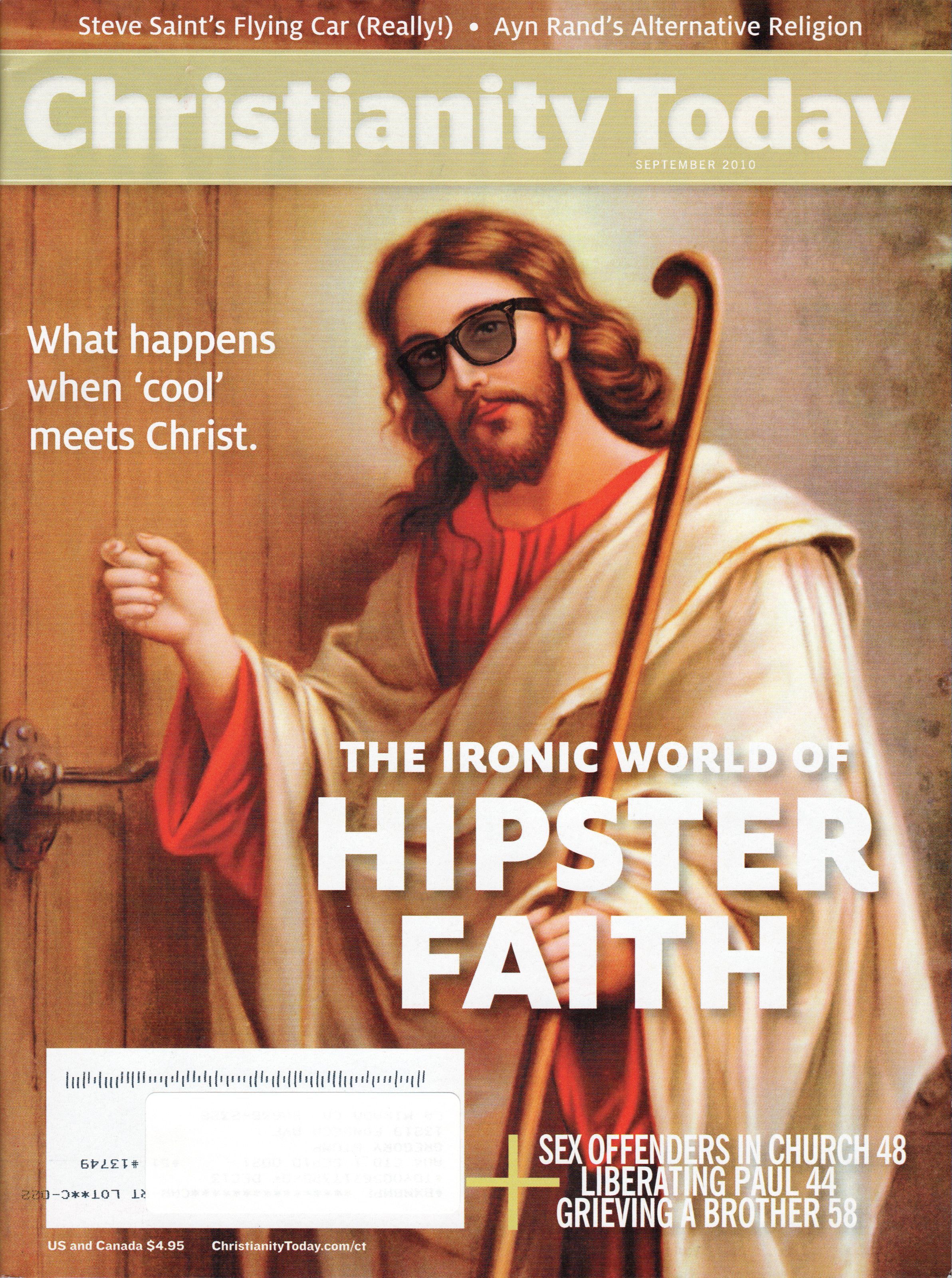
SO, it has become impossible to ignore the phenomenon of “Hipster Christianity” that is sweeping through evangelicalism these days (blazing from the cover of my newest Christianity Today).  Or should I say the COMMENTARY on “Hipster Christianity” (I’m going to keep using those ironic quote marks because I think it is such a ridiculous term, I don’t want to give it the pleasure of legitimacy in the realm of English idioms).

The LEAST hip illustration you could use...look up "trucker hat WWJD" for the best.

A while back, an acquaintance sent me a Facebook invite to become a “fan” of a page that “he thought I’d like”:  “Hipster Christianity.”  I was like, wha?  I checked it out.  There was a link therein to a “quiz” that would tell you if you were a “Christian Hipster.”  I clicked on said link, visited linked website which included these photo shoots of types of “Christian Hipsters” and questions about which kind of books or films I liked, then saw that this was all a quasi-interactive marketing scheme for a book called “Hipster Christianity” and I got THE HELL out of there.

What kind of queer (in the classical sense, my dear gay friends) Christian publishing house marketing person came up with this idea?  “See if you’re ‘hip’—ironically laugh at the stereotypes—ponder the connection between faith and culture in your own disaffected and detached way—now go buy the effing book you little shit.”  If anyone had the slightest inclination to consider themselves “hip” wouldn’t they know that aligning yourself with something that identifies you as such (using a word that has scarcely BEEN “hip” since 1965) is the first sign that you have lost all possibility of truly being that very thing?  So basically they are trying to appeal to people who are either poseurs or those who cannot stand “Christian hipsters”?  I can only assume it was the former…(Which, of course, is not the reason which I MYSELF left the website—I simply cannot stand Christian marketing…of anything.)

So I did not become a fan of aforementioned FB page or aforereferenced book.  My reasoning was that I thought the book was playing to the movement of those who would want to become known as “Christian Hipsters.”  However, I later came across the book & decided to scan over the beginning, just to see how ridiculous it was.  Turns out, the book is kind of a CRITIQUE of this movement (is it really a movement?  Maybe a style, a flavor, an expression of some part of a movement?).  Anywho, a central question in the “introduction” (lower case “i” in the book) was “whether or not Christianity can be, should be, or is, in fact, cool.”  The author claims that his book is “not an advertisement or rallying cry for ‘hip Christianity’ (my quotes, not his), nor is it an outright chastisement.  It’s a critical analysis.  It’s about the contradictions inherent in the phenomenon of Christian cool and the questions Christians should be asking of themselves if they find themselves within this milieu.”

Before I rip a hole in this idea of “contradictions” between “Christian” and “cool,” we need to zero in on one little word, not central to his claim, but which undoes any credibility to his forthcoming argument:  “milieu.”  WHO USES THIS WORD outside of a grad-school thesis?  I mean, I read that and I’m thinking “Ahem, is the milieu you mention au courant vis-a-vis the locus of a bête-noire or an enfant terrible?”  Oops, I missed one pretentious term, but he picks it up a few lines later:  “it’s en vogue for Christians to hate on Christianity in all of its mainstream forms.”  (I’m sorry, is it outre to hate on the use of ostentatious language?)  Maybe that’s the way he talks, maybe it just popped out from Thesaurus.com the day he was writing (at “a table,” he somberly notes, “in the dining room of the Kilns—the home of C.S. Lewis.”  This is relevant…apropos of what?).  I’m sorry, but all of this is adding up to a sorry picture of our tour guide through the world of “Hipster Christianity.”  And this “authorial tone” is part of the thing that cuts the legs off of the central argument I see here against Christians who are “cool” (though I must say I AM glad he is not advocating the sense I first got from his book’s website).

He says that this whole phenomenon “boils down to one simple desire: the desire to make Christianity cool.”  But his definition of “cool” seems to reveal more about his own social experience of cool than what anyone else may take the term to mean:  he writes, “Cool = an attractive attribute that embodies the existential strains to be independent, enviable, one-of-a-kind, and trailblazing.”  Hmm, except for the words “attractive” and “enviable” this definition could fit the Unabomber.  These two words then reveal that it’s all about what other people think.  The whole enterprise of “Hipster Christianity,” from this book’s perspective, feels like it’s about those who are trying to “one up” other people, to be in on something before anyone else is, to have people notice you, etc. and making their faith “cool” is part of this process.  Bro, these are SCENESTERS!  They’re followers of whatever is elusive (wearing a t-shirt that says, “I’m so indie, I’m into music even I haven’t heard of yet.”).  He even comes out and says that “cool is basically a perception of others—it can’t exist as anything intrinsic or detached from public perception.”  SAYS YOU!

I would argue that coolness is something like a combination of good taste, non-conformity and self-possession—it doesn’t matter if people think you have good taste or not (do YOU know why you like it?), or whether you are not-conforming to something which the majority of people reject or approve (you’re simply not willing to follow a trend just because others are—you think for yourself), and you don’t get flustered by others judgments or assessments of you (e.g. “I still like Coldplay…I don’t care if you think they’re corporate label Radiohead rip-offs”).  Was Jesus cool in this sense?  Absolutely.  Can Christians be cool?  Yeppers.  So can atheists, Sufi Muslims, Trekkies, sportos and motor heads, geeks, sluts, bloods, wastoids, dweebies, and dickheads.

The metaphors for “cool” this book uses feel so off to me as to be referencing the opposite of what it claims–those who are so caught up in TRYING to be cool that there’s no way they could actually BE COOL:  “ahead of the pack,” “the road less travelled,” “survival of the hippest,” “the pursuit of individuality,” “affirmation through attention.”  In the author’s mind (and perhaps, experience), cool is a social phenomenon.  You’re not cool unless other people think you are cool and you have to struggle somehow to maintain cool or you could possibly become uncool.  And this is one of his central objections to “Hipster Christianity,” that somehow Christians are going to try so hard to be cool that they are going to eventually align Christianity with the pursuit of cool or get stuck in some old “trend” (“HIP” PASTOR:  “Hey micro-brewery night on Sunday!” POST-“HIPSTER CHRISTIAN”: “Micro-brews are so 2 months ago, I’m bailing on this whole Christianity thing”).

Man, if we need a book called “Hipster Christianity” then we also need some social analysis and critique of “Dork Christianity” or “Lemming Christianity” or “Sentimental Christianity” or any other number of phenomena that you can see in the church today.  Turning the microscope on guys with lumberjack beards isn’t really that insightful if they are just cut from the same old imitative cloth that every other era of Christianity has had—just write about people who have no internal sense of the good, the true, and the beautiful.  But it’s making my boy Elijah and I and people whom we truly consider “cool” look bad cause we DO like Sufjan and N.T. Wright and Wes Anderson and all of the things associated with these trend-stalking scenesters.  To be honest, I want to make a t-shirt that says, “If you have to write a book, you wouldn’t understand.”

All this to say, I suppose, that while this author’s critique may fit some bills, I’d prefer if he didn’t label my friends and I according to his little scheme, photo shoots & quizzes.

One last thing:  I remembered seeing an association of “hipster” with “Christian” in the liner notes of a Belle & Sebastian album from 2000 (a tell-tale sign of my “hipness”)…I reproduce it here as a more positive association of these terms:

Update:

"Awesome Christianity"

Another update:  My friend, Matt Barber, pointed me to a review of “Hipster Christianity” by philosopher James K.A. Smith that is along the lines of what I’ve pointed out above, except that it is a well-formed argument, written by a prolific published author, and doesn’t sound quite as bitchy.

Top 20 Bands: 18 & 17

In continuing my Top 20 Bands countdown, I present you with two more amazing musical acts:

18. The Kinks [UPDATE: moved to number 13.]

The Kinks were an unstoppable force during the British Invasion of America in the mid-60s, popping out hits like ‘You Really Got Me‘, ‘All Day and All of the Night‘, ‘Tired of Waiting for You‘, etc.  While these are surely classic tunes, their excessive familiarity to me (through being forced to listen to oldies radio stations as a child) gave me a great aversion to The Kinks.  But like my aversion to The Beatles and The Beach Boys, I have grown out of this distaste for The Kinks (thanks to initial interest years ago via Rushmore and the watering of the seed by the Greg, the Band Evangelist) – and I even love their hits now too!  It’s probably a shame to some people that The Kinks are down here at number 18 in my top 20, but I’m not especially familiar with their work after 1970’s Lola Versus Powerman and the Moneygoround, Part One and I’ve only been really listening them for some four years now.  Give me more time to wise up. Their album The Village Green Preservation Society (1968) can be found among my Top 50 Albums.

‘Sunny Afternoon’ single promo, later included 1966’s Face to Face:

‘Apeman’, featuring a creepy and massive-haired Ray Davies, from 1970’s Lola Versus Powerman and the Moneygoround:

+++++

17. Danielson/Daniel Smith

Whether it is through a band consisting primarily of his siblings (Danielson Famile), through a solo project consisting of the man in a gigantic tree costume (Brother Danielson) or his most recent incarnation as just plain Danielson, Daniel Smith has been consistently producing honest, unusual and compelling art over the last two decades.  Danielson appeared on my radar soon after my conversion to Christianity in the beginning of high school and I have grown more in love with them/him ever since.  Interesting note: Through his association with Danielson I first gave Sufjan Stevens a shot.  Read more about Daniel in this post.  His/their second record,  Tell Another Joke at the Ol’ Choppin’ Block (1997), is featured on my Top 50 Albums list.

I wanted to post ‘Headz in the Cloudz’ from the debut Danielson Famile album, 1996’s A Prayer for Every Hour, but embedding is disabled.  View it here.

‘Things Against Stuff’, live from 2004’s Brother Is to Son from Brother Danielson:

‘Did I Step on Your Trumpet?’ from 2006’s Ships by Danielson (one of the best music videos of all time):

+++++

Top 20 Bands: 20 & 19

Top 20 Bands: 20 & 19

In typical LITC obsessive list-making fashion I’ve decided to compile a list of my Top 20 Bands of all time.  I must admit that this list is prone to change, whether it be in order or in composition (perhaps in the coming years more recent groups like Frightened Rabbit, Grizzly Bear and Deerhunter might make their way on or classics that have been in my rotation for most if not all of my life will sneak in like Starflyer 59, Nirvana, The Rolling Stones and The Smashing Pumpkins).  I’ll probably modify this list with my ever-changing taste and an ever-growing musical collection, but I will say that the bulk of this list has remained rather consistent over the last few years.  I’ve decided instead of one massive post to split it up into groups of two.  Perhaps you’ve not really given some of these groups a fair listen, or perhaps this will encourage you to give them another shot.  So without further ado, I give you 20 and 19.

20. Spiritualized

This group, borne from the ashes of Spacemen 3 in 1990-1, consists primarily of Jason Pierce (J. Spaceman) and his inability to stop creating good music.  From space rock to gospel, Spiritualized have been a mainstay of English music for two decades, while their commercial success has yet to match their commercial success.  Annette first turned me onto this band in 2006 (very late in the game) and I can’t get enough.  Their 2008 record Songs in A & E can found among my Top 50 Albums.  Might I also suggest 1997’s Ladies and Gentlemen We are Floating in Space, which was narrowly edged out of my Top 50 Albums in a move I’m not entirely confident in.

‘Broken Heart’ from Ladies and Gentlemen We are Floating in Space, live in 1998 on Later… with Jools Holland:

‘You Lie You Cheat’ from Songs in A & E, live on The Late Show with David Letterman, 2008:

+++++

19. Sebadoh/Lou Barlow

Lou Barlow is an amazing songwriter and over the last 20+ years he has certainly spread his influence through Dinosaur Jr., Sebadoh, Sentridoh, The Folk Implosion and his recent solo career.  As mentioned before, Greg first turned me on to Lou Barlow.  Read more about him (and take a look at list of Greg and my ‘Top 30 Lou Barlow Songs‘) in this post.  His amazing record with Sebadoh III (1991) is featured among my Top 50 Albums.

‘Rebound’ from Sebadoh’s 1994 album Bakesale:

‘Too Much Freedom’ from Lou Barlow’s 2009 album Goodnight Unknown:

The Onion on the [slightly close to] Ground Zero ‘Mosque’

Though this piece lacks some of the sublime subtlety that the Onion has evidenced in the past, I do love the counter-karmic force their “article” on the average American’s opinion regarding the NYC ‘mosque’ controversy may produce.  For instance, the “We’ve Got to Stop the Mosque at Ground Zero” video is just beyond evil…(Joseph Goebbels is cracking a little smile in whatever worm-ridden corner of hell he’s rotting in).  Here’s the beginning of the Onion piece (full article here):

Man Already Knows Everything He Needs To Know About Muslims

SALINA, KS—Local man Scott Gentries told reporters Wednesday that his deliberately limited grasp of Islamic history and culture was still more than sufficient to shape his views of the entire Muslim world.

Gentries, 48, said he had absolutely no interest in exposing himself to further knowledge of Islamic civilization or putting his sweeping opinions into a broader context of any kind, and confirmed he was “perfectly happy” to make a handful of emotionally charged words the basis of his mistrust toward all members of the world’s second-largest religion.

“I learned all that really matters about the Muslim faith on 9/11,” Gentries said in reference to the terrorist attacks on the United States undertaken by 19 of Islam’s approximately 1.6 billion practitioners. “What more do I need to know to stigmatize Muslims everywhere as inherently violent radicals?”

“And now they want to build a mosque at Ground Zero,” continued Gentries, eliminating any distinction between the 9/11 hijackers and Muslims in general. “No, I won’t examine the accuracy of that statement, but yes, I will allow myself to be outraged by it and use it as evidence of these people’s universal callousness toward Americans who lost loved ones when the Twin Towers fell.”

“Even though I am not one of those people,” he added.

When told that the proposed “Ground Zero mosque” is actually a community center two blocks north of the site that would include, in addition to a public prayer space, a 500-seat auditorium, a restaurant, and athletic facilities, Gentries shook his head and said, “I know all I’m going to let myself know.”

Counter-point (to my own post):

Would everyone be cool with an “International Center for Political Cartoonists Who Depict Mohammed” going up next door to the mosque?  What’s good for the goose, eh?

Moby Books in Comparision to Original Text

In response to my post on the Moby Books Illustrated Classic Editions, one of our faithful readers…ok, my brother, asked what the difference was between the abridged version of a Moby Books edition (MB) and the original version.  I thought I would provide a sample of the first chapter from the MB edition of Robert Louis Stevenson’s Treasure Island in contrast to Stevenson’s original text.
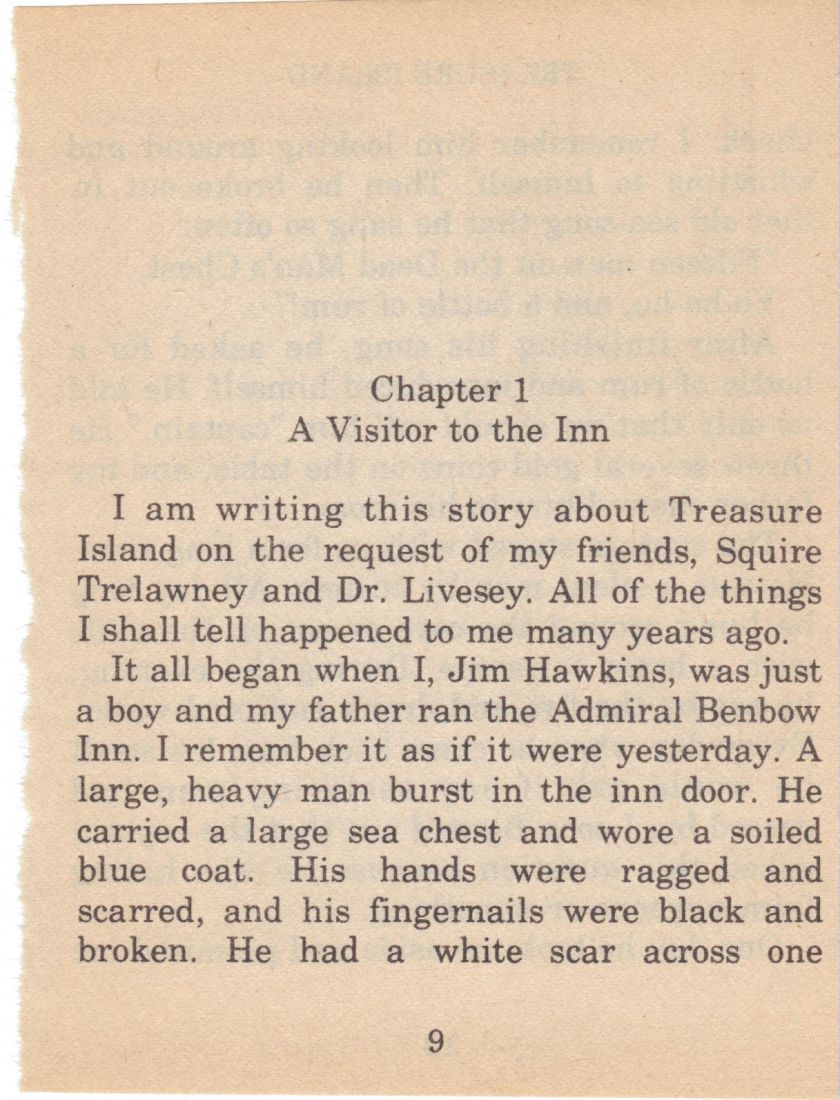
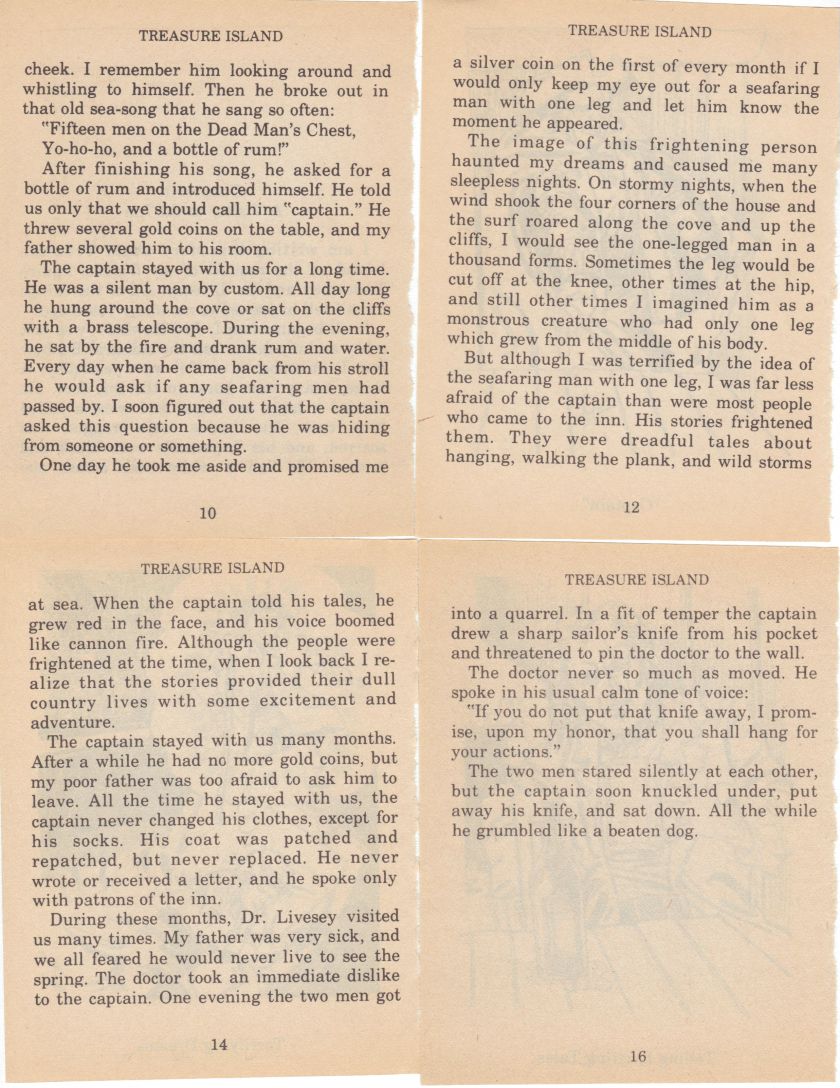
Chapter 1:

The Old Sea-dog at the Admiral Benbow

SQUIRE TRELAWNEY, Dr. Livesey, and the rest of these gentlemen having asked me to write down the whole particulars about Treasure Island, from the beginning to the end, keeping nothing back but the bearings of the island, and that only because there is still treasure not yet lifted, I take up my pen in the year of grace 17__ and go back to the time when my father kept the Admiral Benbow inn and the brown old seaman with the sabre cut first took up his lodging under our roof.

I remember him as if it were yesterday, as he came plodding to the inn door, his sea-chest following behind him in a hand-barrow–a tall, strong, heavy, nut-brown man, his tarry pigtail falling over the shoulder of his soiled blue coat, his hands ragged and scarred, with black, broken nails, and the sabre cut across one cheek, a dirty, livid white. I remember him looking round the cover and whistling to himself as he did so, and then breaking out in that old sea-song that he sang so often afterwards:

“Fifteen men on the dead man’s chest– Yo-ho-ho, and a bottle of rum!”

in the high, old tottering voice that seemed to have been tuned and broken at the capstan bars. Then he rapped on the door with a bit of stick like a handspike that he carried, and when my father appeared, called roughly for a glass of rum. This, when it was brought to him, he drank slowly, like a connoisseur, lingering on the taste and still looking about him at the cliffs and up at our signboard.

“This is a handy cove,” says he at length; “and a pleasant sittyated grog-shop. Much company, mate?”

My father told him no, very little company, the more was the pity.

“Well, then,” said he, “this is the berth for me. Here you, matey,” he cried to the man who trundled the barrow; “bring up alongside and help up my chest. I’ll stay here a bit,” he continued. “I’m a plain man; rum and bacon and eggs is what I want, and that head up there for to watch ships off. What you mought call me? You mought call me captain. Oh, I see what you’re at– there”; and he threw down three or four gold pieces on the threshold. “You can tell me when I’ve worked through that,” says he, looking as fierce as a commander.

And indeed bad as his clothes were and coarsely as he spoke, he had none of the appearance of a man who sailed before the mast, but seemed like a mate or skipper accustomed to be obeyed or to strike. The man who came with the barrow told us the mail had set him down the morning before at the Royal George, that he had inquired what inns there were along the coast, and hearing ours well spoken of, I suppose, and described as lonely, had chosen it from the others for his place of residence. And that was all we could learn of our guest.

He was a very silent man by custom. All day he hung round the cove or upon the cliffs with a brass telescope; all evening he sat in a corner of the parlour next the fire and drank rum and water very strong. Mostly he would not speak when spoken to, only look up sudden and fierce and blow through his nose like a fog-horn; and we and the people who came about our house soon learned to let him be. Every day when he came back from his stroll he would ask if any seafaring men had gone by along the road. At first we thought it was the want of company of his own kind that made him ask this question, but at last we began to see he was desirous to avoid them. When a seaman did put up at the Admiral Benbow (as now and then some did, making by the coast road for Bristol) he would look in at him through the curtained door before he entered the parlour; and he was always sure to be as silent as a mouse when any such was present. For me, at least, there was no secret about the matter, for I was, in a way, a sharer in his alarms. He had taken me aside one day and promised me a silver fourpenny on the first of every month if I would only keep my “weather-eye open for a seafaring man with one leg” and let him know the moment he appeared. Often enough when the first of the month came round and I applied to him for my wage, he would only blow through his nose at me and stare me down, but before the week was out he was sure to think better of it, bring me my four-penny piece, and repeat his orders to look out for “the seafaring man with one leg.”

How that personage haunted my dreams, I need scarcely tell you. On stormy nights, when the wind shook the four corners of the house and the surf roared along the cove and up the cliffs, I would see him in a thousand forms, and with a thousand diabolical expressions. Now the leg would be cut off at the knee, now at the hip; now he was a monstrous kind of a creature who had never had but the one leg, and that in the middle of his body. To see him leap and run and pursue me over hedge and ditch was the worst of nightmares. And altogether I paid pretty dear for my monthly fourpenny piece, in the shape of these abominable fancies.

But though I was so terrified by the idea of the seafaring man with one leg, I was far less afraid of the captain himself than anybody else who knew him. There were nights when he took a deal more rum and water than his head would carry; and then he would sometimes sit and sing his wicked, old, wild sea-songs, minding nobody; but sometimes he would call for glasses round and force all the trembling company to listen to his stories or bear a chorus to his singing. Often I have heard the house shaking with “Yo-ho-ho, and a bottle of rum,” all the neighbours joining in for dear life, with the fear of death upon them, and each singing louder than the other to avoid remark. For in these fits he was the most overriding companion ever known; he would slap his hand on the table for silence all round; he would fly up in a passion of anger at a question, or sometimes because none was put, and so he judged the company was not following his story. Nor would he allow anyone to leave the inn till he had drunk himself sleepy and reeled off to bed.

His stories were what frightened people worst of all. Dreadful stories they were–about hanging, and walking the plank, and storms at sea, and the Dry Tortugas, and wild deeds and places on the Spanish Main. By his own account he must have lived his life among some of the wickedest men that God ever allowed upon the sea, and the language in which he told these stories shocked our plain country people almost as much as the crimes that he described. My father was always saying the inn would be ruined, for people would soon cease coming there to be tyrannized over and put down, and sent shivering to their beds; but I really believe his presence did us good. People were frightened at the time, but on looking back they rather liked it; it was a fine excitement in a quiet country life, and there was even a party of the younger men who pretended to admire him, calling him a “true sea-dog” and a “real old salt” and such like names, and saying there was the sort of man that made England terrible at sea.

In one way, indeed, he bade fair to ruin us, for he kept on staying week after week, and at last month after month, so that all the money had been long exhausted, and still my father never plucked up the heart to insist on having more. If ever he mentioned it, the captain blew through his nose so loudly that you might say he roared, and stared my poor father out of the room. I have seen him wringing his hands after such a rebuff, and I am sure the annoyance and the terror he lived in must have greatly hastened his early and unhappy death.

All the time he lived with us the captain made no change whatever in his dress but to buy some stockings from a hawker. One of the cocks of his hat having fallen down, he let it hang from that day forth, though it was a great annoyance when it blew. I remember the appearance of his coat, which he patched himself upstairs in his room, and which, before the end, was nothing but patches. He never wrote or received a letter, and he never spoke with any but the neighbours, and with these, for the most part, only when drunk on rum. The great sea-chest none of us had ever seen open.

He was only once crossed, and that was towards the end, when my poor father was far gone in a decline that took him off. Dr. Livesey came late one afternoon to see the patient, took a bit of dinner from my mother, and went into the parlour to smoke a pipe until his horse should come down from the hamlet, for we had no stabling at the old Benbow. I followed him in, and I remember observing the contrast the neat, bright doctor, with his powder as white as snow and his bright, black eyes and pleasant manners, made with the coltish country folk, and above all, with that filthy, heavy, bleared scarecrow of a pirate of ours, sitting, far gone in rum, with his arms on the table. Suddenly he–the captain, that is–began to pipe up his eternal song:

“Fifteen men on the dead man’s chest– Yo-ho-ho, and a bottle of rum! Drink and the devil had done for the rest– Yo-ho-ho, and a bottle of rum!”

At first I had supposed “the dead man’s chest” to be that identical big box of his upstairs in the front room, and the thought had been mingled in my nightmares with that of the one-legged seafaring man. But by this time we had all long ceased to pay any particular notice to the song; it was new, that night, to nobody but Dr. Livesey, and on him I observed it did not produce an agreeable effect, for he looked up for a moment quite angrily before he went on with his talk to old Taylor, the gardener, on a new cure for the rheumatics. In the meantime, the captain gradually brightened up at his own music, and at last flapped his hand upon the table before him in a way we all knew to mean silence. The voices stopped at once, all but Dr. Livesey’s; he went on as before speaking clear and kind and drawing briskly at his pipe between every word or two. The captain glared at him for a while, flapped his hand again, glared still harder, and at last broke out with a villainous, low oath, “Silence, there, between decks!”

“Were you addressing me, sir?” says the doctor; and when the ruffian had told him, with another oath, that this was so, “I have only one thing to say to you, sir,” replies the doctor, “that if you keep on drinking rum, the world will soon be quit of a very dirty scoundrel!”

The old fellow’s fury was awful. He sprang to his feet, drew and opened a sailor’s clasp-knife, and balancing it open on the palm of his hand, threatened to pin the doctor to the wall.

The doctor never so much as moved. He spoke to him as before, over his shoulder and in the same tone of voice, rather high, so that all the room might hear, but perfectly calm and steady: “If you do not put that knife this instant in your pocket, I promise, upon my honour, you shall hang at the next assizes.”

Then followed a battle of looks between them, but the captain soon knuckled under, put up his weapon, and resumed his seat, grumbling like a beaten dog.

“And now, sir,” continued the doctor, “since I now know there’s such a fellow in my district, you may count I’ll have an eye upon you day and night. I’m not a doctor only; I’m a magistrate; and if I catch a breath of complaint against you, if it’s only for a piece of incivility like tonight’s, I’ll take effectual means to have you hunted down and routed out of this. Let that suffice.”

Soon after, Dr. Livesey’s horse came to the door and he rode away, but the captain held his peace that evening, and for many evenings to come.

Moby Books Illustrated Classic Editions

“Rosebud.”  The classic symbol of nostalgic longing from Orson Welles’ Citizen Kane (though I won’t mention what Rosebud is exactly, as I myself had the mystery spoiled by finding out the answer before I had seen the film).  Just as William Randolph Hea–oh, I mean, Charles Foster Kane, yearned for the symbol of his lost childhood in his dying moments, many people today become fixated on preserving some memento from their younger, more care-free days when they become adults:  sports trading cards, doll collections, Star Wars action figures, etc.

The logo that launched a thousand internet searches.

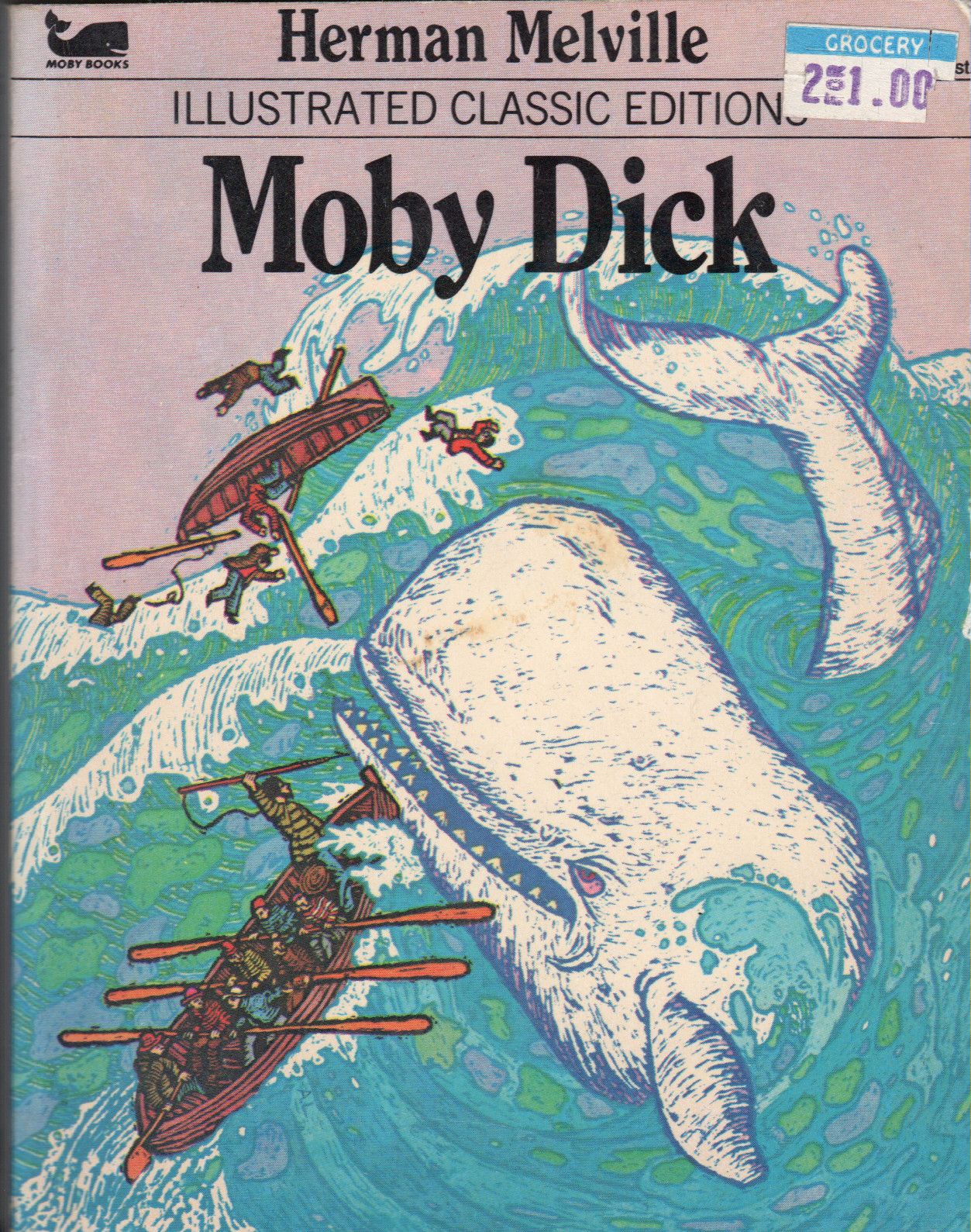
For me, the emblem of my childhood is a set of mini-books called “Moby Books Illustrated Classic Editions.”  These were a series of small (5 1/2 x 4″) editions of classic novels published in the 1970’s and 80’s which had been abridged and simplified so that a young reader could grasp the story and encounter key sections of the original dialogue and narration of a classic work of literature.  One of the most notable features for me, as a young reader, was the comic-style illustrations that accompanied each page of the narrative, as well as the vividly-depicted covers, which had a simple, Van Gogh-like beauty in their coloring and style.

How, exactly, does one see this as being a “grocery”?

I have discovered in my wanderings on the sea of human information that is the Google Search Engine that there are others who share in my fascination with these books; however, there has yet to be a definitive site dedicated to these volumes (as was pointed out here–this post was part of my motivation to finally write this!).

While this will not be the final word on Moby Books, I would like to share as much information as I have with my fellow devotees and the world at large; however, there are many more questions that require researchers far better than myself to answer.

My first memory of Moby Books came from opening a McDonald’s “Happy Meal” sometime in the late 1970’s (back when only millions had been served) and discovering a copy of Charles Dicken’s “A Christmas Carol” inside (smelling of french fries I’m sure).  McDonald’s apparently worked with Moby Books on a special promotion tied into a TV series the fast-food company was sponsoring on PBS called “Once Upon a Classic.”  After years of searching, I found a copy of this version in quite good condition, which is the crown of my Moby Books collection.

God bless Moby Books…each and every one!
Replacing the MB logo with the golden arches? BLASPHEMY!!

After reading that first book, I pressed my parents to buy more and more of these books (which could be found at grocery stores!) and began to fancy myself quite the literary type.  At my elementary school library, I checked out a copy of James Fenimore Cooper’s The Pioneers (the unabridged original), believing that I had already taken on his The Last of the Mohicans (in Moby Book form)–I was in for a sharp awakening, as I couldn’t get past the first few pages!!  Even though it took me a while to wean myself from the Moby Books versions of classic novels, they were my “gateway drug” to the realms of classic and contemporary fiction which have been a passion ever since.

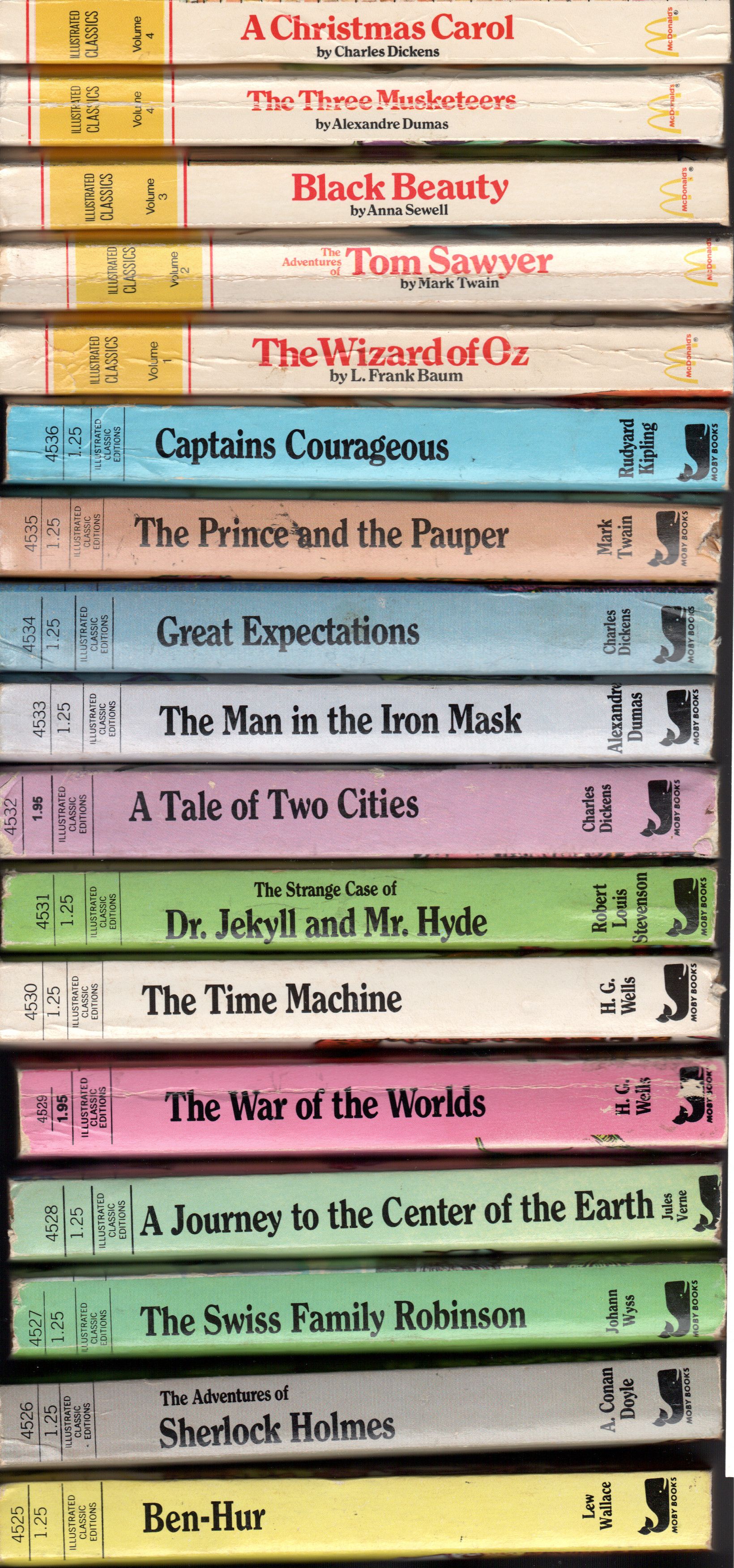
Around 5 years ago, my mom brought over some of my old Moby Books to give to MY kids and it reawakened so many memories of being lost in other lands and people’s lives in these books that I decided that I needed to obtain the full collection.  At this point, I believe I have all of the books that are available to be had (41 total), but I would love to complete the collection if I find any more.  Here are some facts about the Moby Books collection I have discovered, as well as some questions that I have, followed by a categorized list (by volume number) of all the Moby Books of which I am aware.

MOBY BOOKS FACTS & FAQS

  • There were 36 Moby Books Illustrated Classic Editions published in 3 batches of 12 each in 1977, 1979, and 1983.  “Moby Books” was the brand name, published by Playmore Inc. out of New York City in arrangement with I. Waldman & Son, Inc.
  • Playmore later released (sometime between 2001-2002) a number of “Illustrated Classic Editions” without the Moby Books imprint and featuring a different style of cover art & illustrations.  I do not consider these to be part of the “canonical collection,” however, these later editions were given catalog numbers in sequence with the earlier editions, so there seems to be some sense of intended continuity by the publisher.
  • The McDonald’s editions are an interesting puzzle.  There seem to have been two sets released of “4 volumes” each in 1977 and 1979; whereas the original series catalog numbers are from 4501-4536, the McDonald’s editions are given catalog numbers from 1001-1004/95.  The books I own from the 1977 set include The Wizard of Oz (1001/95, vol. 1), Black Beauty (1003/95, vol. 3), and The Three Musketeers (1004/95, vol. 4).  I have never found the 2nd volume of this set.  Of the 1979 set, I have Tom Sawyer (1002/95, vol. 2) and A Christmas Carol (1004/95, vol. 4); I have also never come across any other books from this set.  Since two books share the same catalog number (1004/95), I am assuming these were completely different sets with no shared titles.  I would love to find out about these missing editions if anyone has any information…


  • In the back of the 1977 and 1983 books, there are two catalogs of the editions in the series.  While the 1983 listing contains the full 36 books from the official Moby Books canon and no more, the 1977 listing includes 5 books that apparently were intended to be part of the series, but were never actually published:  Frankenstein (which was later released in a 2002 “non-canonical” edition), Aesop’s Fables, The Hunchback of Notre-Dame, Kim (by Kipling), and “Stories from the Bible.”

This is the information I have.  For those wishing to begin their own collection of Moby Books, I would recommend a frequent search of eBay listings, as you can find people selling 15-20 books for 5 dollars total.  There is also a site called Series Books which sell the books, but they are much more expensive.  The McDonald’s editions are quite hard to come by and sell for $25-30 a piece (I found mine for around $3-5 a while back!).  Below I have listed the books with catalog numbers…any corrections or new information would be greatly appreciated!

Moby Books Illustrated Classics editions

Catalog No./Title/Author/Publishing Date

4501 Wizard of Oz, The Baum, L. Frank 1977
4502 Sherlock Holmes and the Case of the Hound of the Baskervilles Doyle, A. Conan 1977
4503 Adventures of Robinson Crusoe, The Defoe, Daniel 1977
4504 Black Beauty Sewell, Anna 1977
4505 Kidnapped Stevenson, Robert Louis 1977
4506 Connecticut Yankee in King Arthur’s Court, A Twain, Mark 1977
4507 20,000 Leagues Under the Sea Verne, Jules 1977
4508 Heidi Spyri, Johanna 1977
4509 Three Musketeers, The Dumas, Alexandre 1977
4510 Treasure Island Stevenson, Robert Louis 1977
4511 Little Women Alcott, Louisa May 1977
4512 Around the World in 80 Days Verne, Jules 1977
4513 Merry Adventures of Robin Hood, The Pyle, Howard 1979
4514 Adventures of Tom Sawyer, The Twain, Mark 1979
4515 Call of the Wild, The London, Jack 1979
4516 Adventures of Huckleberry Finn, The Twain, Mark 1979
4517 Oliver Twist Dickens, Charles 1979
4518 David Copperfield Dickens, Charles 1979
4519 Count of Monte Cristo, The Dumas, Alexandre 1979
4520 Moby Dick Melville, Herman 1979
4521 Last of the Mohicans, The Cooper, James Fenimore 1979
4522 Mutiny on Board H.M.S. Bounty Bligh, William 1979
4523 Oregon Trail, The Parkman, Francis 1979
4524 Tales of Mystery and Terror Poe, Edgar Allan 1979
4525 Ben-Hur Wallace, Lew 1983
4526 Adventures of Sherlock Holmes, The Doyle, A. Conan 1983
4527 Swiss Family Robinson, The Wyss, Johann 1983
4528 Journey to the Center of the Earth, A Verne, Jules 1983
4529 War of the Worlds Wells, H.G. 1983
4530 Time Machine, The Wells, H.G. 1983
4531 Strange Case of Dr. Jekyll and Mr. Hyde, The Stevenson, Robert Louis 1983
4532 Tale of Two Cities, A Dickens, Charles 1983
4533 Man in the Iron Mask, The Dumas, Alexandre 1983
4534 Great Expectations Dickens, Charles 1983
4535 Prince and the Pauper, The Twain, Mark 1983
4536 Captain Courageous Kipling, Rudyard 1983
4537 Red Badge of Courage Crane, Stephen 2002
4538 Frankenstein Shelley, Mary 2002
4539 King Arthur and the Knights of the Round Table Pyle, Howard 2002
4540 Jungle Book, The Kipling, Rudyard 2002
4541 Hunchback of Notre Dame, The Hugo, Victor 2002
4542 Wind in the Willows, The Grahame, Kenneth 2002
4543 Gulliver’s Travels Swift, Jonathan 2002
4544 Invisible Man, The Wells, H.G. 2002
4545 Legend of Sleepy Hollow, The Irving, Washington 2002
4546 Rebecca of Sunnybrook Farm Wiggin, Kate Douglas 2002
4547 Alice in Wonderland Carroll, Lewis 2002
4548 Pride and Prejudice Austen, Jane 2002