The Mirror & the Telescope, Part III

THE MIRROR & THE TELESCOPE, PART III:  EXAMPLES OF DISTINGUISHING BETWEEN DIVINE & HUMAN SUBJECTS

We will now consider several biblical passages in light of the dual-subject approach to Scripture.  In Psalm 137:8-9, an exilic or post-exilic author writes:  “O daughter Babylon, you devastator!  Happy shall they be who pay you back what you have done to us!  Happy shall they be who take your little ones and dash them against the rock!”  We must ask whether this text reveals to us theological source material that we may to develop a doctrine of God’s severity in paying back evildoers, or if it reveals anthropological source material in which we primarily see the human desire for brutal retributive justice (if not merely revenge)?

"By the Rivers of Babylon" by Eugène Delacroix

This passage in particular was what stimulated Witherington’s observation that Scripture may “be as much a revelation of human character as of divine character,” in that, we must consider how this text “comports with the idea of a God who loves all humankind and is especially concerned for the weak, the vulnerable, and the young.” (Living Word, 24) Witherington’s thought process hints at a hermeneutical key we will explore subsequently, but we may for now say that there is evidence to suggest that the divinely inspired author of Psalm 137 was revealing human nature to us rather than depicting God’s attributes.

Dealing with this passage in terms of anthropological source material, we must then ask whether it represents a revelation of positive human character that God is commending, or whether it is a negative attribute that is merely being accurately recorded.  To determine where this passage falls, we could see if the author had cited God’s approval of this desire for revenge; if so, then we may consider this a model of human behavior that God finds acceptable.  However, we do not see this, so without this divine endorsement, we must remain ambiguous toward the text:  it may be a legitimate human response to evil, or it may represent an attitude that is contrary to God’s will for humanity.  Overall, we can say that God certainly allows humans to express their feelings of anger, even in the extreme.  Also, this text reveals to us historical background on the plight of the Jews in exile—their experience must have been incredibly dreadful to elicit such a monstrous response.

Let us consider another example, from Psalm 13, which evinces a more specific claim about God that we must discern as being either theologically absolute or an example of human experience.  The author, presumably David, cries out, “How long, O LORD?  Will you forget me forever?  How long will you hide your face from me? (Ps. 13:1).  Do we see this as theological source material from which we can develop a theology of God’s “hiddenness”—was David correct in asserting that God was hiding from him?  Had God indeed forgotten him, not literally, but relationally? Or does this reveal an anthropological picture of David’s experience of feeling like God was hiding from him and that God had forgotten about him?

There is more ambiguity here, due to the fact that many Christian thinkers (e.g. Luther, St. John of the Cross) see evidence for a theology of God’s hiddenness in the pages of Scripture.  While we cannot rule this out as being true of God, it does seem obvious that the passage is primarily speaking of David’s experience of feeling and thinking particular emotions and thoughts, so it would be safe to say this reveals more about the human subject than the divine.

We may wonder, then, if Psalm 13 is actually more about an experience of human perception than divine actuality, could we say the same about Psalm 139, where David makes claims that have been used to support a number of theological doctrines:  God’s omniscience (“Even before a word is on my tongue, O LORD, you know it completely” v. 4), omnipresence (“Where can I go from your spirit?  Or where can I flee from your presence?” v.7), and human predestination (“In your book were written all the days that were formed for me, when none of them yet existed” v. 16).  Could all of these examples reveal David’s human sense of God’s intimate involvement in his life without necessarily being absolutely true of God’s being or plans?

One could ask the rather blunt question of David:  how exactly do you know all of these things?  What access do you have to God’s mind to comment upon what he knows?  Have you been to heaven or Sheol, or have you seen God’s book in which your days are numbered?  We can logically assume that none of these questions could be answered positively to support David’s assertions and yet we also find no evidence that David has actually been told these things by God, as we see in other parts of Scripture where it is claimed that “the Word of the LORD” came upon an author.  This is an argument from silence going in both directions—we don’t know whether God revealed these things to David or not, though they do seem in line with other theological claims we see in Scripture.  Ultimately, there is tension, particularly in a genre like lyrical poetry, between being able to clearly discern what is reliable theological source material and what are examples of human experience (such as doubt, fear, or anger) that contribute to an inspired and accurate anthropology.

We could also look beyond claims or statements in poetical works to accounts and narratives in Scripture in order to raise questions of whether the Bible is telling us about humanity or God.  For instance, when Noah curses Canaan to become “lowest of slaves” to his brothers in Genesis 9:25, do we take it to be the case that God approves of this curse, which was later used to promote racism and the practice of enslaving Africans (who were purported to be the sons of Ham)?  It is interesting to note from the text that Noah does ask God to bless Shem and Japheth and make Canaan their slaves (Gen. 9:26-27)—but we do not see evidence of whether God endorses Noah’s curse or not.

"Noah Curses Ham for His Mockery" by Julius Schnorr von Carolsfeld

From a human perspective, we can see that Noah is angry, embarrassed, and struggling with a hangover—it would be natural for him to lash out at his son, as many of us would do in this situation.  We must not assume that merely because God commends a biblical actor at some points in the Bible that it means everything they do subsequent to that time is approved by God.  Noah’s reaction may clearly serve as anthropological source material, but to put a divine stamp of approval upon this curse is not necessarily justified from the text.  So why should we allow critics to place the blame of Christian use of this verse to support racism on God (even though the identification of blacks with the sons of Ham is nowhere in the text as well)?  Noah spoke the curse and we have no reason of which I am aware to believe God fulfilled it.  This stands in contrast with God’s specific promise to Abram to “bless those who bless you, and the one who curses you I will curse” (Gen. 12:3).

[In Part IV, we will consider the problem of discerning between the two subjects in biblical interpretation.]

The Mirror & the Telescope, Part II

THE MIRROR & THE TELESCOPE, PART II:  THE NEED FOR REVELATION ABOUT HUMANITY TO HUMANITY

[Part I available here]

Before delving into the issue of how we may make distinctions between claims about the divine and human subjects of Scripture, we must address the question of why we would need to have revelation about humanity, particularly since part of the intrinsic concept of revelation is that it is “the disclosure of what was previously unknown.” (Dictionary of Evangelical Theology, 1031) It is obvious that we need God to reveal himself to us because he is outside of our common experience, his nature and being are not evident to us, and as YHWH himself says, “My thoughts are not your thoughts, nor are your ways my ways” (Is. 55:8).  In contrast, we have a great deal of understanding about humanity:  we ourselves are humans, we see evidence and examples of humanity all around us, and we have created our own reflections on the human race in philosophy, history, and cultural artifacts.  So why would we need for God to write down an inspired account of humanity for us in the Scriptures?

Subliminal shout-out to Gregg TenElshof's book, I Told Me So

First, we tend to lie to ourselves about ourselves.  The prophet Jeremiah declares, “The heart is devious above all else; it is perverse—who can understand it?” (Jer. 17:9).  The apostle Paul asserts that in our human wickedness, we have suppressed the truth, become futile in our thinking, and our minds were darkened (Romans 1:18-21).  Though Paul specifically refers in this passage to deceiving ourselves about God’s person, it seems reasonable to believe we do the same with our own self-knowledge (cf. 1 John 1:8).  We need revelation about the human subject because we need God to show us hard truths about ourselves that we are often unwilling to acknowledge.

Second, revealing the truth about humanity, particularly our sinfulness and inability to fully obey his commands, ultimately exposes our deep need for the Gospel and for holistic transformation.  In this light, an accurate anthropology both plays a part in the overall biblical story of redemption, as well as offering an unvarnished portrait of fallen humanity to which we can relate (for we do not only see examples in Scripture of perfectly holy people who do not make the same errors to which we seem prone).  This reason for revelation about humanity would explain the presence of lies, wickedness, and bad theology cited in our introduction.

Third, and more positively, disclosing the truth about humanity reveals occasions where persons do respond in faith and obedience, which we may imitate, as well as many other instances where God still chooses to use and bless people who are living contrary to his desires, which demonstrates his love, patience, and grace toward his creation.

All of these reasons make the inclusion of humanity as a subject of revelation a somewhat non-controversial addition to our understanding of Scripture.  What is more problematic, and likely more unsettling for the conservative, is the question of how to distinguish which parts of special revelation are about God and which are about humanity in the biblical texts.  The difficulty of parsing between theological claims in Scripture that reflect humanity’s perspective on God (such as Job’s friends) and those that accurately reflect Divine truth becomes a daunting proposition.  Indeed I. Howard Marshall despairs at the attempt:

The books of the Bible contain what are clearly regarded as the words of human actors telling about human actors and on occasion reporting what people said to God.  They also contain what are identified as the words of God [including divine communication to humans and prophetic announcements].  In many cases it would be hard to decide just where God stopped speaking and the human author took over—and indeed meaningless and futile to try to do so.  How could one distinguish between the more personal expressions of Paul’s emotions and his more direct statements of what he believed to be divine revelation? (Biblical Inspiration, 21)

This reticence on Marshall’s part may be due to his feeling that if one begins to identify human aspects in Scripture, then the “inspired” notion of the Bible becomes unintelligibly bifurcated into some parts human and some parts divine.  Clark Pinnock is more comfortable with dividing Scripture into levels of revelation:  “In the so-called ‘Writings’ of the Hebrew Bible…there are far fewer claims of divine revelation [than in prophetic works], only occasional references at best.”  Pinnock goes on to assert that “in the Old Testament collection there are different kinds of literature, some that make a powerful claim to divine origin and others that do not, some that stand on the high ground of revelation and others that occupy a little lower position.” (The Scripture Principle, 62)

While Marshall is reluctant to potentially split the inspiration in Scripture, Pinnock is willing to sort between “kinds and degrees of inspiration” (64) in biblical revelation; however, the approach I am proposing contends that indeed all of Scripture remains inspired, it simply reveals inspired truth about different subjects.  What we must distinguish is between the Divine or human subjects of revelation and not whether the things written in Scripture are fallible human statements or inerrant divinely inspired words of God through human authors.  We cannot limit ourselves to Donald Bloesch’s approving citation of the notion of a biblical “double truth” that must be held when he says, “the Bible is both God’s testimony about himself and the human writers’ inspired testimony about God.” (Holy Scripture, 67)  We must instead say that the Bible is both God’s testimony about himself and humanity, and the human writer’s inspired testimony about God and their fellow humans.

In a simple example of distinguishing between the two, we can clearly tell that the fool who says “There is no God” in Psalm 14:1 is an instance where a human perspective of bad theology is accurately and truthfully revealed in the biblical text, thereby evidencing that humanity is the subject of this portion of revelation.  However, when Moses says, “Hear O Israel: The LORD is our God, the LORD alone” in Deuteronomy 6:4, we may be sure that it is not Moses’ human opinion that is evident, but rather an instance of an inspired truth claim regarding the Divine subject.  We trust that Scripture provides us with some tools to distinguish between a fool and a prophet of YHWH.  Unfortunately, it is not always as easy to distinguish as in these two examples!  Indeed, we must face a greater deal of the complexity in the hermeneutical enterprise this position advocates, which we will do in Part III by looking to several passages from the Psalms.

The Mirror & the Telescope, Part I

THE MIRROR & THE TELESCOPE, PART I:  TOWARDS A DUAL-SUBJECT APPROACH TO BIBLICAL REVELATION

Here is a trustworthy statement, worthy of full acceptance:  The Bible is filled with lies, wickedness, and bad theology.  [Pause]  Now before you begin gathering wood to burn me as a heretic, it must be said that this sentence is an accurate assertion that any signer of the “Chicago Statement on Inerrancy” could affirm.  Of course, there is some equivocation in the phrasing:  I should say, “the Bible is filled with examples of lies, wickedness, and erroneous theology.”

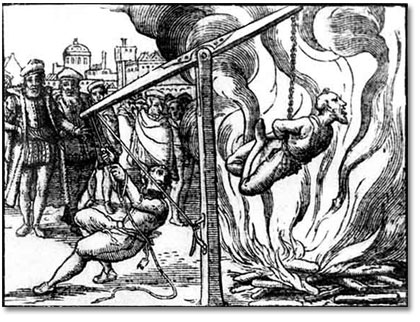
Now I know how Joan of Arc felt...as the flames rose to her Roman nose.

We see lies in Scripture, accurately recounted, from the beginning until the end:  in Genesis alone we see deception in the words of the serpent in the Garden, as well as from the mouths of Cain, Abraham, Isaac, Jacob, Jacob’s sons, Potiphar’s wife, Joseph, and many more.  Examples of wickedness in Scripture include murder, brutality, rape, gang rape, incest, incestuous rape, and attempted genocide.  We may also find many examples of bad theology in the form of worship of idols (sometimes led by Israel’s leaders, such as Aaron in Ex. 32:4-5), false prophecies from those who claim to be true prophets of YHWH, and even the claim in Psalm 14:1 that “there is no God” (don’t worry, we’ll qualify this later).

The existence of these elements in the Bible is unquestionable; however, the purpose they serve in the text may sometimes perplex the thoughtful reader, particularly when one considers the classic concept of Scripture as “revelation.”  Most Christian definitions of “revelation” look similar to what we find in the Evangelical Dictionary of Theology:  “the term is used primarily of God’s communication to humans of divine truth, that is, his manifestation of himself or his will.”

The question then is how do examples of lies, wickedness, and bad theology serve to reveal a “manifestation” of God or his will to us?  How does the presence of these disturbing aspects in the written “Word of God” act as divine self-disclosure?  In order to answer that question, I would like to argue that the Bible actually has two subjects of its revelation:  God and humanity (see footnote 1 below).  To use an analogy, Scripture acts as a mirror and telescope:  it is a mirror that accurately depicts and evaluates the human condition; and it is also a telescope, revealing the transcendent, eternally “other” Divine Being.  And ultimately, Christ serves as the mirror in the telescope, perfectly imaging near to us the fullness of God in heaven.

How a reflecting telescope works...

While many treatises on revelation focus primarily on the Divine subject, there are some theologians who have noted the significance of the divinely inspired revelation of the human subject in Scripture.  Ben Witherington poses the idea that “maybe the Bible is meant to be as much a revelation of human character as of divine character, and how the two do and should interact.” (Living Word, 24)  Although this is more of an aside for Witherington, his comments touch upon the need for students of Scripture to reconsider what it is exactly that we see the inspired Word as revealing to us: only God’s nature, or humanity’s as well.

I believe that we need to make more of Witherington’s conjecture that the Bible is indeed “as much” about humanity as it is about God, for the simple reason that as we consider the whole of Scripture, we see that large sections, particularly in the historical works and poetry of the Hebrew Scriptures, focus much more on revealing humanity than divinity.  For instance, God tells Job’s friends that “they have not spoken of me what is right” (Job 42:7); does this then cast much of this book’s contents into theological suspicion?  Being that the reader has seen what caused Job’s suffering in the prologue, we know at the very least that their accusations against Job are faulty—what about their theological ideas?  Could it be that Job’s friends serve as examples of bad theology, but they speak in ways which still accurately reveal authentic human perspectives?  This example suggests that we must distinguish in Scripture between theological source material (what we can say about God) and anthropological source material (how we see human beliefs and experiences depicted).  Furthermore, we must differentiate accurate theological ideas from erroneous ones (i.e. persons may say something about God in Scripture, but it does not mean it is true), as well as between accurate or positive anthropological material (including those Biblical figures we should emulate) and false ideas about or negative examples of humanity. (Footnote 2)

[In Part II, we will explore why it is that humans would need revelation about…humans.]

Footnotes:

  1. Of course there are more subjects in Scripture, such as animal and plant life, the cosmos, angelic beings, etc. but God and humanity are clearly the primary subjects of revelation
  2. It must be said that the Bible exists as more than informational “source material;” it also “performs” God’s covenantal actions (as Kevin VanHoozer has suggested) as well as transforming us into people who are “on mission” with God to heal and redeem the whole creation (as N.T. Wright has proposed).

See PART IV for Works Cited

A Brief Commentary on September Eleventh

I remember exactly where I was ‘when it happened’. Whilst many other major American tragedies like the assassination of John F. Kennedy and the Space Shuttle Challenger disaster happened before I was born, I was in my second year of high school on 11 September 2001. The 1995 Oklahoma City bombing was the only thing that compared in my lifetime, but it is all but forgotten in the shadow of ‘September Eleventh’.

My older sister came into my room that morning to wake me up as she normally did, but this time she added, ‘An aeroplane crashed into the World Trade Center.’ ‘What?’ She was just as confused as I was and had merely heard the headline on her alarm clock radio. I thought at first, ‘The World Trade Center [near our home] in Long Beach?!’

We went into the family room and turned on the television. We saw live feed of the first tower, billowing smoke, then suddenly another jetliner appeared on screen. My first thought was, ‘Oh God, they actually got video of the crash.’ We knew nothing of a terrorist plot — at this point we assumed it was merely a single tragic aviation accident. But then I realised that we were still watching the live feed; a second plane had hit the second tower of the World Trade Center just after 6 AM, Pacific Standard Time. We watched in horror as reporters pointed out that what appeared to be small pieces of the building falling to the ground were not actually small pieces of the building, but were people. Before we had to leave for school the first tower collapsed.

I would find out later that the second tower collapsed, another plane had hit the Pentagon and yet another plane had crashed in a field in Pennsylvania. Throughout the day my teachers suspended their normal lessons. We sat in mourning, much of it in silence. We didn’t know the details of the tragedy, but we did know—and it was stated very explicitly by one teacher that day—that from now on the world would be a different place.

We would all eventually learn that the attacks were the plot of the terrorist group al-Qaeda (which has since become an infamous household name in America) and that in the end nearly 3000 people had been killed in the attacks and an additional 6000 were injured. These tragic events would come to justify the ‘War on Terror’ and the US-led invasions of Afghanistan and eventually Iraq. Western society underwent a metamorphosis almost immediately. Alongside institutional changes in national security policy, there was a massive shift in public consciousness. The radical Sunni Islam al-Qaeda was grouped with all Muslims and all people of Western Asian descent—your classmates, your neighbours, your doctor, etc.—could be potential terrorists. We were made to believe that al-Qaeda wanted to kill every last American simply for being American.

People will believe what they want — that terrorist groups like al-Qaeda are merely an example of what ‘true Islam’ looks like when fully embraced, that the West is oppressed merely for ‘being different’, that the events of September 11 were primarily a demonstration of a religion and not a political ideology. I cannot buy into these things.

God and the Christian religion are not so small and weak that we need to demonise every other belief system in order to justify our faith. I know why I am not a Muslim. It’s not because Islam is violent or necessarily archaic (and this is in no way a support of so-called ‘fundamentalist’ Islamic nations). I am not a Muslim because in many ways, the the teaching of the Islamic faith about God is different from the teaching of the Christian faith about God. It is the acts of the teaching of the Christian faith about God that call for any sort of adherence. This teaching espouses that God has invested in the creation to the utmost degree through the Incarnation and the life, death and resurrection of Jesus Christ. Jesus is an expression of God’s love for and solidarity with the world, not merely a honourable prophet, as is held by the teaching of Islam. This teaching affirms all people in this solidarity and extends an invitation into the Kingdom and an intimate friendship through the Holy Spirit. The only proper response to such love and grace is a life of love, grace and service.

But the September 11 attacks were not simply attacks on one religion from another religion. America is not a Christian nation and—if you talk to the vast majority of Muslims around the world—al-Qaeda and any who would terrorise others in the name of Allah are not true Muslims. I don’t have a solution for the problems that have been introduced as a result of the tragedy that transpired nine years ago today, but as a Christian I do know that my responsibility is to love, to be just and to seek peace.

May all those who perished on 11 September 2001 rest in peace and may their loved ones be comforted by the God who so thoroughly loves the world.

+++++

+++++

Top 20 Bands: 6 & 5

6. Sufjan Stevens [UPDATE: moved to number 3.]

My deep admiration for Sufjan Stevens is paired with the sad realisation that his rapid rise to fame in 2005 inevitably wore him out.  Many feared that Sufjan wouldn’t make another proper record after certain statements he made last year, but lo and behold, this year he unexpectedly released a new EP (All Delighted People) and his newest album, The Age of Adz was released on 12 October [and topped my and Greg’s Top 10 Albums of ’10].  Exciting times, and from the sound of his newest material he is pulling away from the mass appeal generated by Illinois.  This recent venture back into semi-electronic, erratic, avant-garde territory is incredibly appealing to me.  Three of his records are featured on my Top 50 Albums list: A Sun Came (2000), Greetings From Michigan (2003) and The Age of Adz (2010).

‘For The Widows In Paradise, For The Fatherless In Ypsilanti’ from Greetings From Michigan, live on a farm:

‘Too Much’ from his forthcoming album Age of Adz, live at Castaways in Ithaca, New York in 2009:

Sorry Sufjan fans (and if he’s reading this, sorry Sufjan), but there’s only room for five in the ‘Top 5’ and he’s not there quite yet. In order to gain membership in my coveted Top 5 [please note the sarcasm] he’ll have to beat the five to follow, beginning with The Smiths.

+++++

5. The Smiths/Morrissey [UPDATE: moved to number 6.]

There are major differences between The Smiths and Morrissey, but it didn’t used to be such a stark contrast.  For instance, everything The Smiths made was great (if not better!) while the Mozzer has been on a steady decline with few recent high points.  Still, taken as a single unit they are phenomenal (and I still believe in you Morrissey!).  Through their charisma and uniqueness (largely on account of the Mozzer’s voice and Johnny Marr’s guitar), The Smiths have secured their place as the kings of indie pop.  Three of their records can be found on my Top 50 Albums list: The Queen is Dead (The Smiths – 1986), Louder Than Bombs (The Smiths – 1987) and Bona Drag (Morrissey – 1990).

‘Heaven Knows I’m Miserable Now’ from Hatful of Hollow (The Smiths – 1984), live in Madrid (after two minutes of cheering fans):

‘Suedehead’ from Viva Hate (Morrissey – 1988), live on Later… with Jools Holland:

+++++

Top 20 Bands: 20 & 19, 18 & 17, 16 & 15, 14 & 13, 12 & 11, 10 & 9, 8 & 7

Top 20 Bands: 8 & 7

8. Pink Floyd

Pink Floyd is one of the most successful bands in history, making their inclusion one of the few commercially accepted ‘greatest bands of all time‘ that I vehemently agree with.  They have certainly earned their place among my favourites from 1967’s Piper at the Gates of Dawn through 1979’s The Wall.  The innovation they nurtured has transformed popular music.  Roger Water’s insightful songwriting is enhanced by the ingenious early guitar work by Syd Barrett and the eventual musical perfection that is David Gilmour’s guitar and voice.  Nick Mason and Richard Wright provide the backbone with their inventive work on percussion and keys.  Two of their records—The Wall and The Dark Side of the Moon (1973)—can be found on my Top 50 Albums list.

‘Astronomy Domine’ from Piper at the Gates of Dawn, live in Belgium in 1968:

‘Comfortably Numb’ from The Wall, at Live 8 in 2005, because David Gilmour is still awesome:

+++++

7. Converge

I have a not-so-secret penchant for metal and among my favourite metal acts (such as Botch, Curl Up & Die and The Beach Boys) Converge stands out as the most consistently excellent, energetic and innovative.  They’ve been bringing it heavy since 1990(!) and they remain a phenomenal live act.  Their seminal 2001 release Jane Doe is featured in my Top 50 Albums list and was one of my Top 21 Albums from the 21st Century (seventh).  Their most recent record, Axe to Fall, was my third favourite record released last year.

‘Concubine/Fault & Fracture’ from Jane Doe:

‘Dark Horse’ from Axe to Fall, live at the Hollywood Palladium in 2009.  The sound isn’t great, but Ben Koller’s introductory drum solo is ridiculous:

+++++

Top 20 Bands: 20 & 19, 18 & 17, 16 & 15, 14 & 13, 12 & 11, 10 & 9

Top 20 Bands: 10 & 9

To begin the countdown of my Top 10 of 20 [favourite] Bands:

10. Grandaddy [UPDATE: moved to number 4.]

Grandaddy was/is a remarkable band that has yet to reach stardom…and they probably prefer[ed] it that way.  They were/are the ultimate ‘DIY’ band.  They often wrote powerpop songs about the struggle between technology and nature in the modern world.  Their child-like keyboard lines and Jason Lytle’s high-pitched singing voice make them one of the most unassuming acts you could ever hear, but truly they ought to be regarded as excellent songwriters.  And yes, I prefer them ever-so-slightly to The Beatles.  Their 2000 release The Sophtware Slump is featured on my Top 50 Albums list.

‘Summer Here Kids’ from 1997’s Under the Western Freeway:

‘The Crystal Lake’ from The Sophtware Slump:

+++++

9. The Clash

The Clash is a very interesting case.  Essentially they ‘sold out’, as is expressed in the 1979 Crass song ‘Punk is Dead’: CBS promote The Clash, Ain’t for revolution, it’s just for cash…  Essentially the eloquent sage Steve Ignorant is right, but that never seemed to keep Clash patches off of the denim jackets of the gutter punks.  The anarchopunks could pump their fists to ‘London’s Burning’ while—on the way to pick up her son from football practise—the white suburban mother could shake her hips to ‘Rock the Casbah’.  It doesn’t matter – everyone loves The Clash.  The Clash (1977) can be found on my Top 50 Albums list.

‘I Fought the Law’ from The Clash:

‘The Magnificent Seven’ from 1980’s Sandinista, live on The Tomorrow Show with Tom Snyder in 1981:

+++++

Top 20 Bands: 20 & 19, 18 & 17, 16 & 15, 14 & 13, 12 & 11

Top 20 Bands: Honourable Mentions

Before I move into the Top 10 of my Top 20 Bands, I feel the need to mention ten significant bands that might have been part of my ‘cut’ at various points in recent history, but just didn’t make it into my Top 20 this time around.  (Perhaps this could be seen as my ’21-30′.)

  1. Frightened Rabbit – Let’s see how the whole longevity thing plays out – the first two records have been a steady improvement from ‘incredible’ to ‘phenomenal’.
  2. Pedro the Lion/David Bazan – Excellent songwriting, but albums are often incoherent with themselves.
  3. Cass McCombs – There’s a quality to Cass McCombs that convinces me he’s one of the greatest living songwriters.
  4. Starflyer 59 – Something’s absent on most of their recent material…
  5. Grizzly Bear – Also needing a bit of longevity – It feels strange to consider Grizzly Bear one of my favourite bands, but they most certainly are.
  6. Deerhunter – Let’s hope they keep up this steam…
  7. Brian Eno – Mostly hit, but sometimes miss.
  8. Camera Obscura – There’s something to this group that keeps me listening, but I am hoping for something to make them stand out.
  9. Cursive – Maybe it’s because they still haven’t grown up?
  10. Curl Up & Die – I wish they had made more material before disbanding.

Perhaps you are thinking, ‘Who can beat the bands above along with Spiritualized, The Kinks, The Velvet Underground, Tom Waits, The Beach Boys, The Beatles and Neil Young?’  I hope not to disappoint, but prepare to find out just how bad my taste actually is in the coming week…

Top 20 Bands: 12 & 11

Rounding out 20-11:

12. The Beatles [UPDATE: moved to number 11.]

Where would the world be without The Beatles?  But then again, where would The Beatles have been without Elvis?  And where would Elvis have been without Big Boy Crudup?  And Crudup without Lead Belly and Blind Lemon Jefferson?  And Blind Lemon Jefferson without Hobart Smith?  STOP!  INFINITE REGRESSION!  So basically Hobart Smith founded The Beatles, who would become the single most influential musical group in history.  I know what some of you are thinking: ‘Beatles not in the Top 5, let alone the Top 10! Blasphemy!’  They are phenomenal, and if George Harrison had written more of their songs (I’m in love with George) and they didn’t write all of their cute pop music that preceded Rubber Soul (and even Rubber Soul isn’t entirely free of it) they’d probably be higher on my list.  While The Beatles will find their way into what seems to be every other Top 10 list, their lack of longevity also plays a factor here.  Still, two of their records are found on my Top 50 Albums list: The Beatles [The White Album] (1968) and Abbey Road (1969).

‘Strawberry Fields Forever’ from their 1967 album Magical Mystery Tour:

‘Let it Be’ from their 1970 album of the same name:

+++++

11. Neil Young [UPDATE: moved to number 14.]

The legendary Neil Young has often been noted for his sincerity – noticing a pattern in my preferences?  It’s true that I’m a sucker for artists that I can truly believe, and among them Neil Young is the Godfather.  This personal touch plus his unique vocal style (oftentimes accompanied by driving guitars) have made him an incredibly distinct artist in a music world full of clones over the last five decades.  His album Harvest (1972) is featured on my Top 50 Albums list and 1970’s After the Gold Rush should probably in there as well.

‘Needle and the Damage Done’ from the album Harvest, performed on The Johnny Cash Show in 1971:

‘After the Gold Rush’, from the album of the same name, live in 1978:

+++++

Top 20 Bands: 20 & 19, 18 & 17, 16 & 15, 14 & 13

Top 20 Bands: 14 & 13

¡Dos más!

14. Tom Waits [UPDATE: moved to number 15.]

Tom Waits is an acquired taste for some, but regardless of his more abrasive presentation since the late seventies, he has been a source of inspiration for countless artists and has been covered by everyone from Bruce Springsteen to Screamin’ Jay Hawkins to the unfortunate thing that was Scarlett Johansson’s debut record.  His unique style of storytelling and experimental production make him an intriguing and always reinvigorating voice in the music world.  His persona is commanding in every sense.  Not only this, but the man’s longevity makes him an enduring legend.  One is not compelled to say, ‘I loved his stuff from ’79-’81, then from ’99-’01.’  He just doesn’t stop making high quality records.  Waits’ album Swordfishtrombones (1983) can be found on my Top 50 Albums list.

‘Heartattack And Vine’ live from his amazing 1980 album of the same name:

‘Chocolate Jesus’ from his 1999 album Mule Variations, live on Late Night with David Letterman:

+++++

13. The Beach Boys [UPDATE: moved to number 12.]

The Beach Boys seem to have always been second best to The Beatles (‘What’s wrong with second best?‘).  It was always a back and forth between the two.  Part of me is tempted to switch the two, but I do love The Beatles just that wee bit more (hinting at a Beatles placement in the very near future) and that’s probably primarily due to the presence of the late great George Harrison.  Still, it must be said that The Beach Boys are nothing short of a phenomenal group.  Where I criticise The Beach Boys’ earlier material I do the same for The Beatles’, but I must hand it to The Beach Boys that they were better pop writers than even The Beatles.  The bigger Brian Wilson’s ambitions were the more I fall in love with The Beach Boys and that ambition is owed, in part, to The Beatles’ Rubber Soul.  Two of The Beach Boys’ records can be found on my Top 50 Albums list: Pet Sounds (1968) and Surf’s Up (1971).

‘Good Vibrations’ from Smiley Smile (1967), live on The Midnight Special in 1979 (it could certainly do without this audience, but look at Dennis owning on the drums):

Wouldn’t It Be Nice‘ from Pet Sounds.

Brian Wilson performs ‘Surf’s Up‘ from the album of the same name.

+++++

Top 20 Bands: 20 & 19, 18 & 17, 16 & 15