Top 20 Bands: 10 & 9

To begin the countdown of my Top 10 of 20 [favourite] Bands:

10. Grandaddy [UPDATE: moved to number 4.]

Grandaddy was/is a remarkable band that has yet to reach stardom…and they probably prefer[ed] it that way.  They were/are the ultimate ‘DIY’ band.  They often wrote powerpop songs about the struggle between technology and nature in the modern world.  Their child-like keyboard lines and Jason Lytle’s high-pitched singing voice make them one of the most unassuming acts you could ever hear, but truly they ought to be regarded as excellent songwriters.  And yes, I prefer them ever-so-slightly to The Beatles.  Their 2000 release The Sophtware Slump is featured on my Top 50 Albums list.

‘Summer Here Kids’ from 1997’s Under the Western Freeway:

‘The Crystal Lake’ from The Sophtware Slump:

+++++

9. The Clash

The Clash is a very interesting case.  Essentially they ‘sold out’, as is expressed in the 1979 Crass song ‘Punk is Dead’: CBS promote The Clash, Ain’t for revolution, it’s just for cash…  Essentially the eloquent sage Steve Ignorant is right, but that never seemed to keep Clash patches off of the denim jackets of the gutter punks.  The anarchopunks could pump their fists to ‘London’s Burning’ while—on the way to pick up her son from football practise—the white suburban mother could shake her hips to ‘Rock the Casbah’.  It doesn’t matter – everyone loves The Clash.  The Clash (1977) can be found on my Top 50 Albums list.

‘I Fought the Law’ from The Clash:

‘The Magnificent Seven’ from 1980’s Sandinista, live on The Tomorrow Show with Tom Snyder in 1981:

+++++

Top 20 Bands: 20 & 19, 18 & 17, 16 & 15, 14 & 13, 12 & 11

Top 20 Bands: Honourable Mentions

Before I move into the Top 10 of my Top 20 Bands, I feel the need to mention ten significant bands that might have been part of my ‘cut’ at various points in recent history, but just didn’t make it into my Top 20 this time around.  (Perhaps this could be seen as my ’21-30′.)

  1. Frightened Rabbit – Let’s see how the whole longevity thing plays out – the first two records have been a steady improvement from ‘incredible’ to ‘phenomenal’.
  2. Pedro the Lion/David Bazan – Excellent songwriting, but albums are often incoherent with themselves.
  3. Cass McCombs – There’s a quality to Cass McCombs that convinces me he’s one of the greatest living songwriters.
  4. Starflyer 59 – Something’s absent on most of their recent material…
  5. Grizzly Bear – Also needing a bit of longevity – It feels strange to consider Grizzly Bear one of my favourite bands, but they most certainly are.
  6. Deerhunter – Let’s hope they keep up this steam…
  7. Brian Eno – Mostly hit, but sometimes miss.
  8. Camera Obscura – There’s something to this group that keeps me listening, but I am hoping for something to make them stand out.
  9. Cursive – Maybe it’s because they still haven’t grown up?
  10. Curl Up & Die – I wish they had made more material before disbanding.

Perhaps you are thinking, ‘Who can beat the bands above along with Spiritualized, The Kinks, The Velvet Underground, Tom Waits, The Beach Boys, The Beatles and Neil Young?’  I hope not to disappoint, but prepare to find out just how bad my taste actually is in the coming week…

Top 20 Bands: 12 & 11

Rounding out 20-11:

12. The Beatles [UPDATE: moved to number 11.]

Where would the world be without The Beatles?  But then again, where would The Beatles have been without Elvis?  And where would Elvis have been without Big Boy Crudup?  And Crudup without Lead Belly and Blind Lemon Jefferson?  And Blind Lemon Jefferson without Hobart Smith?  STOP!  INFINITE REGRESSION!  So basically Hobart Smith founded The Beatles, who would become the single most influential musical group in history.  I know what some of you are thinking: ‘Beatles not in the Top 5, let alone the Top 10! Blasphemy!’  They are phenomenal, and if George Harrison had written more of their songs (I’m in love with George) and they didn’t write all of their cute pop music that preceded Rubber Soul (and even Rubber Soul isn’t entirely free of it) they’d probably be higher on my list.  While The Beatles will find their way into what seems to be every other Top 10 list, their lack of longevity also plays a factor here.  Still, two of their records are found on my Top 50 Albums list: The Beatles [The White Album] (1968) and Abbey Road (1969).

‘Strawberry Fields Forever’ from their 1967 album Magical Mystery Tour:

‘Let it Be’ from their 1970 album of the same name:

+++++

11. Neil Young [UPDATE: moved to number 14.]

The legendary Neil Young has often been noted for his sincerity – noticing a pattern in my preferences?  It’s true that I’m a sucker for artists that I can truly believe, and among them Neil Young is the Godfather.  This personal touch plus his unique vocal style (oftentimes accompanied by driving guitars) have made him an incredibly distinct artist in a music world full of clones over the last five decades.  His album Harvest (1972) is featured on my Top 50 Albums list and 1970’s After the Gold Rush should probably in there as well.

‘Needle and the Damage Done’ from the album Harvest, performed on The Johnny Cash Show in 1971:

‘After the Gold Rush’, from the album of the same name, live in 1978:

+++++

Top 20 Bands: 20 & 19, 18 & 17, 16 & 15, 14 & 13

Top 20 Bands: 14 & 13

¡Dos más!

14. Tom Waits [UPDATE: moved to number 15.]

Tom Waits is an acquired taste for some, but regardless of his more abrasive presentation since the late seventies, he has been a source of inspiration for countless artists and has been covered by everyone from Bruce Springsteen to Screamin’ Jay Hawkins to the unfortunate thing that was Scarlett Johansson’s debut record.  His unique style of storytelling and experimental production make him an intriguing and always reinvigorating voice in the music world.  His persona is commanding in every sense.  Not only this, but the man’s longevity makes him an enduring legend.  One is not compelled to say, ‘I loved his stuff from ’79-’81, then from ’99-’01.’  He just doesn’t stop making high quality records.  Waits’ album Swordfishtrombones (1983) can be found on my Top 50 Albums list.

‘Heartattack And Vine’ live from his amazing 1980 album of the same name:

‘Chocolate Jesus’ from his 1999 album Mule Variations, live on Late Night with David Letterman:

+++++

13. The Beach Boys [UPDATE: moved to number 12.]

The Beach Boys seem to have always been second best to The Beatles (‘What’s wrong with second best?‘).  It was always a back and forth between the two.  Part of me is tempted to switch the two, but I do love The Beatles just that wee bit more (hinting at a Beatles placement in the very near future) and that’s probably primarily due to the presence of the late great George Harrison.  Still, it must be said that The Beach Boys are nothing short of a phenomenal group.  Where I criticise The Beach Boys’ earlier material I do the same for The Beatles’, but I must hand it to The Beach Boys that they were better pop writers than even The Beatles.  The bigger Brian Wilson’s ambitions were the more I fall in love with The Beach Boys and that ambition is owed, in part, to The Beatles’ Rubber Soul.  Two of The Beach Boys’ records can be found on my Top 50 Albums list: Pet Sounds (1968) and Surf’s Up (1971).

‘Good Vibrations’ from Smiley Smile (1967), live on The Midnight Special in 1979 (it could certainly do without this audience, but look at Dennis owning on the drums):

Wouldn’t It Be Nice‘ from Pet Sounds.

Brian Wilson performs ‘Surf’s Up‘ from the album of the same name.

+++++

Top 20 Bands: 20 & 19, 18 & 17, 16 & 15

Top 20 Bands: 16 & 15

Today’s installment of my Top 20 Bands:

16. Descendents [UPDATE: moved to number 20.]

Descendents are amazing and have been greatly overlooked for their role in the historical progression from punk rock to hardcore.  Their lyrics aren’t often phenomenal (and sometimes downright explicit!), but their material has a mysterious attraction and drive behind it for me.  I listen to gems like ‘My Dad Sucks’ and ‘I Like Food’ and think, ‘This was 1981?!’  They probably aren’t a band for everyone (though they should be!), but I encourage everyone to give them a shot (or five – it has taken some friends several listens before they ‘see’ the light…some never see it).  Their record Milo Goes to College (1982) is one of my absolute favourites and is featured on my Top 50 Albums list.

‘Suburban Home’ from Milo Goes to College:

‘Descendents’ from their 1985 album I Don’t Want to Grow Up:

+++++

15. The Velvet Underground [UPDATE: moved to number 16.]

The Velvet Underground are an incredibly influential group.  Mixing exceptional songwriting and uncommon and difficult subject matter (such as prostitution and drug use), they influenced the subsequent generation of both popular and independent music.  Their record The Velvet Underground (1969) is found among my Top 50 Albums (and it’s cover features and incredibly Andrew-looking Lou Reed, though Lou is certainly less handsome).

‘I’m Waiting for the Man’ from their 1967 album The Velvet Underground & Nico:

‘Sunday Morning’, also from The Velvet Underground & Nico (as it is so difficult to find a good track off of their other records on Youtube):

+++++

Top 20 Bands: 20 & 19, 18 & 17

Top 20 Bands: 18 & 17

In continuing my Top 20 Bands countdown, I present you with two more amazing musical acts:

18. The Kinks [UPDATE: moved to number 13.]

The Kinks were an unstoppable force during the British Invasion of America in the mid-60s, popping out hits like ‘You Really Got Me‘, ‘All Day and All of the Night‘, ‘Tired of Waiting for You‘, etc.  While these are surely classic tunes, their excessive familiarity to me (through being forced to listen to oldies radio stations as a child) gave me a great aversion to The Kinks.  But like my aversion to The Beatles and The Beach Boys, I have grown out of this distaste for The Kinks (thanks to initial interest years ago via Rushmore and the watering of the seed by the Greg, the Band Evangelist) – and I even love their hits now too!  It’s probably a shame to some people that The Kinks are down here at number 18 in my top 20, but I’m not especially familiar with their work after 1970’s Lola Versus Powerman and the Moneygoround, Part One and I’ve only been really listening them for some four years now.  Give me more time to wise up. Their album The Village Green Preservation Society (1968) can be found among my Top 50 Albums.

‘Sunny Afternoon’ single promo, later included 1966’s Face to Face:

‘Apeman’, featuring a creepy and massive-haired Ray Davies, from 1970’s Lola Versus Powerman and the Moneygoround:

+++++

17. Danielson/Daniel Smith

Whether it is through a band consisting primarily of his siblings (Danielson Famile), through a solo project consisting of the man in a gigantic tree costume (Brother Danielson) or his most recent incarnation as just plain Danielson, Daniel Smith has been consistently producing honest, unusual and compelling art over the last two decades.  Danielson appeared on my radar soon after my conversion to Christianity in the beginning of high school and I have grown more in love with them/him ever since.  Interesting note: Through his association with Danielson I first gave Sufjan Stevens a shot.  Read more about Daniel in this post.  His/their second record,  Tell Another Joke at the Ol’ Choppin’ Block (1997), is featured on my Top 50 Albums list.

I wanted to post ‘Headz in the Cloudz’ from the debut Danielson Famile album, 1996’s A Prayer for Every Hour, but embedding is disabled.  View it here.

‘Things Against Stuff’, live from 2004’s Brother Is to Son from Brother Danielson:

‘Did I Step on Your Trumpet?’ from 2006’s Ships by Danielson (one of the best music videos of all time):

+++++

Top 20 Bands: 20 & 19

Top 20 Bands: 20 & 19

In typical LITC obsessive list-making fashion I’ve decided to compile a list of my Top 20 Bands of all time.  I must admit that this list is prone to change, whether it be in order or in composition (perhaps in the coming years more recent groups like Frightened Rabbit, Grizzly Bear and Deerhunter might make their way on or classics that have been in my rotation for most if not all of my life will sneak in like Starflyer 59, Nirvana, The Rolling Stones and The Smashing Pumpkins).  I’ll probably modify this list with my ever-changing taste and an ever-growing musical collection, but I will say that the bulk of this list has remained rather consistent over the last few years.  I’ve decided instead of one massive post to split it up into groups of two.  Perhaps you’ve not really given some of these groups a fair listen, or perhaps this will encourage you to give them another shot.  So without further ado, I give you 20 and 19.

20. Spiritualized

This group, borne from the ashes of Spacemen 3 in 1990-1, consists primarily of Jason Pierce (J. Spaceman) and his inability to stop creating good music.  From space rock to gospel, Spiritualized have been a mainstay of English music for two decades, while their commercial success has yet to match their commercial success.  Annette first turned me onto this band in 2006 (very late in the game) and I can’t get enough.  Their 2008 record Songs in A & E can found among my Top 50 Albums.  Might I also suggest 1997’s Ladies and Gentlemen We are Floating in Space, which was narrowly edged out of my Top 50 Albums in a move I’m not entirely confident in.

‘Broken Heart’ from Ladies and Gentlemen We are Floating in Space, live in 1998 on Later… with Jools Holland:

‘You Lie You Cheat’ from Songs in A & E, live on The Late Show with David Letterman, 2008:

+++++

19. Sebadoh/Lou Barlow

Lou Barlow is an amazing songwriter and over the last 20+ years he has certainly spread his influence through Dinosaur Jr., Sebadoh, Sentridoh, The Folk Implosion and his recent solo career.  As mentioned before, Greg first turned me on to Lou Barlow.  Read more about him (and take a look at list of Greg and my ‘Top 30 Lou Barlow Songs‘) in this post.  His amazing record with Sebadoh III (1991) is featured among my Top 50 Albums.

‘Rebound’ from Sebadoh’s 1994 album Bakesale:

‘Too Much Freedom’ from Lou Barlow’s 2009 album Goodnight Unknown:

Happy 41st, Elliott

Today marks what would have been Elliott Smith’s 41st birthday and I’d like to share a brief thought.

Think about some of the most influential popular musicians from the last 50 years.  Perhaps Bob Dylan, The Beatles, Pink Floyd, Michael Jackson, Nirvana, Creed [followed by an audible laugh] and so on.  Perhaps we could come to a consensus and say that these names (with the exception of one) are legendary.  Dylan, McCartney, Lennon, Gilmour, Waters, Jackson, Cobain.  We could continue the list for ages, but what I want to point out is that I’ve listed surnames and readers who are familiar with popular music in America and Britain probably knew exactly whom I was referring to.  When I write ‘Paul and John’ you probably realise that I am referring to the principle songwriters (though George is clearly the best) of one of the most influential bands in history and in the proper context we will often call Michael by his forename without too much confusion.  This is probably due to the fact that Michael Jackson and The Beatles are very much household names.  Still, taken on their own we’ll more typically employ the surname.

Now, I am not suggesting that somehow Elliott Smith might someday be recognised among these greats.  He’s been grossly underrated and ignored in the public, but such is the lot of a shy and reclusive indie songwriter who killed himself at 34.  Regardless, I find it quite interesting that when I write about Elliott Smith I cannot write, ‘Smith recorded his debut record while still fronting Heatmiser.’  It feels unnatural and impersonal.  Elliott wouldn’t want to be talked about that way (although he probably wouldn’t want to be talked about at all).  (This is all apart from the fact that ‘Smith’ is one of the most common surnames in the English language.)  Perhaps the same can be said of Sufjan Stevens, but we all know that writing/saying ‘Sufjan’ is a billion times more pleasing than writing/saying ‘Stevens’.  When we write or talk about Elliott it is as if we are talking about an old friend.  I never knew Elliott.  I never met him and I never saw him in concert, but his music reaches out to listeners like me and each listen becomes a very personal encounter.  Elliott shares his soul with us and—as I’ve written about before—he shares our souls for us.

I’ve been compiling a list of my ‘Top 50 Elliott Smith Songs’ for several months now.  As Greg so conscientiously shared his ‘Top 50 Sufjan Stevens Songs’ in order based upon his preference, I had hoped to do the same for Elliott.  But Elliott’s work is quite different from Sufjan’s and I found that after arranging the first few songs on the list in preferential order it became very arbitrary – I am in love with different tracks for different reasons.  So, like my ‘Top 50 Albums’, I am going to organise these songs by title.  These tracks (as well as many many others) are all gems and if you don’t own any of the official releases I suggest you look into making some purchases immediately.  Enjoy.

Top 50 Elliott Smith Songs

  1. ‘2:45 A.M.’/Either/Or, 1997
  2. ‘Angeles’/Either/Or, 1997
  3. ‘Baby Britain’/XO, 1998
  4. ‘Between the Bars’/Either/Or, 1997
  5. ‘The Biggest Lie’/Elliott Smith, 1995
  6. ‘Can’t Make a Sound’/Figure 8, 2000
  7. ‘Christian Brothers’/Elliott Smith, 1995
  8. ‘Coast to Coast’/From a Basement on the Hill, 2003
  9. ‘Dancing on the Highway’/Basement era sessions, circa 2003
  10. ‘A Distorted Reality Is Now a Necessity to Be Free’/From a Basement on the Hill, 2003
  11. ‘The Enemy Is You’/Either/Or era, circa 1997
  12. ‘Everybody Cares, Everybody Understands’/XO, 1998
  13. ‘Everything Means Nothing to Me’/Figure 8, 2000
  14. ‘Going Nowhere’/Either/Or era, circa 1997, officially released on New Moon in 2007
  15. ‘Good to Go’/Elliott Smith, 1995
  16. ‘Happiness’/Figure 8, 2000
  17. ‘High Times’/Either/Or era, circa 1997, officially released on New Moon in 2007
  18. ‘How to Take a Fall’/Either/Or era, circa 1997
  19. ‘I Better Be Quiet Now’/Figure 8, 2000
  20. ‘I Can’t Answer You Anymore’/3 Titres Inedits (French promo), 2000
  21. ‘I Didn’t Understand’/XO, 1998
  22. ‘In the Lost and Found (Honky Bach)’/Figure 8, 2000
  23. ‘King’s Crossing’/From a Basement on the Hill, 2003
  24. ‘L.A.’/Figure 8, 2000
  25. ‘Last Call’/Roman Candle, 1995
  26. ‘Let’s Get Lost’/From a Basement on the Hill, 2003
  27. ‘Miss Misery’/Good Will Hunting (soundtrack), 1997
  28. ‘Needle In the Hay’/Elliott Smith, 1995
  29. ‘No Name #2’/Roman Candle, 1995
  30. ‘O So Slow’/Basement era sessions, circa 2003
  31. ‘Oh Well, Okay’/XO, 1998
  32. ‘A Passing Feeling’/From a Basement on the Hill, 2003
  33. ‘Pictures of Me’/Either/Or, 1997
  34. ‘Pitseleh’/XO, 1998
  35. ‘Pretty Mary K’/Figure 8, 2000
  36. ‘Roman Candle’/Roman Candle, 1995
  37. ‘Rose Parade’/Either/Or, 1997
  38. ‘Say Yes’/Either/Or, 1997
  39. ‘Shooting Star’/From a Basement on the Hill, 2003
  40. ‘Son of Sam’/Figure 8, 2000
  41. ‘Southern Belle’/Elliott Smith, 1995
  42. ‘Splitsville’/Southlander (soundtrack), 2001
  43. ‘Strung Out Again’/From a Basement on the Hill, 2003
  44. ‘Stupidity Tries’/Figure 8, 2000
  45. ‘Sweet Adeline’/XO, 1998
  46. ‘True Love’/Basement era sessions, circa 2003
  47. ‘Twilight’/From a Basement on the Hill, 2003
  48. ‘Waltz #2 (Xo)’/XO, 1998
  49. ‘The White Lady Loves You More’/Elliott Smith, 1995
  50. ‘You Make it Seem Like Nothing’/Either/Or era live recording, circa 1996

(For the sake of space I’ve omitted anything Elliott did with other musical acts, otherwise I’d certainly include ‘Plainclothes Man’ and ‘Half Right’ from Heatmiser’s 1996 album Mic City Sons and the rare recording from a French radio broadcast of ‘The Machine’ from Elliott’s high school band Stranger Than Fiction.)

Happy birthday, Elliott.

1969 – 2003

Imaging the Kingdom IV: The ‘Self’ in the kingdom of God

Let me begin by stressing that this post is by no means an exhaustive or thorough look at this particular issue, but rather a starting point for a conversation and potential implications we can draw out for understanding the our existence in the kingdom of God, thus impacting the way we approach life in the kingdom, as is the case with all Imaging the Kingdom.

The concept of the ‘Self’ is one of great importance in the conversation of modern philosophy and Western society at large.  This can take the form of investigations regarding the composition of the Self, for instance, a Scientologist might argue that the Self is composed of one’s ‘thetan’ (similar to the concept of one’s ‘spirit’).  But what composes the Self in this particular sense (essence) is not the concern of this post.  We will rest upon our holistic assumptions from previous ‘Imaging the Kingdom’ posts: God is the Ruler of the universe that he has created, visible and invisible.  An individual will not be broken down into separate parts, as God is concerned for and invested in both in the Christian tradition.

Many modern philosophers have concerned themselves with the concept of the Self as if we can attain it through our own clever thought processes.  Just as one cannot repair a hammer with said hammer, so one cannot, as a Self, step outside of said Self.  In his Treatise on Human Nature, Hume writes,

For my part, when I enter most intimately into what I call myself, I always stumble on some particular perception or other, of hear or cold, light or shade, love or hatred, pain or pleasure, I never catch myself at any time without a perception, and never can observe anything but the perception.

(David Hume, Treatise on Human Nature, Book I, Part IV, Sec. VI)

According to Hume, the concept of the Self can amount to, as Russell put it, ‘nothing but a bundle of perceptions’.  This non-religious observation can actually assist us in our kingdom-oriented task as it can be deduced that the confidence with which, say, I perceive my Self as an individual should be softened.  But the case is not closed there by any means.  Hume’s conclusion does not entirely negate the value of this ‘bundle of perceptions’, but rather redefines it.  As long as we are redefining the Self in light of our inability to look inward in any objective sense, I believe that the principles of the kingdom of God have profound implications for our definition.

In exploring the answer to the question ‘What is man?’ in his essay ‘The Christian Proclamation Here and Now’, Barth states,

Man exist in a free confrontation with his fellow man, in the living relationship between a man and his neighbour, between I and Thou, between man and woman.  An isolated man is as such no man.  ‘I’ without ‘Thou’, man without woman, and woman without man is not human existence.  Human being is being with other humans.  Apart from this relationship we become inhuman.  We are human by being together, by seeing, hearing, speaking with, and by standing by, one another as men, insofar, that is, as we do this gladly and thus do it freely.

(Karl Barth, God Here and Now [London: Routledge, 2003], 7.)

Although Barth is answering the question ‘What is man?’ and not ‘What is the Self?’, we see community as a God-given (and necessary) setting for human existence.

Writing more specifically regarding the Self in the opening pages of The Sickness Unto Death, Kierkegaard describes the ‘Self’ as,

The self is a relation which relates to itself, or that in the relation which is its relating to itself.  The self is not the relation but the relation’s relating to itself.  A human being is a synthesis of the infinite and the finite, of the temporal and the eternal, of freedom and necessity.  In short a synthesis.  A synthesis is a relation between two terms.  Looked at in this way a human being is not yet a self.

In a relation between two things the relation is the third term in the form of a negative unity, and the two relate to the relation, and in the relation to that relation; this is what it is from the point of view of soul for soul and body to be in relation.  If, on the other hand, the relation relates to itself, then this relation is the positive third, and this is the self.

(Søren Kierkegaard, The Sickness Unto Death [London: Penguin Books, 2008], 9-10.)

In this way the self is fully understood in the relationship.  This is a relationship with the Self and relationship with the creator of the Self.  Relationship is the basis for any human understanding of anything and no less for a proper understanding of the Self.

In light of Barth and Kierkegaard’s insights, a human is only truly human in community with God and man.  This conclusion very closely resembles the Greatest Commandments (Matthew 22:36-40).  In the kingdom of God an understanding of the Self ought to be similarly characterised by God’s intentions for the Self.

Perhaps the greatest theological tenet in the Christian tradition to attest to the necessary communal aspect of existence can be found in the Trinity.  Two contemporary theologians who have some very helpful insights for this discussion are John Zizioulas and Leonardo Boff.  Zizioulas represents an important bridge between the Eastern and Western traditions (drawing from the work of Vladimir Lossky).  Heavily influenced by the Cappadocian Fathers, Zizioulas derives that communion is an ontological category and that God exists in communion. Therefore, Vali-Matti Kärkkäinen summarises, “there is no true being without communion; nothing exists as an ‘individual’ in itself…Human existence, including the existence of the church communion, thus reflects the communal, relational being of God.”  (Vali-Matti Kärkkäinen, The Trinity: Global Perspectives, [Louisville: Westminster John Knox Press, 2007], 90.)  In this way, without the doctrine of the Trinity there would be no God.

In Trinity and Society, Boff states, “The Trinity is not something thought out to explain human problems.  It is the revelation of God as God is, as Father, Son, and Holy Spirit.” (Leonardo Boff, Trinity and Society [Maryknoll: Orbis Books, 1998], 3.)  Boff argues that humanity is given a guide through this specific revelation by which to structure society.

Gathering the tools before us we can develop a picture of what the Self might properly look like in the kingdom of God:

  • From Hume we can argue that an individual cannot objective conceive of the Self, but rather ‘a bundle of perceptions’ that fall short of the Self.
  • From Barth we can argue that it is God’s intention for the individual to find fullest existence in community.
  • From Kierkegaard we can argue that the Self is only properly understood in Hegelian relational terms – the individual, the creator and the witness of that relationship.
  • From Zizioulas we can argue that the communal aspect of God is absolutely essential to his being, that the Trinity is not an appendix to Christian theism, but its heart.
  • From Boff we can argue that human society ought to be structured based upon the community of the Trinity.

So where does this leave us?

Perhaps the reason for the philosophical dilemma of the Self is the fact that we’ve been taking our cues from the wrong place.  If it is God’s nature to necessarily exist in the communion of the Trinity, perhaps it is no surprise that our being is also of a communal nature.  In the kingdom of God the individual is not called to be alone but in community.  In such a way a fuller understanding of the Self is possible, for instance:

As I relate to myself I experience all that is unique to that experience.  As I relate to, say, Greg, he is able to see and experience something unique to his perspective of me.

As we relate, these things are synthesised and a fuller picture of the Self is possible.  Through the differences that Greg and I encounter in one another God has designed us to act as signposts for one another to himself and his ‘otherness’.

As we look toward God we discover that Christ has come to redeem the entire world and to give humanity a new paradigm to live out of, including a new method of ‘discovering the Self’.  A member of the kingdom of God has a new identity, one independent of who we once thought we were and who we may still think we are.  As we relate to God we are transformed into his design for the Self.  To consider us as individuals the supreme experts regarding our ‘Self’s outside of God’s intentions as demonstrated in the establishing of his kingdom through the Gospel is to ignore the reign and active investment of God in our lives.  To embrace the concept of the Self that finds its fullest meaning in relating to God and to others in love we will experience the greatest blessing ­– the blessing that flows from active participation in and submission to the kingdom of God.  In this way we ought to take seriously the call to relate to others, for it is antithetical to ‘the Self in the kingdom of God’ when we do not.

We believe in one God, the Father All Governing, creator of heaven and earth, of all things visible and invisible;

And in one Lord Jesus Christ, the only-begotten Son of God, begotten from the Father before all time, Light from Light, true God from true God, begotten not created, of the same essence as the Father, through Whom all things came into being, Who for us [humans] and because of our salvation came down from heaven, and was incarnate by the Holy Spirit and the Virgin Mary and became human.   He was crucified for us under Pontius Pilate, and suffered and was buried, and rose on the third day, according to the Scriptures, and ascended to heaven, and sits on the right hand of the Father, and will come again with glory to judge the living and dead.  His Kingdom shall have no end.

And in the Holy Spirit, the Lord and life-giver, Who proceeds from the Father, Who is worshiped and glorified together with the Father and Son, Who spoke through the prophets; and in one, holy, catholic and apostolic Church.  We confess on baptism for the remission of sins.  We look forward to the resurrection of the dead and the life of the world to come.  Amen.

(Creed taken from John H. Leith (ed.), Creeds of the Churches [Louisville: Westminster John Knox Press, 1982], 33.)

Imaging the Kingdom III: Homosexuality & the kingdom of God

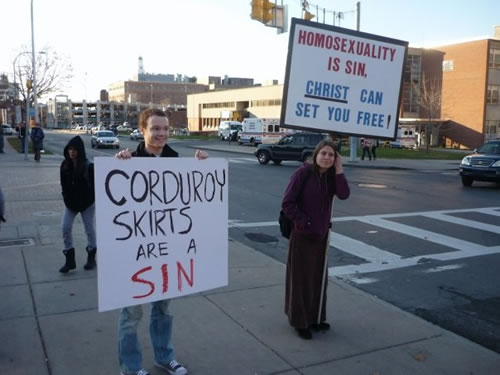
The issue of ‘homosexuality’ is probably one of the more heated social issues facing the contemporary Church.  Among different denominations (and even within single denominations) the issue divides on a scale from peaceful disagreement to violent hatred.  Perhaps the most visible and widely despised of these positions is illustrated by the antics of the Topeka, Kansas-based Westboro Baptist Church and their signature slogan: ‘God Hates Fags’.

Needless to say, this is a MASSIVE conversation in the Church and society at-large.  Unfortunately the debate within the Church—the topic of this post—frequently results in an ever-divergent hatred for the opposition.  One view (we’ll call it ‘Perspective I’ to avoid confusing, overused and unhelpful ‘conservative’ vs. ‘liberal’ labels) essentially believes that the Church and the Scripture attest to the opposition of LGBT+ people in the kingdom of God.  In this view God has designed sexual relationships to take place in a particular way – in other words, heterosexually.  This is often supported with social and psychological analyses of homosexuality in Western culture.  The ‘slippery slope’ is often appealed to here, concerning the possibility in a culture that grows more accepting of ‘public homosexuality’.  An example of how this view sees homosexuality adversely affecting the Church follows: same-sex marriage is made fully legal, churches will lose tax-exempt benefits for teaching portions of Scripture that seem to attest to the prohibition of homosexuality in the kingdom of God and ultimately conservative priests will be prosecuted and imprisoned for merely teaching what the Church has generally held to for nearly two-thousand years.

Another view (which we’ll call ‘Perspective II’) essentially believes that the Church is mistaken and that the Scripture is not explicitly clear regarding sexuality, often appealing to socio-historical evidence for the manner in which homosexuality was practised in the Scripture’s first-century-Roman context.  In this view homosexuality is not generally considered a choice, but a specific sexual orientation that defines a significant part of what makes an individual an individual.

There are numerous positions around and about these two views (including two views based upon the assumption that homosexuality is natural – one view holding that LGBT+ people are called to celibacy in the kingdom of God while the other holds that homosexuality is natural and should be openly embraced in the kingdom of God) and it is would be impossible to explore them all, but I believe we’ve got a moderate sample of the two major ‘sides’ of this argument within the Church in Perspectives I and II.

One interesting thing I feel the need to point out is the general historical oppression of non-heteronormative people in Western society.  Even today, with the elimination of laws prohibiting homosexual practise in Western countries (though these are still quite present in many nations today), massive stigmas and stereotypes are used to oppress LGBT+ people.  In my experience I have heard many-a-Christian rants on how homosexuality has ‘infiltrated our culture’ and is being used to ‘pervert our youth’.  That’s a very loaded assessment. I am generally sceptical of such sweeping statements regarding a group of people who by and large don’t even have the legal right to marry in the vast majority of American states.  Homophobia is rampant and this (like other forms of xenophobia) oftentimes leads to very aggressive mistreatment of LGBT+ people.  Even the recent claim by Cardinal Bertone that homosexuality was to blame for the Catholic abuse scandals ignored the fact that many of the abused were in fact females (and also that the large number of males abused might be a result of the general pairing of girls with nuns and boys with priests in schools) in exchange for trying to oppressively pin the failure of the Church on a whole people group.

My honest opinion is quite open in general, although my tendency is to lean toward Perspective II.  Whilst I hold Church tradition in high esteem, the Church has certainly been wrong in the past with numerous issues and our trusty Nicene Creed makes no mention whatsoever concerning the nature of sexual relationships in the kingdom of God.  For now I merely want to pose two brief lines of questioning to the two main camps on either side of the issue of homosexuality.  These questions are not meant to pull the rug out from either side, but to promote a more compassionate and gracious way of thinking about the debate.  I do not necessarily agree with each one of these questions on either side, but they seem to be valuable things to address.

Perspective I

  • Is it possible that in the Church, homosexuality, if considered a sin, is often treated very differently than other issues that are considered sins (even other sexual sins) in an unfair manner?
  • In Mere Christianity, Lewis argues that the nature of particular sins can make them more or less cancerous within the Church.  For instance, pride involves sinfully elevating oneself above another.  Is it possible that an egotistical zealot might be more divisive and harmful to the community of a local church than a homosexual couple in a committed relationship?
  • Can the few passages in Scripture that are often associated with anti-homosexual views be interpreted in any other manner?  What are we to make of the lack of teaching regarding homosexual relationships in the teaching of Christ found in the Gospels?  Let me stress that I do not believe that these issues alone make or break Perspective I (the general tradition of the Church might be able to provide some added strength to this view), but I do believe that these possibilities might serve to soften the tone of Perspective I.

Perspective II

I have many thoughts on these issues, but I’ll cease my questions and open up the discussion.  What I hope and pray for in this conversation is mutual respect and beyond everything else, love and compassion.  Profound love is what ought to characterise the words, thoughts and actions of a member of the kingdom of God who has been profoundly confronted by the immense grace and love of God as demonstrated in the life, death and Resurrection of Christ and the advent of his holy and inviting Church.

There are many good thoughts and perspectives on either side of this debate.  Please share your input, but take care to use gracious language and to neither demonise nor dehumanise the opposing perspective or your comment may be deleted.  I am not demanding that everyone shares my views or that no one holds firmly to his/her own view—I encourage you to share your convictions with a loving and gracious passion.

We believe in one God, the Father All Governing, creator of heaven and earth, of all things visible and invisible;

And in one Lord Jesus Christ, the only-begotten Son of God, begotten from the Father before all time, Light from Light, true God from true God, begotten not created, of the same essence as the Father, through Whom all things came into being, Who for us [humans] and because of our salvation came down from heaven, and was incarnate by the Holy Spirit and the Virgin Mary and became human.   He was crucified for us under Pontius Pilate, and suffered and was buried, and rose on the third day, according to the Scriptures, and ascended to heaven, and sits on the right hand of the Father, and will come again with glory to judge the living and dead.  His Kingdom shall have no end.

And in the Holy Spirit, the Lord and life-giver, Who proceeds from the Father, Who is worshiped and glorified together with the Father and Son, Who spoke through the prophets; and in one, holy, catholic and apostolic Church.  We confess on baptism for the remission of sins.  We look forward to the resurrection of the dead and the life of the world to come.  Amen.

(Creed taken from John H. Leith (ed.), Creeds of the Churches [Louisville: Westminster John Knox Press, 1982], 33.)

Read more of Imaging the Kingdom.

An added treat:

[Greg adds: One more?]