Imaging the Kingdom II: Orthodoxy vs Orthopraxy

I believe that Greg and I were exercising a subconscious experiment to see if we could go the entire month of May without a post, but I am pleased to continue the Imaging the Kingdom series.

The terms ‘orthodoxy’ and ‘orthopraxy’ are tossed around a lot in contemporary Christian circles.  Among Protestants, two groups seem to gravitate toward one or the other: Emergents (Post-modern Christians) toward orthopraxy (emphasising the practise of religion) and Evangelicals toward orthodoxy (emphasising the belief of religion).  It might seem obvious to you, my beloved readers, that any branch of Christianity that is given over to one of these two positions exclusively is incredibly weak.  Perhaps you’re not so convinced that both are absolutely essential to members of the kingdom of God (which they are) or you want to explore how the two relate to one another in the kingdom of God (like me).  This is a long conversation that goes back through the centuries.  It seems that within the Church people are often reacting to one side, then to the other.  This is especially evident since the Protestant Reformation, which I will expound [crudely for the sake of brevity].

In his Ninety-Five Theses (written in 1517 – the document that sparked the Protestant and Catholic Reformations, essentially) Luther argues against clerical abuses and states explicitly that both outward and inward repentance is important.  Luther believed—and I would say believed rightly—that the Church was abusing authority primarily with regard to specific gifts to the Church (indulgences) that were being used to fund the building of the papal palace.  In return for these gifts, people were given pardons from certain amounts of time in Purgatory (as is the purpose of indulgences in the Catholic tradition).  In his Theses Luther also argues against the demotion of the Scripture in Church worship for the sake of things like said pardons.  At the time, it was not Luther’s intention to break away from the Roman Church, but to reform it.  Still, Luther’s refusal to back down from his increasingly hostile criticisms against the Catholic Church brought about his excommunication in 1521.

Perhaps the most enduring aspect of Luther’s teachings in the Protestant world involves his principles of sola fide (‘by faith alone’), sola gratia (‘by grace alone’) and sola scriptura (‘by Scripture alone’).  Luther was convinced that the Church had drifted from the Pauline teaching of salvation by faith in Christ alone, instead opting for additional works in order to ‘acquire salvation’.  The Council of Trent (1545) made clear the belief in the Catholic Church that it was exclusively by God’s grace that salvation came to the believer, but by this time the teaching of Luther and the reformers that followed after him had done its damage.  One of the central tenets of the ‘Lutheran view’ is that the epistles of St Paul dealt with the issue of the Jewish understanding of ‘salvation by works’ (a controversial notion that I believe is an inaccurate read of both Second Temple Judaism [6th century BCE to the 1st century CE] and the writings of Paul).  When Luther looked at Paul’s writings he saw his situation (a Christian dealing with the false teachings of an established religion based upon salvation by works) coupled with Paul’s dealings with the ‘Judaisers’.  As a result of this interpretation, the Lutheran and Reformed traditions have always possessed what some might consider to be a disproportionate aversion toward the concept of ‘works’.  Luther’s view has been criticised by those that hold a more traditional view and the recent work by Protestants like  Krister Stendahl, E. P. Sanders, James Dunn and Tom Wright (the ‘New Perspective on Paul’), which in itself is a 20th century reaction to the Protestant Reformation.

As the Protestant Reformation made its way across Europe, it opened the door for the replacement of the feudal social system with a more mercantile (eventually capitalistic) social system.  The Enlightenment came to pass, which generally pressed that the right beliefs (essentially by way of right logic) precede right actions.  In the late 18th and early 19th centuries The Romantic and Counter-Enlightenment movements reacted against the Enlightenment, stressing the inadequacy of bare logic and doctrine.  Friedrich Schleiermacher played an important role in the intellectual history of Europe at this time.  He held that experience was to inform doctrine.  Theological liberalism followed Schleiermacher and dominated Western Christianity for the next century.

In the early 20th century we see the birth of Modernism and WWI.  Karl Barth, reacting against the endorsement of the Weimar Republic’s expansionistic ambitions by his liberal theological mentors, rejected the conclusions of Schleiermacher.  Barth, inspired by Hegel and Kierkegaard, instead proposes a dialectic approach in which the unknowable God has revealed Godself in Jesus Christ and it is through Christ alone, the Word of God, that a Christian might experience God.  Modernism pressed forward after the First World War, critiquing orthodoxy, which prompted the Fundamentalist Evangelical reaction.  This movement made way for the surge in popularity of the Restorationist Movement (emphasising ‘proper’ action) and the anti-intellectual Jesus Movement (emphasising ‘correct’—though not necessarily orthodox—beliefs).

Post-modernism has found expression in the Emergent Movement, which emphasises ‘belonging before belief’, prompting yet another Evangelical reaction emphasising ‘belief before belonging’.  In reaction to this whole mess we also have those who try to hold onto something universal and unchanging – ‘Ecumenists’, like me.

In looking very briefly at some Western intellectual history over the last 500 years I hope to have not offended too many readers.  If you feel my incredibly brief summary has not treated your views equally I apologise profusely and ask that you would please comment if you’d like to add something relevant – I might have more detailed reasons for much of what I did write and we can engage in an enlightening (excuse my language) dialogue.

So where are we now?  We’ve determined that [Protestant] Christians have shifted frequently between emphases on orthodoxy and orthopraxy.  We’ve also determined that two prominent Protestant movements are currently in conflict over this very issue.  What does the Gospel of the kingdom of God have to say about these two things?

We can look to Scripture for some insight, but I quickly want to express a few things with regard to Scripture.  I believe that it is essential to acknowledge that Scripture was written by different people at particular points in time, in particular geographical locations, for particular reasons.  This is not to say that the Scripture has become entirely inaccessible to anyone in our present age.  I believe that God has given the Church authority and therefore as a product of the Church, the Bible has authority.  God is also a living and active God and the Holy Spirit of God can provide guidance and insight in our explorations, potentially.  Still, the Scripture is not a treatise on everything – that is not its purpose.  I believe a sure way to orient ourselves in order to see the world (and this issue of orthodoxy vs. orthopraxy) in light of the kingdom of God we must look toward our example of proper living in the kingdom of God: Jesus of Nazareth.

With regard to the life of Christ, the primary focus of Christian tradition and the Scripture is the three-year period leading up to his death and Resurrection.  This is considered Christ’s public ministry.  When we look at Christ’s ministry, what is it characterised by?  Do we see an exclusive emphasis on orthodoxy?  What about orthopraxy?  It is quite clear that Christ valued both things and didn’t paint one especially important over the other.  Instead it is more of a process.

Some might say that works are necessary for a member of the kingdom of God.  I would say that works are inevitable for a member of the kingdom of God.  We do not enter the kingdom by our works, neither do our good works merely demonstrate that we are part of the kingdom.

I actually propose that our good works are a reaction in themselves, a reaction to the grace of God through the Gospel.  Some might say, sceptically, “Oh great, the obscure ‘Gospel’ card again,” as if it is some inexplicable and abstract notion.  Others might argue that this emphasis on the Gospel seems to imply a preeminence of belief over works.  It is true that the Gospel is composed of data in part – historical facts regarding the actions of God, culminating in the death and Resurrection of Christ and the advent of the Church.  But instead of viewing the Gospel as brute facts, I would rather see it as something we perceive with our whole being.  We do not merely hear its words and think, ‘I believe that.’  The Gospel is the effective power of God through the Holy Spirit and the invitation to participate in the redemptive mission of the creator of the universe as members of God’s family, the Church.  Therefore I would see this reaction to the Gospel not as a reaction to bare facts or experience, but the entirety of what it is to begin to comprehend the grace of God for the creation.

The God of history has entered into history and has redeemed all things, visible and invisible, and in this we cannot see a serious Christian faith without a balance of orthodoxy and orthopraxy.  In other words, Christianity is not merely about doing the right thing or believing the right thing.  Perhaps Christianity is more about doing the right thing based upon the right motives.  It is an active faith, that does not exclusively demand our beliefs, nor does it exclusively demand our actions – it demands all that we are, visible and invisible.

We believe in one God, the Father All Governing, creator of heaven and earth, of all things visible and invisible;

And in one Lord Jesus Christ, the only-begotten Son of God, begotten from the Father before all time, Light from Light, true God from true God, begotten not created, of the same essence as the Father, through Whom all things came into being, Who for us [humans] and because of our salvation came down from heaven, and was incarnate by the Holy Spirit and the Virgin Mary and became human.   He was crucified for us under Pontius Pilate, and suffered and was buried, and rose on the third day, according to the Scriptures, and ascended to heaven, and sits on the right hand of the Father, and will come again with glory to judge the living and dead.  His Kingdom shall have no end.

And in the Holy Spirit, the Lord and life-giver, Who proceeds from the Father, Who is worshiped and glorified together with the Father and Son, Who spoke through the prophets; and in one, holy, catholic and apostolic Church.  We confess on baptism for the remission of sins.  We look forward to the resurrection of the dead and the life of the world to come.  Amen.

(Creed taken from John H. Leith (ed.), Creeds of the Churches [Louisville: Westminster John Knox Press, 1982], 33.)
Imaging the Kingdom I: Foundations of the kingdom of God

Since I converted to Christianity in my teens I have been continually exploring what it means to be a Christian.  In my experience I have become increasingly convinced that Christianity hinges upon one major theme: the kingdom of God.   It is used throughout the Christian tradition and is referred to throughout the Scriptures many times (oftentimes referred to as ‘the kingdom of heaven’).   The phrase can be picked apart from many sides, but I believe that its general implications are as follows:

  1. God is the king of the kingdom
  2. The kingdom of God is both visible and invisible
  3. To be a Christian is to be a citizen or member of the kingdom of God

In the Christian tradition, these implications, while very basic, are indispensible.  This series, Imaging the Kingdom, is intended to explore the nature of the kingdom of God and its implications in the universe, and therefore in our world and in the lives of all Christians.  It must be noted that this exploration is inevitably non-exhaustive – we will explore why later.  First we will briefly analyse these three implications.

1. God is the king of the kingdom

The kingdom of God is the most important theme in the Christian tradition (and arguably the other two Abrahamic religions: Judaism and Islam).  The natural head of any ‘kingdom’ is the ‘king’.  To say that God is the king of the kingdom of God is to say that God is the ruler of the kingdom, a rightful monarch without equal.  All authority and power in the kingdom of God belongs to God.

2. The kingdom of God is both visible and invisible

In my experience I have noticed that oftentimes conversations about the kingdom of God (if the kingdom of God is spoken of at all) revolve around the ‘already but not yet’ nature of the kingdom of God.  There are real issues affecting how we experience the presence of the kingdom of God in this age, the Church age.  The orthodox Christian understanding is that throughout history God has been extending his reign over a fallen universe that has rejected his reign.  This extension has taken its most dramatic leap forward in the life, death and Resurrection of Jesus Christ.  Since (and through) that event, God has established his Church on earth, empowered by the Holy Spirit to live out what it means to be in the kingdom of God, which we will talk more about later.  There is an element (or are elements) of the kingdom of God that is not yet present, something made especially evident in the Christian experience.  The expectation of Christians throughout history is that God will bring about the fullness of the kingdom of God at some future point in the second coming of Jesus Christ.  This is what is meant in the ‘but not yet’, and while the discussion of what is ‘not yet’ is necessary, the primary focus of this study will be that which is ‘already’.  I use the language ‘visible and invisible’ as it is written in the Nicene-Constantinopolitan Creed of 381 CE, which I consider the most fundamental and comprehensive ecumenical (general) Church creed:

We believe in one God, the Father All Governing, creator of heaven and earth, of all things visible and invisible…

Even in this first section of the Creed we see our first two implications (1. God is the king of the kingdom; 2. The kingdom of God is both visible and invisible).  The language of the Creed is helpful because it seeks to paint a very clear and concise picture of the orthodox Christian faith.  The words ‘visible and invisible’ help us to see the overarching nature of the universe and God’s reign of that universe.  Orthodox Christian theology does not paint the universe in a dichotomy of ‘physical’ and ‘spiritual’.   Throughout the ages, this dualism has caused countless conflicts that have been deemed heretical.   Indeed, to see humans or the universe as split into ‘physical’ and ‘spiritual’ conflicts with the way that God has both created the world and redeemed it – holistically.  God is not interested in creating a physical world just to destroy it.  The Incarnation and the life, death and Resurrection of Christ point to a God who created unified, holistic beings, whose nature is fully understood in unified, holistic terms.   As St Paul writes in 1 Corinthians 15, Christ’s bodily Resurrection is “the first fruits” of “those who belong to Christ.”  The kingdom of God is not a disembodied spiritual kingdom, but it is the reign of God over all things that he has created and deemed good, both ‘visible and invisible’.

3. To be a Christian is to be a citizen or member of the kingdom of God

Because of the first two implications of the kingdom of God, that God is the king and that the kingdom is universal, to be a Christian is to be a part of that kingdom.  We cannot understand any part of what it means to be a part of that kingdom without understanding first that God is the king of said kingdom and that this kingdom is universal; all other implications of the kingdom of God hinge upon these principles.

The inevitable imprecision of our talk about God and his kingdom: ‘Imaging’

Since Christians are members of the kingdom of God, subjects as to a monarch even, it serves us well to learn, rehearse and enact what that means for the way we live and think.   Unfortunately we face one significant roadblock: God himself.   I’ve been writing, “God is this” and “God is that”, but as the seminal twentieth-century Reformed theologian Karl Barth reminds us time and time again, God is entirely ‘other’.  What is meant by this is that God as a being is distinct from his creation and while he has invested into his creation through Christ, the Holy Spirit and the presence of the kingdom of God, in trying to talk about God we will inevitably be imprecise.   This might seem discouraging, but I can’t tell you how pleased I am that I haven’t figured everything out in my early twenties!  The comfort rests in the fact that God is gracious.

God has been gracious to us through giving us his Son, Jesus Christ, who not only demonstrates to us what it is to be fully human (an implication of the kingdom of God we will save for another post) and what it is to live in the kingdom of God, but it is Christ himself who is the revelation of God to us.  It is through an active conversation with God as his Church that we learn more and more what it is to be that very thing: God’s Church.  Because of this inevitable imprecision, I find that looking at the Christian life from the perspective of the orthodox understanding of the Gospel is our most reliable source, as it is concrete enough to transform our lives, while remaining very open to conversation and interpretation.   In such a way we are ‘imaging’ the kingdom of God, developing ways to talk about God and his kingdom that effectively inform the way that we live.  Having this ‘imaging’ perspective also encourages a fruitful conversation between all Christian traditions, helping us to be unified and effective in living out the kingdom of God in this world as one Body, the Church.

As we explore the kingdom of God in this series, addressing issues like culture, politics, theology (yes, our theology should be informed by other theology), etc., I hope that it is intellectually stimulating, but most of all I hope that God uses this conversation to transform our lives via the Holy Spirit in order to love God, other people and the world we live in more and more.  The Nicene-Constantinopolitan Creed:

We believe in one God, the Father All Governing, creator of heaven and earth, of all things visible and invisible;

And in one Lord Jesus Christ, the only-begotten Son of God, begotten from the Father before all time, Light from Light, true God from true God, begotten not created, of the same essence as the Father, through Whom all things came into being, Who for us [humans] and because of our salvation came down from heaven, and was incarnate by the Holy Spirit and the Virgin Mary and became human.   He was crucified for us under Pontius Pilate, and suffered and was buried, and rose on the third day, according to the Scriptures, and ascended to heaven, and sits on the right hand of the Father, and will come again with glory to judge the living and dead.  His Kingdom shall have no end.

And in the Holy Spirit, the Lord and life-giver, Who proceeds from the Father, Who is worshiped and glorified together with the Father and Son, Who spoke through the prophets; and in one, holy, catholic and apostolic Church.  We confess on baptism for the remission of sins.  We look forward to the resurrection of the dead and the life of the world to come.  Amen.

(Creed taken from John H. Leith (ed.), Creeds of the Churches [Louisville: Westminster John Knox Press, 1982], 33.)

Exercise in Love

The present Western culture is largely ‘post-Christian’, fed up with the tired dogmas of the past.  One common mistake made by the Christian community is to try to revamp the relevance of Christianity through massive immersion.  The thought is (in an admittedly crudely-reduced form) that if we flood the world with Bibles and ‘the Gospel message’, the Christian community will finally end up back on top, like the idyllic golden age during which God was the ruler of the world.  Unfortunately the Christian ideal has never been a part of reality.  People may look back at post-war America in the 1950s and conclude, “That was a good time.  People were decent.  It was the 1960s that brought about our current distress.  Abortion, homosexuality and the utter moral corruption of Western society.”

It is not my attempt to provide a thorough analysis of Western society since World War II, but I will point out that the heart of Christianity has never been about this set of morals, morals defined and packaged for Evangelical Christians by the Religious Right in the 1980s.  The principal response of the Christian community seems to be pointing the finger.  In his book, The Post-Christian Mind, Harry Blamires tends to point out that the problems facing the Christian community during this time are not the fault of the Christian community itself.  He writes,

If we are to examine from the inside the machinery of contemporary error, we must step outside of our theological skins.  Everything that gives shape and meaning to our conception of the span of human life derives from a system of beliefs that the post-Christian mind rejects.  The Christian finds the ultimate meaning of things outside time, outside the boundaries of our earthly human career.

(Harry Blamires, The Post-Christian Mind [London: SPCK, 2001], 3.)

I’m afraid that Mr Blamires is mistaken on several counts.  As the rest of his book points out, he generally defines “Everything that gives shape and meaning to our conception of the span of human life” as a set of morals based upon family values.  For instance, he harps on the attack against the sanctity of marriage.  While I agree that the value of marriage has been greatly reduced in Western society, I believe that the Christian community is largely at fault.  By this, I mean that the Christian community has not demonstrated a great apologetic for marriage, giving no standard by which to critique the ‘secular’ tendency to divorce.  My second main issue with Mr Blamires’ words has to do with a general presupposition concerning the utter ‘otherness’ of the Christian life, one in which we find “the ultimate meaning of things outside time, outside the boundaries of our earthly human career.”  While God is most certainly greater than our realm, God is also very present and committed to time and space, which is most fully demonstrated in the Incarnation, the giving of the Holy Spirit, the advent of the Church and the rapid expansion of the universal kingdom of God.

Still, this tendency toward perceiving ourselves so fully identified with this ‘otherness’ helps the Christian community to embrace a false sense of exile.  In such a way, the Christian can justify societal rejection based upon the life of Christ.  Michael Frost in his book Exiles: Living Missionally in a Post-Christian Culture, writes,

I suspect that the increasing marginalization of the Christian movement in the West is the very thing that will wake us up to the marvellously exciting, dangerous, and confronting message of Jesus.

(Michael Frost, Exiles: Living Missionally in a Post-Christian Culture [Peabody, MA: Hendrickson, 2006], 9.)

This is very close to what I think we need to hear, but the language of ‘exile’ is too heavy-handed.  Frost is very glad to leave what he considers the “Christendom era”.  To set ourselves apart from the Christian tradition and to adopt what we consider to be ‘the message of Christ’ is dangerous.  This is a mistake primarily because ‘the message of Christ’ is convoluted, and if we limit this message solely to the Scripture (as is by-and-large the practice of Protestantism) we undermine the very nature of Scripture.  Scripture was not given to the Christian community as a tool by which we can live without the Church.  That old Lutheran ideal, Sola Scriptura simply does not account for the robustness of the Christian presence throughout history.  We are dealing with a living God and a living Church.

While Christianity is something very contrarian, we cannot accept that we are so holy and counter-cultural that exile is a result of our ‘doing things right’.  The Christian community could do well by listening to the culture in a self-critical way.  Unfortunately, I believe that this can be done wrong.  In fact, I believe that the Christian community is experiencing its present dilemma because it has been taking the things of God, the way we rehearse the Gospel, the way we understand our role in this world, and severely altering it based upon our preconceived notions of how things should be.  For instance, during the time of the Reformation, Calvinists began to wear black, not initially to express modesty, but to align the clergy with academia, showing that the Reformed priests were educated, unlike the Catholic priests who wore colourful vestments based upon the seasons within the Church year.

Changing our faith based upon preconceived notions has had far more adverse effects than the clerical wear of the Reformers, the most tragic of which I believe is the castration of the Gospel.  What I mean by this is that the far-reaching effects of the Gospel have been greatly minimised in order to attend to the desires of Western culture.  The culmination of Christ’s life, death and Resurrection has moved from an incredible cosmic event in which the transformation of the universe was initiated and the Church created and redeemed into a hyper-individualistic ticket to a spiritual heaven paradise.  Was not the God of the Nicene Creed the God who created all things, visible and invisible?

Christianity is not a set of morals, it is not a set of mental suppositions and it is not a social programme – it is God’s transformative initiative in the universe, the Gospel.  The Gospel is therefore the heart of Christianity and the heart of the Gospel is love.  Perhaps the primary reason why Christianity has experienced such a drop in public sentiment is because love, and consequently the Gospel, has been corrupted and is void of much of its usefulness.  Now, I will neither deny the sincerity of the entire Christian community nor the power of God as demonstrated through even the most meagre of Gospel proclamations.  We are fortunate that God is far more powerful and mysterious than our systems of belief, no matter how informed or refined.

What I am going to propose will not change the fact that God is far more than we comprehend on a daily basis, but I do hope that, as should be the case in any theological endeavour, this exercise will serve to draw us as the Christian community closer to the heart of God and his mission to the world.  His mission is not one of ‘add-ons’.  Being a Christian is not an ‘app’ one can purchase for their iPhone.  Being a Christian is neither a new t-shirt nor a whole new wardrobe.  Being a Christian is a radical transformation and orientation toward the will of God.

Love is the central tenet of the Gospel – God loves the universe they created.  The existence of anything is contingent upon the grace and love of God and for us God demonstrated this love most tangibly through the life, death and Resurrection of Jesus Christ.  Throughout the whole of Scripture God demonstrates his love, and Christ, when asked by a Pharisee, “Teacher, which commandment in the law is the greatest?” responds, “‘You shall love the Lord your God with all your heart, and with all your soul, and with all your mind.’  This is the greatest commandment.  And a second is like it: ‘You shall love your neighbour as yourself.’  On these two commandments hang all the law and the prophets.”  (Matthew 22:34-40, NRSV)

In theory, the Christian community accepts most of these things with open arms, but the magnitude of what ‘love’ means is where the real weakness of the present Gospel takes shape.  Perhaps a more revealing passage is found in the Sermon on the Mount,

You have heard that it was said, ‘You shall love your neighbour and hate your enemy.’  But I say to you, Love your enemies and pray for those who persecute you, so that you may be children of your Father in heaven; for he makes his sun rise on the evil and on the good, and sends rain on the righteous and on the unrighteous.  For if you love those who love you, what reward do you have?  Do not even the tax collectors do the same?  And if you greet only your brothers and sisters, what more are you doing than others?  Do not even the Gentiles do the same?  Be perfect, therefore, as your heavenly Father is perfect.

(Matthew 5:43-48)

A pious Christian might call out an “Amen!” without thinking twice about this passage, but I believe a more honest response might be, “Oh shit, we’re doing it wrong.”

Indeed, the love of Christ is not some half-hearted commitment not to hate.  The Christian community has a propensity to take the positive commands of God and turn them into negative commands.  Instead of this radical calling ‘to love everyone’, we turn it into a meagre calling ‘not to hate anyone’.  Even then we must weaken our definition of hate and say, “Well I don’t hate anyone, I simply dislike some people.”  Whether we define our lack of love as ‘hate’ or ‘dislike’, we are still missing the point – we are called to love.

But we must also understand that the love of Christ is a very complex thing.  God does not suspect that we will master his greatest commandment with relative ease.  To love in the way that the Christian community is called to love involves a daily dependence on God’s strength and guidance by way of the Holy Spirit.  We can hardly even begin to imagine what it is to love in the way that God demonstrated through Christ.  Even on the Cross in the midst of his persecutors tradition maintains that Jesus requests of his ‘heavenly Father’, “forgive them; for they do not know what they are doing.”  (Luke 24:34)  Jesus’ love is a radical love, and it was a love that brought about massive transformation: reconciliation between God and people (‘love your God’), reconciliation between people and other people (‘love your neighbour’; ‘love your enemy’), reconciliation within individuals toward themselves and reconciliation between people and the creation.  The greatest commandments can summarise this grand reconciliation.  If we love God in the freedom granted by the work of Christ we will love the entirety of the creation because God has created, loved and redeemed it.  This holistic reconciliation in the Gospel can be used to counter the neo-Gnostic trajectory of contemporary Christianity.

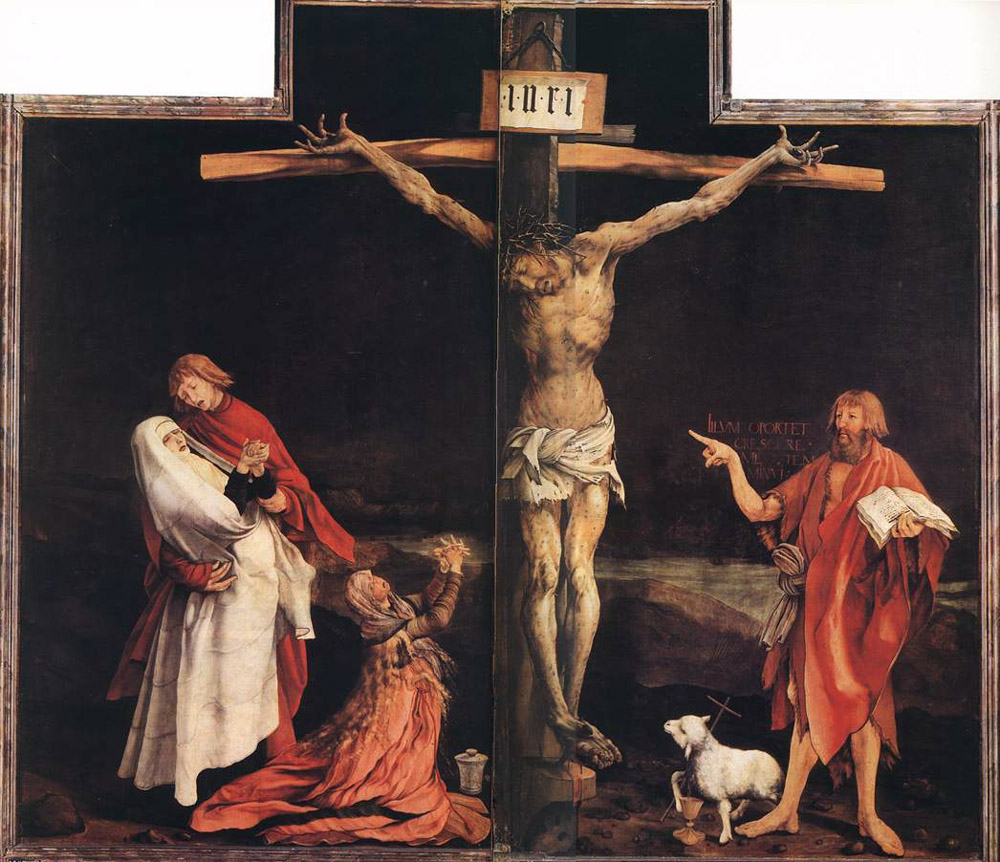
When considering the implications of these reconciliatory principles, the unfathomable depth of the love God has for us and the love that God has called the Christian community to, I believe that a it is a good exercise to seek to see it all from the perspective of the Cross.

Grünewald’s Isenheim Altarpiece (1512-1516), Unterlinden Museum, Colmar

+++++

When your parents have failed you miserably

Remember Christ’s love on the Cross.

When a friend betrays you

Remember Christ’s love on the Cross.

When a co-worker spreads a rumour about you

Remember Christ’s love on the Cross.

When a stranger cuts you off on the road

Remember Christ’s love on the Cross.

When you see the unhoused person on the street

Remember Christ’s love on the Cross.

When someone succeeds as you fail

Remember Christ’s love on the Cross.

When your significant other does not see your point of view

Remember Christ’s love on the Cross.

When your child disobeys you

Remember Christ’s love on the Cross.

When you give into the temptation yet another time

Remember Christ’s love on the Cross.

In all things

Remember Christ’s love on the Cross.

Be transformed by Christ’s love on the Cross.

+++++

Exploring and employing the implications of God’s love is an eternal task, but I end this post with these thoughts: To be a Christian is to be a subject in God’s kingdom and to be a subject in God’s kingdom requires one thing: robust obedient love.  This world can only ever benefit from more love.  Nothing in this world ever went bad nor will anything ever go bad because there was ‘just too much love’.

Nihilo sanctum estne?

I recall when the first iPod came out in 2001.  It was revolutionary – 1000 songs on a portable and extremely attractive hard drive!   Less than two years after the release of the iPod, Apple launched the iTunes Store.   It was one thing to fit [a portion of] your CD collection onto an iPod, it was another to be faced with the reality that said CDs were no longer useful; one can simply purchase and download digital files which would be synced up with your iPod in minutes.  One need not drive to the record store only to find out that the record they intended to buy was no longer in stock (and would, say, Best Buy even carry a Danielson record?!).  Soon the iPod (or any MP3 player for that matter) would be easily adaptable to all settings: one’s car or one’s living room, through a portable stereo in the park or strapped to one’s arm during a workout.  The sale of CDs has steadily dropped since the introduction of the iPod and similar devices and CDs are quickly becoming a thing of the past.

Although I often despise the association, I am of the CD generation.  My family made excessive use of cassette tapes (especially my father’s Van Halen and Eric Clapton and my mother’s Fleetwood Mac and The Beach Boys), but CDs were around for four years before I was even born.  I remember my first two CDs: Weezer’s first self-titled record (aka The Blue Album) and Mellon Collie and the Infinite Sadness by The Smashing Pumpkins.   Since then, my collection has grown considerably.  Still, even with the hundreds of CDs I’ve collected over the last fifteen years, I can fit four times as many on my 120 GB iPod.  With services like iTunes, eMusic, Lala, Amazon, etc., complete MP3 albums can be downloaded for a fraction of the price of a new CD, and unless one has some high-end headphones or a high-end stereo system (a lot of $, £, €, ¥,…) the difference between a standard MPEG audio file (160 kbps) and a standard CD (1200 kbps) is rather unnoticeable.

With all of this technological allure some people are still unsettled by the change.   I myself prefer to have the album in my hands because I appreciate creative packaging design to a near-obsessive degree.  Any look inside a [post Pablo Honey] Radiohead album booklet would quickly convince one of the inferiority of an exclusively digital musical experience (even such an experience with a picture of an album cover on a computer screen).   And while we already have the platform for digital music (computers and MP3 players) couldn’t we save on so much physical consumption by switching exclusively to digital music?   Even when considering environmental issues like the possibility reducing the production of plastics and paper, I find this option difficult to stomach for the same reason that I find digital books difficult to stomach.   There’s something to having a physical CD/package and a physical book in one’s hand…or is there?

Mass production of recorded music didn’t exist until about a quarter of the way into the 20th century.   At that time the vinyl phonograph record was the standard and it could only play from two-to-three minutes of music per side.  By 1949, vinyl records were in 12-inch LP (45-minute long play) form.  This became the standard length of a record.  Eventually this was followed by the use of magnetic tape: the 8-track cassette in the late sixties and early seventies followed by the compact cassette, which could generally play up to 45 minutes of music.

In a recent interview with Paste, Sufjan Stevens expressed his own crisis with regard to this whole shift in the way we can experience music:

I’m wondering, why do people make albums anymore when we just download?  Why are songs like three or four minutes, and why are records 40 minutes long?  They’re based on the record, vinyl, the CD, and these forms are antiquated now.  So can’t an album be eternity, or can’t it be five minutes? … I no longer really have faith in the album anymore.  I no longer have faith in the song.

Perhaps we find ourselves in this crisis with Sufjan, but while he remains skeptical, I remain hopeful.  From 2006 to 2007, vinyl record sales jumped more than 85%, and from 2007 to 2008 vinyl record sales jumped another 89%.  Yes, collecting vinyl records is extremely trendy and hip at the moment, and yes, when these hipsters accidentally become parents or are forced into real life via some other circumstance they might realise that investing their money in vinyl records solely for the propagation of their hipster image is not very hip after all.  But I still believe that these market figures are indicative of a basic human need for ritual and tradition of some sort.

It is true that there is nothing particularly sacred about the length of an LP or a cassette or a CD, but does the freedom of the age of digital music distribution and consumption require that we abandon the [recent] traditions we’ve grown up with?   Just because the technology moves along and just because we move along with it doesn’t mean that we can’t slow down and savour the beauty and simplicity of the traditional way we experience recorded music, packaging included.  After all, music is art and art is aesthetic and aesthetic is beauty and beauty, as Kant has defined for us in the Third Moment of his Critique of the Power of Judgment, “is the form of the purposiveness of an object, insofar as it is perceived in it without representation of an end.”

I see great correlations between this issue, ritual, and Church tradition, but that’s for another post.

[Elijah adds: Pet Sounds added to Listening]

Chiming in on Palin

Expressing my objective journalistic intentions with this favourable press shot of Mrs Sarah Palin

Former Alaskan Governor and Republican Vice Presidential nominee Sarah Palin has been the primary topic of discussion (courtesy of Mark) in three different posts on Criticism As Inspiration thus far:

I remained rather silent (for the most part) regarding my specific views of Sarah Palin.  One might assume that because I typically espouse views that lean toward the left to varying degrees that I despise Palin on the grounds that she is a conservative.  That is simply not so.  Frankly, there are plenty of conservatives that I am far less irritated by.  It is not my goal to lay out with great detail why I have this distaste for Palin, but I will mention several specific things, beginning with the ‘straw that broke the camel’s back’ and inspired this post.

Just this week President Barack Obama accepted the Nobel Peace Prize in Oslo.  Sarah Palin was interviewed by USA Today regarding his acceptance speech.  Several news outlets (including USA Today) have expressed shock at Palin’s comment, “I liked what he said.”  Unfortunately this comment was quickly overshadowed and devoid of all value with the follow-up comment:

I thumbed through my book quickly this morning to say ‘Wow!  That really sounded familiar.’  Because I talked in my book too about the fallen nature of man and why war is necessary at times.

Of course.  I must make sure that this is known: my grievance has nothing to do with my negative view of war.  I could criticise that (and I do, not only against Palin, but also President Obama), but I must acknowledge the very broad acceptance of ‘Just War Theory’ (which was espoused both in Obama’s acceptance speech and Palin’s comments).  The issue that I take with Sarah Palin’s comments revolve around her self-referential statements, which have become extremely familiar.  Ever since she emerged onto the national political scene and into public’s eye it seems as if she has been shamelessly selling herself – and it’s getting really old.  Palin went on to say that President Obama should behave more like President George W. Bush.

We have to stop those terrorists over there…We’ve learned our lesson from 9/11.  George Bush did a great job of reminding Americans every single day that he was in office what that lesson is.  And, by the way, I’d like to see President Obama follow more closely in the footsteps of George Bush and [Bush’s] passion keeping the homeland safe, his passion for respecting – honoring our troops.

I can hand the benefit of the doubt to Palin and assume that this interview was rather off-handed, but could she please use slightly more sophisticated language when speaking about such serious issues (“those terrorists over there…”).  She speaks so vaguely.  What lesson did American learn from 9/11 and how did President Bush do a “great job of reminding Americans [of that lesson] every single day that he was in office”?  I am not necessarily disagreeing with her statement, but I want to know what she means.  I suspect (as evidenced from her interviews and writing) that she doesn’t mean anything, it’s simply her default: empty rhetoric.  Also, how does President Obama fall short of Bush’s supposed passion for “keeping the homeland safe,” and “for respecting – honoring our troops.”?  Once again, maybe he does fall short (though I doubt one could really make a case for that), but how?  Sarah Palin is not here to answer these questions (though Mrs Palin, if you’re reading, please feel free to enlighten us with responses), so I’ll move onto another recent irritation…

In a radio interview last week Palin was commenting on the recent news that former Arkansas Governor and Republican Presidential candidate Mike Huckabee used poor judgment nearly a decade ago in his granting of clemency to a convict who went on to murder four police officers.  Palin commented,

It was a bad decision obviously, but my heart goes out to Huckabee.  I love him, and I feel bad for him to be in this position.  But I feel even worse for the victim’s families in this situation.  I do feel bad for Huckabee, but it was a horrible decision he made.

Way to stab Huckabee in the back while giving him a hug?  In typical Palin fashion she went on to make sure that the listeners knew that during her gubernatorial service she never once pardoned or granted clemency to prisoners.

I don’t have a whole lot of mercy for the bad guys, I’m on the good guys’ side.

It’s strange for Palin to compare her two-and-a-half year service as governor Alaska to Mike Huckabee’s 10+ year service as governor of a state with more than four times as many people as Alaska.  But strangeness aside, she did it and will continue to make statements like it.  Also, it’s good to know that Sarah Palin is on the “good guys’ side.”  We need more of the Bush-era absolutist ‘good vs. evil’ talk.  I am not denying the existence of absolute goods and evils – they most certainly exist.  What I am saying is that one ought to exercise a little caution and humility when placing other people (and even ourselves) into those two categories.

In the same interview Palin was asked about her political future.  She didn’t rule out the possibility of running as an independent in the 2012 election, stating,

That depends on how things go in the next couple of years…There are enough Republicans who are realizing, ‘Oh whoops, some of us liberal Republicans have screwed up.’  And I’m not including myself in that group, but some liberal Republicans have screwed up.  If the Republican Party gets back to that base, I think our party is going to be stronger and there’s not going to be a need for a third party, but I’ll play that by ear in these coming months, coming years.

Once again, Palin barrages the interviewer with folksy, inarticulate language, vague statements and self-referential moral absolutism (“I’m not including myself in that group, but some liberal Republicans have screwed up…”).  How have “liberal Republicans screwed up,” and what does it mean for the Republican Party to get “back to that base.”?

I’m not suggesting that Sarah Palin thinks that she is perfect, but she is trying really hard to sell herself as such – morally unscathed, fighting tirelessly for the average American! When President Reagan didn’t have an answer he would respond with humility, yet confident in the conservative principles that he embodied.  Like him or not, Reagan was true to his well-established core values.  Palin is a very different story.  The self-referential image she so desperately seeks to sell (her vastly [and terrifyingly] popular memoir is called Going Rogue – how many ‘rogues’ do you know and how many of them are self-professing rogues?) seems pathetic and empty.

Best Albums of 2009 Revisited

Since Greg shared his more finalised version of the ‘Best Albums of 2009’ I figured it was as good a time as any to revisit my list.  I would have simply updated the original post, but there have been some significant changes to my ‘Best Albums of 2009 (thus far)‘ list due to the release of several amazing records since I left America.  I have therefore removed the following from my previous list:

  • Cass McCombsCatacombs
  • Andrew BirdNoble Beast
  • Sunset RubdownDragonslayer
  • The Pains of Being Pure at HeartThe Pains of Being Pure at Heart

I must say that the four records above are worth buying, but in narrowing my list down to ten with the inclusion of a larger canon of new albums in 2009 (my previous list was posted nearly three months ago) I needed to revise my list.  Therefore I give you my more official and updated ‘Best Albums of 2009‘.

07 - These Four Walls

10.  We Were Promised Jetpacks—These Four Walls
I still stand by the excellence of this record, but it has slipped three slots (from seven to ten).  Enjoy the incredible Scottish sincerity and steady flow of energy.

9.  Atlas Sound—Logos
Bradford Cox (of Deerhunter) really did an excellent job on this record (released 19 October in the UK) with a little help from Noah Lennox (aka ‘Panda Bear’) and Lætitia Sadier (of Stereolab).   Cox demonstrates his exceptional and deeply personal writing abilities and leaves room for many more excellent Atlas Sound records to come.

8.  Times New Viking—Born Again Revisited
I first heard Times New Viking last year when they released Rip it Off.  That album proved to be a great surprise (which was enhanced by the energy and precision of their live shows).  This next record (released 21 September in the UK) proves to employ the same techniques – simple pop songs performed by a three piece band (drums, guitar, keys) and production that is intentionally downgraded for an extremely primitive and lo-fi sound.  But the songwriting on this album represents a broader stylistic spectrum than their previous work which makes this record more accessible and even more listenable (for someone who usually enjoys what others have sometimes deemed ‘unlistenable’).

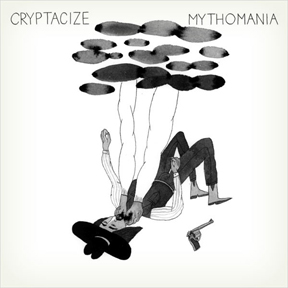
08 - Mythomania

7.  Cryptacize—Mythomania
As I mentioned previously, this album was very surprising, and it has proven more surprising as I’ve listened on, securing it a rank of number seven (previously eight).  At this point one might ask, “Wait, with this subjective switch aren’t your reviews worth the computer screens they are illuminated on?”  Correct, the albums I deem worthy of listen are based upon my dynamic personal preferences.  But in the end, we must wait for NME’s ‘Top Albums of the Decade’ instead of taking their top album from each year of the decade because of developing musical trends and tastes, so I don’t feel so guilty.  This album deserves this spot and maybe even a higher one.  This album possesses a near-perfect amount of creativity, innovation, skills and utter fun!  A great improvement from Chris Cohen’s previous work on Asthmatic Kitty (Curtains).

6.  Girls—Album
I first heard the track “Hellhole Ratrace” back in August.  It was raved about by Pitchfork and Stereogum and I found the track very enjoyable, but not as incredible as the reviews were claiming.  I bought the record soon after its release on 22 September and gave it a listen.  By the second listen I was hooked.  Think of a more nihilistic and energetic Elvis Costello circa 1977, with a hint of Buddy Holly.

04 - My Maudlin Career

5.  Camera Obscura—My Maudlin Career
This record (along with Cursive’s new record) slipped a slot entirely due to the release of my new number three record of the year.  As I’ve mentioned previously, this is probably my favorite release from Camera Obscura.  The more I’ve listened the more I appreciate the record and also the more sure I am that I didn’t simply “love it so much because Belle & Sebastian hasn’t released an LP since 2006.”  Well orchestrated and executed indie-pop, with plenty of Scottish wit.  Even if there is a hint of my love for B & S in this pick, the album (and the band) stands on its own through musical precision and artistic maturity.

03 - Mama

4.  Cursive—Mama, I’m Swollen
Mama, I’m Swollen probably seems to be an odd pick for this number [four] slot, but I will always have a soft spot for Cursive.  This is not to say that this album is undeserving of praise.  Cursive is not interested in being another experimental freak-folk-electro-post-rock-cross-genre-remixed piece of overproduced crap like so many other groups are becoming (namely Dirty Projectors).  They are faithful to their expressive indie roots, this album being far less poppy than Happy Hollow.  It reminds me of Domestica even.  Tim Kasher is still obsessed with refuting a theistic/morally superior worldview, but he does it with so much passion and angst I can’t help but be stirred.  Cursive encourages us to realize the failure of our Enlightenment/modern ideals and to accept our animalistic/primitive nature.  I don’t buy it (but not because it’s not packaged well).  I say we drop the Enlightenment and read more Kierkegaard and Barth.

3.  Converge—Axe to Fall
After all these years Converge is still bringing ‘it.’  What is ‘it?’  ‘It’ is unrelenting energy.  Of all of the bands on this top ten album list, Converge is by far my favorite.  This album (released 20 October) is both extremely heavy and true to Converge’s metal roots while remaining very accessible (like 2001’s Jane Doe).  Axe to Fall has also made its way into my top three all-time Converge records.

02 - Merriweather

2. Animal Collective—Merriweather Post Pavilion
Retaining its number two slot, Merriweather Post Pavilion – though it is more accessible (think Pet Sounds) than their entire repertoire (a bad start in my odd musical sense) – is very unique, big (to the point of breathtaking at times), and yet more cohesive with itself than any other Animal Collective album.  The songs don’t leave you asking, “When is this going to end/how does that even fit?”

01 - Veckatimest

1.  Grizzly BearVeckatimest
I raved about their performance in Glasgow earlier this month and I stand by this pick as the ‘Best Album of 2009.’  My first listen of this record was a positive, but not profound experience.  Only two tracks really stuck out to me: “Two Weeks,” and “While You Wait for the Others.”  I was even a little disappointed with the album version of “While You Wait for the Others,” at first (compared to their incredible live performance I saw on Morning Becomes Eclectic last year).  I sat with the album for another month and at that point it hit me.  This is by far (maybe I’ll get harassed for saying that) Grizzly Bear’s best record.  By best I mean that they demonstrate great maturity and excellence both in writing and execution, two points that have always seemed to miss one another by an ever-so-slight degree.  This record is certain to remain among my favorites unless I fully give myself over to jazz-fusion or something.

Do you know what I am?

Suddenly everyone is a Los Angeles fan.  I’m talking baseball, of course.

The Los Angeles Angels took the American League West division and faced-off against the wild card Boston Red Sox.

The wild card, for those who don’t know, is an opportunity for the number two teams in both the American and National Leagues to enter the playoffs.  This is supposedly justified by the fact that there are teams in competitive divisions (like the AL East featuring the New York Yankees, the Boston Red Sox, the Baltimore Orioles, the Tampa Bay Rays, and the Toronto Blue Jays – though the Yankees and the Red Sox are the only two “competitive” teams in the AL East as if evident from the six wild card slots that the Red Sox have garnered since its introduction into MLB in 1994) that will not get 1st place, but will end the regular season with better records than other division clinchers in the same league (see my previous baseball post).

Well, in a very non-Boston Red Sox playoff appearance, the Red Sox were swept by the Angels.  Historically, Boston has consistently dominated the Angels in the playoffs.  Last season the Angels went to the playoffs as the winningest team in baseball and were defeated in the first round (in four games) by the AL East champion Red Sox (the Red Sox went on to lose the ALCS against the Rays).  But this season the Angels accomplished a clean sweep and will face the New York Yankees, the best team in baseball history and the winningest team of the 2009 season (103 wins) for the American League Championship Series – the most coveted pennant.  From the looks of it the Angels will not pull through, but I’ll be rooting for them over the Yanks.

Now onto the National League…

Out of the four division championship series three have been divided by a sweep (four division championship series = eight teams: AL East, Central, West, wild card; NL East Central West, wild card).  The Yankees swept the Twins (as I predicted: “the Twins…move on to an immediate elimination during the first round of the playoffs…have no chance…going up against the Yanks in the first round…“), the Angels swept the Red Sox, and the Los Angeles Dodgers swept the St Louis Cardinals.  Currently the Philadelphia Phillies are leading 2-1 in the NLDS against the Colorado Rockies.  The winner of that game will go on to play the Dodgers for the NLCS.  [UPDATE: Phillies win NLDS and move on to face the Dodgers for the NLCS.]

The Dodgers spent a significant portion of this season with more wins than any other team.  But in standard Dodger fashion they lost momentum after the All-Star break.  By the end of the season their record was 3rd in the MLB (1st: NYY, 2nd LAA).  Still, they took their division and will most likely take the NLCS.

If the Angels can win the ALCS (unlikely, but you never know when it’s Angels vs Yankees…) and the Dodgers can win the ALCS, the World Series will pit the Los Angeles Angels against the Los Angeles Dodgers, a first for Los Angeles.  How exciting it is to have that as a possibility this late in the season!  Deep down inside every Angeleno wants to see the two teams play one another in the World Series.  Sure, they play interleague “Freeway Series” during the season, but that feud pales in comparison to the rivalry that would develop during a World Series.  And with this possibility I find that many of my once-indifferent friends (there are many people that are indifferent toward baseball…) are suddenly the biggest Dodgers/Angels fans.  I don’t necessarily blame them, but do you know what I am?  I’m a Detroit Tigers fan.

PS. If by some odd chance there was an Angels/Dodgers World Series, my allegiance would be with the Dodgers 100%.

I became President and all I got was this Nobel Prize

Not even a year into his presidency and Barack Obama has won the Nobel Peace Prize.  He didn’t even need to make a documentary.  And it will look good between his two Grammys.

There will most certainly be both many praises and many criticisms floating about regarding the bestowal of this honor upon the young American President, but I really must say that my first reaction was overwhelming joy.  Why?  I simply believe that while standing up for what he believes America needs, President Obama still retains a considerable amount of respect from the rest of the world (or at least from those who vote for the Nobel Prize).

Once again, I am working from the assumption that two-way communication with the rest of the world is a positive thing.  From my view I would say that President Obama is not bowing down to the demands of the ‘enemies‘ of America (part of the reason for his winning of the Nobel Prize is the fact that he has really amped up calls for nuclear disarmament and human rights).

Still, while I am filled with joy, I wonder how the President of the United States could have won this award after only being President for roughly eight months (let me also add that the nomination proceedings for the Nobel Prize took place before he had even been in office for one full month).  [But let’s not also forget that one need not be a President to be awarded a Nobel Prize, i.e. he could have received it (in theory) even if he had not won the election.]  And in the back of my head is the thought that perhaps President Obama simply looks so much more attractive to the rest of the world in contrast to the administration that he followed…

Either way, I hope that people won’t get nasty about this award: Obama didn’t ask for it.  This is meant to be a gift from the Norwegian Nobel Committee to someone who has contributed significantly to the cause of peace.  I think it would be difficult to defend the belief that President Obama has yet to actually impact the global political climate/landscape.  Even North Korea is changing its tune (for now).

Whether or not the world is unanimous in approval of President Obama’s receipt of this award, we can all agree that a world where peace flourishes is a good goal; may we hope and pray that President Obama would continually make decisions that point the way (in as much as one man can) to that goal.

"Damn."
Another disappointing day.

Travesty of the Decade

The Detroit Tigers (arguably the best team of any sport in world history – I couldn’t argue this in good conscience, but I wish I could) were in the lead in the AL Central (arguably the best division of any sport in world history – I couldn’t argue this in good conscience, but I wish I could) for the vast majority of the season until the unthinkable happened.  The Minnesota Twins began to win, and they didn’t win many games, just enough to catch up.  Let me emphasize how pathetic the AL Central really is:

MLB 2009 Season Leaders by Division

  • AL East: New York Yankees – .636
  • AL Central: Minnesota Twins – .534
  • AL West: Los Angeles Angels – .599
  • NL East: Philadelphia Phillies  – .574
  • NL Central: St Louis Cardinals – .562
  • NL West: Los Angeles Dodgers – .586

To take a division with .534 is pitiful, what is even more pitiful is a look at all of the teams with better records than the Twins that didn’t clinch their division:

  • AL East: Boston Red Sox – .586 *wild card (more discussion on this practice in another post…)
  • AL West: Texas Rangers – .537
  • NL East: Florida Marlins – .537
  • NL Central: Chicago Cubs – .516 (let’s face it, the MLB Central divisions are awful)
  • NL West: Colorado Rockies – .568; San Francisco Giants – .543

So last night I had to go to sleep in Scotland (which is five hours ahead of EDT) with the tie-breaking 163rd game of the season to determine which team – the Tigers or the Twins – would move on to an immediate elimination during the first round of the playoffs looming over me (let’s face it, both teams had/have no chance, especially since they are going up against the Yanks in the first round…). What a thrill!  Two teams that barely won over half of their games this season fighting for the coveted AL Central title.  But alas I had no television and decided it would have been better to check in the morning after the damage had been done.

The game itself was rather epic though.  The Metrodome (Minneapolis) was packed and the teams fought for nearly 12 full innings!  If I had watched it I might have had an asthma attack or died instantly of a broken heart.

So the Tigers, being the historical team that they are, have become the first team in history with a three-game lead and only four games to go in the regular season to totally drop the ball.  Better luck next decade.

Meltdown

Elliott Smith, Intercessory Psalmist

This post, in partial attempt to push my last post under the radar, is more in my line of pseudo-expertise and at least non-inflammatory interest…

On 6 August 2009 Elliott Smith would have turned 40 years old.  Instead, on 21 October 2009 we grieve six years without him.  Readers may or may not know who Elliott Smith was (or is), but if you’ve heard the film soundtracks for either Good Will Hunting, Hurricane Streets, American Beauty, Keeping the Faith, Antitrust (sadly), The Royal Tenenbaums, Thumbsucker, Georgia Rule (unfortunately), The Go-Getter, or Paranoid Park, or if you’ve played through Guitar Hero 5, you’ve been exposed to at least a portion of his work.  If you’ve not heard any of that, maybe you saw the 70th Academy Awards (1998) and caught his performance “Miss Misery,” which was nominated for best original song (losing to James Horner and Will Jennings for “My Heart Will Go On,” from the film Titanic).  Though he never experienced a great degree of commercial success, Elliott Smith has left a legacy of what I believe are some of the best pop/folk songs ever written.

Elliott Smith’s singing voice can be characterized as a tenor-whisper (which is also doubled in most tracks – Elliott is among the finest/if not the finest doubling singers I’ve ever heard).  When I first heard his unique voice I didn’t know what to expect regarding his looks.  The first time you see a picture of Elliott after hearing his voice you might ask yourself, “Really?”  Yet when you see a live performance (something now only possible through video recordings) the deep honesty of his voice is a perfect complement to the deep honesty of his weathered face.

Lyrically Elliott is typically rather dark, which typically leaves his listeners ultimately unsurprised (though devastated) when they learn of his suicide.  His lyrics often feature the themes of existential despair, love (or the absence of such) and the looming prospect of taking one’s own life (“Instruments shine on a silver tray | Don’t let me get carried away | Don’t let me get carried away | Don’t let me be carried away” – last lines on From a Basement on the Hill‘s ‘King’s Crossing’, one of the last songs he ever wrote).

But contrary to accusations I’ve often heard against it, Elliott’s music is not a tool for thrusting oneself into despair.  I cannot precisely explain the emotional quality that draws me into Elliott Smith’s music, but it is not one that is dismal so much as it is honest.  When I listen to Elliott Smith I find an advocate, a counselor, one not above the darkness, but in its midst.  Like the Psalmist, Elliott cries out for me when I have no words.  And that is what gives Elliott the edge in my musical library: he is so substantive and of this earth.  His passions, his pains, his loves, his hates, his strengths, and his weaknesses are all laid out with the utmost artistic integrity.  I truly believe every word that comes from his mouth, or at least I believe that he believes what he is singing.

If you’re looking for shallow comfort listen to The Beach Boys’ ‘Wouldn’t it Be Nice’, one of my favourite pop songs of all time.  But if you want to experience someone’s heart laid out before you and if you want to taste both the sweetness and bitterness of a true artist, give Elliott Smith a listen, a long intentional listen.

Elliott Smith Full-Length Releases

Let me first say that I consider every Elliott Smith album an excellent album, and I don’t award such praise lightly (at least I don’t think I do…).

01 Roman Candle

From 1991 to 1996 Elliott sang/played guitar in the alternative rock band Heatmiser.  While in the band he began his solo career, resulting in 1994’s Roman Candle, nine tracks (the last one instrumental) that Elliott had not actually intended on releasing in album form.  With this in mind, Roman Candle is much less cohesive than Elliott’s later releases, but still showcases his exceptional musical/writing ability, as well as the signature lo-fi production that characterizes most of his music.

02 Elliott Smith

Elliott released his self-titled album in 1995, like Roman Candle, while still in Heatmiser.  This album includes the track, “Needle in the Hay,” featured in the film The Royal Tenenbaums.

03 Either-Or

Either/Or, released in 1997, follows in the same vein as Elliott’s first two releases.  The title comes from Søren Kierkegaard’s book, Enten ‒ Eller. Several songs from this album were used in the film Good Will Hunting (though “Miss Misery,” the song for which Elliott was nominated for an Academy Award, was written specifically for the film and saw no studio album release).

04 XO

Elliott followed Either/Or with 1998’s XO, his first release through DreamWorks and thus his first release on a major label.  Elliott’s earlier philosphical/aesthetic sentiments are present, but begin to manifest themselves differently through this album, which features more instruments and better production.

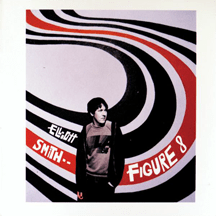
05 Figure 8

Following in the same musical/productive trajectory of XO, Elliott released Figure 8 in 2000.  This album is simply incredible.  The cover photo was taken in front of the A/V repair shop Solutions in Los Angeles by photographer Autumn de Wilde.  If you’re in Los Angeles you can visit and leave a message on the wall (located at 4334 W. Sunset Blvd.), which has become an unofficial Elliott Smith memorial.

06 From a Basement on the Hill

At the time of his death, Elliott was still working on this album, which was released posthumously in 2004.  Though we don’t have Elliott’s final product here, his former producer along with his girlfriend compiled this album from the material he had been working on in the studio.  They did a good job.

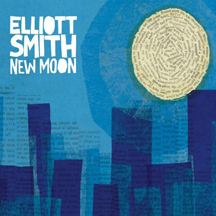
07 New Moon

This album is actually a compilation of B-sides, outtakes and rarities generally from the self-titled and Either/Or sessions, and the style/production is predominantly reflective of that period.  It was released in 2007.

For more information on Elliott Smith visit Sweet Adeline, his official website.