Imaging the Kingdom V: Agnosticism in the kingdom of God

This long-overdue installment of Imaging the Kingdom will be focusing on what I consider to be a healthy degree of agnosticism in the Christian faith, and I’d like to begin with a personal story. In my first year as a theological studies undergraduate student I became aware of an interesting issue within American Christianity: the age of the earth and the interpretation of the Book of Genesis. Coming from a more scientific background, accepting the idea that the universe originated with the Big Bang was no struggle for me. Belief in the God of creation and the discoveries of contemporary science were not contentious, unless of course those scientific conclusions depended entirely on an exclusive naturalism, a presupposed atheism that is just as certain of the non-existence of a deity as theism is of the existence of one. Despite claims of the purity and certainty of science and reason, I found these atheistic presuppositions to be more experienced-and-feeling-based, like a religion – but I digress.

Through my late exposure to American Evangelicalism I was confronted with another story, a story that claims with certainty despite strong scientific evidence (proof even!) that the earth alone is some 4.5 billion years old, that argues for a ‘young earth’ model. If the earth is only several thousand years old, then how could biological evolution have happened? Exactly. This view also claims that the ‘theory of evolution’ (as if emphasising ‘theory’ makes it less legitimate straight away) is a fabrication of the godless scientific community. While many evolutionary biologists have presupposed atheism—seeing evolution, as opposed to theistic creation, as a legitimate way of explaining the diversity of life on earth—I still found no significant tension between the concept of evolution and my belief in God. That may simply be a matter of my own ignorance, but indulge me.

So as a first year undergraduate student I was confronted with these ‘young earth’ views and I wasn’t sure what I ought to do with them. I decided to consult someone I trusted, someone whose name was synonymous with ‘wisdom’ in the seminary I attended: Ed Curtis. Dr Curtis was (and still is) a white-haired sagely Professor of Biblical and Theological Studies who specialised in the Hebrew language and Wisdom Literature. On top of this, prior to pursuing theology he studied physical science and worked as an engineer and physicist. I approached Dr Curtis during a theological staff-student lunch and shared my recent confrontation with the conservative Evangelical position on creation. He told me that he found himself confronted with the same tension, but in his gentle Texan-drawl he delivered a profound piece of wisdom that has stayed with me since: ‘If we only concerned ourselves with that which we can actually know we’d have enough on our plate.’

This reality puts a significant perspective on how we approach issues of doctrine, belief and practice as Christians. The ‘that which we can actually know‘ that to which Dr Curtis referred is essentially boiled down to the love that God has revealed to us so explicitly.  In other words, as Christians we know that God loves the world that they created and the incarnation and giving of Jesus Christ in order to upend the power structures of this world is a profound demonstration of this love. Not only that, but in response to this love, empowered by God’s Spirit, we are called to love God and to love our neighbour. In fact, loving our neighbours is very much synonymous with loving God, as we hear in Jesus’ words from Matthew 25:31-40 (NRSV):

‘When the Son of Man comes in his glory, and all the angels with him, then he will sit on the throne of his glory.  All the nations will be gathered before him, and he will separate people one from another as a shepherd separates the sheep from the goats, and he will put the sheep at his right hand and the goats at the left.  Then the king will say to those at his right hand, “Come, you that are blessed by my Father, inherit the kingdom prepared for you from the foundation of the world; for I was hungry and you gave me food, I was thirsty and you gave me something to drink, I was a stranger and you welcomed me, I was naked and you gave me clothing, I was sick and you took care of me, I was in prison and you visited me.”  Then the righteous will answer him, “Lord, when was it that we saw you hungry and gave you food, or thirsty and gave you something to drink?  And when was it that we saw you a stranger and welcomed you, or naked and gave you clothing?  And when was it that we saw you sick or in prison and visited you?”  And the king will answer them, “Truly I tell you, just as you did it to one of the least of these who are members of my family,* you did it to me.”’

Truly, if we primarily concerned ourselves with caring for the holistic needs of all of those around us we would have plenty with which to occupy ourselves. That all sounds so beautiful, but that still leaves the issue of uncertainty wide open and Westerners don’t like uncertainty, right? A more troubling thing is that these adamant ‘young earth’/’anti-evolutionary’ views are not bound the sidelines of public discussion – the prominent Republican political figures Sarah Palin, Michele Bachmann and Rick Perry (the latter two are currently competing for the Republican Party’s nomination for president) all hold to and promote conservative Evangelical views on these issues. In our society these people have a right to hold these views, but the general intolerance demonstrated by many who hold such views only seems to promote needless division.

So what happened? How did we get to this point? At one point our Enlightened Western world accepted that through the power of our good science and our right reasoning we can solve anything; we can have certainty. Over the last few centuries, the findings of science and reason began to challenge the way that we understand Christianity, from Thomas Jefferson’s attempt to remove all things supernatural from New Testament in writing The Life and Morals of Jesus of Nazareth in 1820 to Stephen Hawking and Leonard Mlodinow’s 2010 book The Grand Design, which asserts that the origin of the universe need not be explained by the existence of God but by physical laws alone. In reaction to these assertions, many Christians (primarily, though not always, those of a more conservative brand) have outrightly rejected science and reason, or have tended toward developing their own exhaustive analytical philosophies and pseudoscience.

While there is no room for half-baked, reactionary ‘science’ in the marketplace of ideas, providing a rational defense for Christian belief/theology is not entirely out of the question. But what I’ve come to appreciate is the freedom to simply not know. In other words, the inevitable transcendence of God (the inability for humanity to know everything about God) means the inevitable ignorance of humanity. The sheer otherness of other people should be enough to help us realise our inevitable, eternal ignorance. Even our inability to know ourselves fully shows us our ignorance.  We don’t need to be insecure about uncertainty and paradox. It’s okay to answer, ‘I don’t know,’ – it’s even okay to answer, ‘I don’t know and I probably never will.’

Over the last few years I’ve engaged with this issue of agnosticism with a close philosopher friend who directed me to the eminent 20th-century Austrian philosopher, Ludwig Wittgenstein. Wittgenstein stresses the importance of holding onto epistemological humility in Philosophical Investigations (426):

Here again we get the same thing as in set theory: the form of expression we use seems to have been designed for a god, who knows what we cannot know; he sees the whole of each of those infinite series and he sees into human consciousness. For us, of course, these forms of expression are like pontificals which we may put on, but cannot do much with, since we lack the effective power that would give these vestments meaning and purpose.

In the actual use of expression we make detours, we go by side roads. We see the straight highway before us, but of course we cannot use it, because it is permanently closed.1

It seems that Wittgenstein is telling us that both our language and our ability to know are significantly limited, thus necessitating a self-reflective hint of humility in how we argue for/hold onto various ideas. I see this fitting perfectly with a healthy Christian agnosticism, as Barth expresses in his Dogmatics in Outline,

Christian faith has to do with the object, with God the Father, the Son, and the Holy Spirit, of which the Creed speaks. Of course it is of the nature and being of this object, of God the Father, the Son and the Holy Spirit, that He cannot be known by the powers of human knowledge, but is apprehensible and apprehended solely because of His own freedom, decision and action.2

This is not to say that we stop our pursuit of the knowledge of God, but that while we pursue a better knowledge—a knowledge that, when coupled with action, has the potential to transform lives and deliver those who are oppressed from their oppressors—we must always hold onto that which is most central to the Christian faith: the grace and love of God. We can and should disagree with one another, as diversity is part of what potentially makes the Church so effective, counter-cultural, welcoming and healthy, but we should also take very seriously the fact that none of us will ever know everything.

We believe in one God, the Father All Governing, creator of heaven and earth, of all things visible and invisible;

And in one Lord Jesus Christ, the only-begotten Son of God, begotten from the Father before all time, Light from Light, true God from true God, begotten not created, of the same essence as the Father, through Whom all things came into being, Who for us [humans] and because of our salvation came down from heaven, and was incarnate by the Holy Spirit and the Virgin Mary and became human. He was crucified for us under Pontius Pilate, and suffered and was buried, and rose on the third day, according to the Scriptures, and ascended to heaven, and sits on the right hand of the Father, and will come again with glory to judge the living and dead. His Kingdom shall have no end.

And in the Holy Spirit, the Lord and life-giver, Who proceeds from the Father, Who is worshiped and glorified together with the Father and Son, Who spoke through the prophets; and in one, holy, catholic and apostolic Church. We confess on baptism for the remission of sins.  We look forward to the resurrection of the dead and the life of the world to come. Amen.3

+++++

1. Ludwig Wittgenstein, Philosophical Investigations, translated by G. E. M. Anscombe (Oxford: Basil Blackwell, 1953), 127e.
2. Karl Barth, Dogmatics in Outline, translated by Colin E. Gunton (London: SCM Press, 1949), 15.
3. John H. Leith, ed., Creeds of the Churches (Louisville: Westminster John Knox Press, 1982), 33.

The Cloud Rank: CHINA MIÉVILLE

It wouldn’t surprise me if many of our readers had not heard of the novelist China Miéville before.  I myself only stumbled upon a story of his in a collection a few years back, and had to read backwards from there to catch up with his writing.  Below, I’d like to share some thoughts about his newest novel, Embassytown and then list “The Cloud Rank” of all of his works that I have read, but before I do, here are just a few brief thoughts by way of introduction…

  • Miéville is primarily known as an author of science fiction/fantasy-esque novels, but they are eruditely creative, densely multilayered (political/spiritual/culturally reflective), and deeply engaging examples of those genres, that is, versus the kind that have implausibly-bosomed alien/elfin women in space/fairy bikinis.  Supposedly, there is a “school” of writing to which Miéville belongs called the “New Weird.”  I don’t know about weird, I just think it’s devastatingly clever. Except when it’s not (see Cloud Rank below for works that fall in the AVOID category).
  • He’s British and male, though his name seemed French and feminine when I first encountered it (he made himself the central character in the first story of his I read, mentioned above).  He is a avowed Marxist (I think? Maybe just a hyper-socialist?) with a PhD in International Something (Law? Economics? Can’t be bothered to fact-check anything floating about in my memory).  He has a shaved head, a plethora of earrings in one ear, and he’s far from either of the polar extremes one normally associates with the sci-fi/fantasy crowd (i.e. skinny nerd or fatty schlub). This last sentence is rendered wholly unnecessary by inserting…
    Portrait of the artist as a person you would hand over your wallet to

    His newest novel, Embassytown, was released in May of 2011, to mostly quite positive reviews.  It is set in the future on the most distant planet of the known universe, when human existence on earth is only a vague memory (or something like that).  I won’t go into the details of plot, character, etc.  All those things can be found in reviews elsewhere with considerable ease.  Instead, I’d simply like to tell you a few of my own impressions…

  • I initially found myself simultaneously intrigued and baffled by the world he created (aliens, technology, politics, etc.), yet I was willing to patiently uncover the meaning of words like “miab” or “immer” by their use in context.  However, I later became a bit bored with this lexical snipe-hunt, being that some words’ meaning seemed almost indeterminable.  Still, the wordsmithery of this writer cannot be denied.
  • The central character and narrator, a human woman called Avice, held my attention and affection throughout, though there was a disquieting passivity to her–intentionally, I’m sure, as Avice describes herself as a “floaker,” which is a neologism the author uses to define someone who is an underachiever/layabout/slacker combination mixed with a dose of elitist and a hint of mischievous social agitator.  I personally would hope to live up to such a description on my finest days…
  • In terms of literary pedigree, I found myself sensing the influence of two works quite strongly in his novel (though he may have read neither):  Ursula LeGuin’s The Left Hand of Darkness (if you’re ever in a used bookshop, look for this & buy a pulpy copy…it’s so worth reading) with its androgynous sexuality and ambassadorial politics, and C.S. Lewis’ Perelandra (I’m pretty sure that Miéville would not be a fan of Lewis, given his harsh words regarding Tolkien) with its re-imagined Edenic narrative and grand human themes.  If you liked either of those books, I think you would enjoy their offspring in Embassytown.
  • The book had the potential to be a microcosmic epic, an unveiling of life in a particular place that seemed to speak to the totality of universal existence.  But ultimately, it lost steam on this quest and became a story that was crushed by its own inability to live up to the grand vision it had promised.  And yet, this book is so much better than most of whatever else that is published every year, so it comes highly recommended nevertheless.

So where does Embassytown fall on the Cloud Rank of China Miéville’s literary output?  About the middle…

  1. The Scar (2002):  This is the second novel in the Bas-Lag trilogy.  It is a sci-fi sea novel (Miéville is also known for experimenting with hybrids of various genres) and one of the greatest stories I’ve ever read.  Cloud Rank = MUST READ (Note: this book can be read as a stand-alone novel, but why not start with…
  2. Perdido Street Station (2000):  The first of the trilogy, sometimes a bit bogged down by detail, but absolutely brilliant in its world creation, vivid descriptions (it can actually be a somewhat intense read with the violent accounts of the horrific “slake moth” monsters and what not), and deeply compelling storyline.  I was gripped by this book.  Cloud Rank = MUST READ
  3. The City & The City (2009):  This is a crime/noir novel set in an Eastern European-esque location which actually houses two distinct cities, existing in the same geographic space but divided by an ingrained, mutual disregard established in a elaborate set of rules that keeps one city from acknowledging the other.  Brilliant conceit, but the story lost the central suspense narrative (to my mind) at some point. Cloud Rank = SHOULD READ
  4. Embassytown (2011):  See above comments.  Cloud Rank = SHOULD READ
  5. Railsea (2012):  Sometimes, a bit hit & miss, this is a postmodern re-imagining of Moby-Dick with trains replacing boats in a futuristic world.  If you can stick to the end, I think you’ll find it is ultimately a satisfying read.  Cloud Rank = SHOULD READ
  6. Looking for Jake (collection, 2005):  A mixed bag of stories and other pieces, notable mainly for the post-apocalyptic vampire novella, The Tain, and a story in the Bas-Lag universe called “Jack.”  Cloud Rank = MOSTLY FOR FANS
  7. Iron Council (2004):  The third book in the Bas-Lag trilogy, half of it written in the manner of a classic western novel, other parts a narrative of class struggle, and yet other parts creepy sci-fi.  I was so deeply disappointed in this conclusion to the trilogy, I finished it only out of a sense of obsessive completism.  Cloud Rank = AVOID, UNLESS YOU HAVE THE SAME NEED TO COMPLETE THE SERIES
  8. Kraken (2010):  I could barely bring myself to keep reading a few chapters in–there was not much that I liked at all.  It felt like a D-grade rehash of Neil Gaiman’s Neverwhere.  And just to be spiteful, I will spoil the end here:  the whole thing with the kraken is just a red herring and the real villain is a former fundamentalist Christian who wants to erase the evidence for Darwinism. This is inexcusably bad.  Cloud Rank = AVOID AT ALL COST

Returning to the Cloud: Fall/Autumn 2011 Preview

Greetings to our faithful cadre of subscribers & readers…it has been some time since I’ve posted anything on our humble little weblog here (due to a overloaded class schedule at Fuller Seminary & increased summer childcare–all three little angels were home with me– combined with a new job at my church) but I am here to announce that a number of posts WILL BE forthcoming in the next weeks and months.  Here’s a preview of what you can expect on this site in Fall/Autumn 2011:

• A number of my favorite novelists have new books that have recently been or will shortly be published.  Along with a brief review of their latest work, I’d like to begin a new feature called, “The Cloud Rank” where I assess and position the rest of their oeuvre (or as many of their novels as I’ve read) against the new work.  Some of the novelists receiving this treatment will include: David Lodge, China Mieville, Tom Perrota, Julian Barnes, and graphic novelist Craig Thompson.

• You may also expect a response to this article about hell from the Summer issue of Biola University’s magazine.  I’ve largely worked through my issues with Biola, my former employer, so you need not expect a diatribe against the conservative evangelical establishment, and I find that I am generally opposed to the the Rob Bell book on eschatology that the Biola article denounces as well.  Rather, some points that the “expert” author makes about annihilationism are quite ill-founded and need a corrective voice to balance out, which I am happy to provide!

• I am also looking forward to reading the upcoming “multiple-views” volume on the topic of evangelicalism (about which John Stackhouse writes here) and adding some thoughts about the schism that seems imminent in the evangelical consensus and ways that we might avoid committing or being the victim of a “friendly-fire” tragedy.

• I am also hoping to do a Cloud Rank on the albums of The Smiths and Morrissey, hopefully publishing a Top 50 Smiths/Morrissey Songs list in the process.

• Finally, as we draw closer to the end of the year, you can count on Elijah and I to continue the long tradition of our best of the year in music here on Lost in the Cloud.

I offer my deepest apologies for this long absence and hope you will enjoy some of the posts in the days ahead!

‘America!’, a ramble

Is America a force for good in the world? Many people would respond positively, convinced of some strange belief called ‘American exceptionalism’, and would top it off with a resounding ‘God bless America!’ But on the other end of the spectrum we find many who would respond with disgust, as if such a question was not worthy of a response at all. Perhaps both of these responses are true.  In an interview on the Dick Cavett Show in 1970, Orson Welles argued,

I think one thing that is generally true, the one generalisation that is true about America is that everything is true about it. It’s impossible to say anything that isn’t true, good or bad. Our enemies are right, our friends are right. It’s an awful big country [with] an awful lot of different kinds of people in it.

I think there’s a lot of truth in that statement. From my perspective, an expatriated American of Scottish extraction, I can’t bring myself to side with either one of the two  extremist responses above. The disestablishmentarian in me would readily scoff at the first answer when looking at the actions of ‘America’ throughout its short history. ‘Manifest Destiny’; CIA plots to interfere with South American politics in order to stop the spread of COMMUNISM(!); capitalistic exploitation in America and in third world countries; the ill-informed invasion of Iraq in 2003; all those boy bands from the 90s – America isn’t a wholly good nation. But then again, such a thing doesn’t exist. All this is not to say that America has done exclusively ‘bad’ things with this power. Throughout history America’s government—however manipulated by an insecure worldview—has acted in self-interest. Sometimes America’s self-interest is beneficial for the rest of the world and sometimes it isn’t.

When I left America for Scotland I was told by a Northern Irish friend that I would probably find myself defending my the States more than I expected. But to be honest, I never had an entirely bleak outlook on America in the first place. At different points I toyed with expatriation as a self-righteous act of political protest, but if anyone wants to lump America together as a homogeneous society of nit-wits I will try my best to convince them that this cannot truly be said of any nation. America, with more than 300 million citizens who for the most part find their origins in faraway countries, is an incredibly diverse and dynamic nation. But as it stands, and while this is not unique to America, many Americans (me included) and American governments have been guilty of making this world a poorer place in many inventive ways.

But America is also a beautiful nation full of beautiful people. This as well is not unique to America. Even so, growing up in and around Los Angeles has shaped who I am in many ways and I wouldn’t change that fact even if I could. And while I profess a love for Scotland, inevitably, it shares many of America’s flaws. I simply can’t escape what is broken with the world because I can’t escape the world. All any of us can do is aim to repair what is broken and spread what is good. But at this point we must ask the question, what is good?

Regarding America, and in celebration of the Fourth of July, when Americans commemorate the signing of the Declaration of Independence in 1776 (according to Thomas Jefferson, Benjamin Franklin, and John Adams), I will now point out two things that I think are exemplary of the good: American music and baseball.

Let me make clear that these two things are not free of their own flaws. For instance, in addition to the 90s boy bands I mentioned earlier, America is also responsible for Journey and a host of other terrible artists. Of course this is a matter of taste, and while some poor folk might think that Elvis Presley and Bob Dylan are passé, their music had and continues to have a profound impact on culture around the world. It is important to be  reminded of the words of Donne, ‘No man is an island’, and the two owe a great deal to a rich and fertile musical heritage borne from countless sources, such as the Negro spiritual. But it can be argued that, among many others, the highly influential genres of ragtime, jazz, country, rock and roll, soul, hip-hop, and grunge were all founded in the US of A. And of course there’s the broad Americana genre. Perhaps these developments can be attributed to the rapid economic growth of America throughout its short history, mixed with the continual convergence of various world cultures, all taking place alongside the development of music recording and transmission throughout the 20th century.

Regardless of the cause, American music has always pushed new ground and inspired subsequent generations of artists. See legendary musicians of days long past like Blind Lemon Jefferson, Jelly Roll Morton, Robert Johnson, Lead Belly, Hank Williams, Billie Holiday, Woody Guthrie, and Pete Seeger (who is still kicking!). Their torch was passed to popular artists like Elvis Presley, Bob Dylan, Louis Armstrong, Dave Brubeck, Johnny Cash, John Coltrane, Miles Davis, Duke Ellington, Ella Fitzgerald, Buddy Holly, Jerry Lee Lewis, Thelonius Monk and Frank Sinatra. Then this was followed by a wave of dramatic developments from American artists like The Beach Boys, Blondie, James Brown, T-Bone Burnett, Devo, Philip Glass, Iggy Pop, Michael Jackson, Love, Ramones, The Talking Heads, Television, The Velvet Underground, Tom Waits, and Frank Zappa.

In more recent years we’ve seen the rise of significant American musicians like Lou Barlow, Jeff Buckley, Botch, Converge, Fugazi, Grandaddy, Aimee Mann, Neutral Milk Hotel, Nirvana, Pixies, R.E.M., Tupac Shakur, Daniel Smith, Elliott Smith, Sonic Youth, Sunny Day Real Estate, The White Stripes, Yo La Tengo, and yet more recent artists like Animal Collective, Deerhunter, Explosions in the Sky, Fleet Foxes, Grizzly Bear, Cass McCombs, and Frightened Rab…nevermind that last one.  Of course there are many more artists that should be included in this list (I merely picked some of my favourites), but that only goes to show how important American music has been in the last century. In Sufjan Stevens alone we can see a massive and ambitious output of constant reinterpretation and innovation.

Now onto the second good thing I want to affirm about America, which probably came as no surprise to seasoned LITC readers. Baseball may not enjoy the global fame of association football, but I happen to think it is the greatest sport to ever grace the face of the earth (though football’s soccer’s not far behind – apologies to cricket, rugby, golf, etc.). I’ve professed my undying love for baseball through blog posts on several different occasions. And despite the inevitable corruption that plagues the sport (greed, performance-enhancing drugs, marital infidelity, bench-clearing brawls, etc.), there’s a magic and heart to baseball that is truly good.

In the classic 1989 film Field of Dreams, the character Terrance Mann (James Earl Jones) is trying to convince the main character, Ray Kinsella (Kevin Costner), to embrace his dream, a vision he had of a baseball field on his farm in Iowa. Because Ray has cleared land for this baseball field and has invested money into its development (outfitted with stadium lights and all), he is losing money rapidly and in this particular scene his brother-in-law is trying to convince him to sell the farm and leave his dream behind. Mann responds,

Ray, people will come Ray. They’ll come to Iowa for reasons they can’t even fathom. They’ll turn up your driveway not knowing for sure why they’re doing it. They’ll arrive at your door as innocent as children, longing for the past. Of course, we won’t mind if you look around, you’ll say. It’s only $20 per person. They’ll pass over the money without even thinking about it: for it is money they have and peace they lack…

And they’ll walk out to the bleachers; sit in shirtsleeves on a perfect afternoon. They’ll find they have reserved seats somewhere along one of the baselines, where they sat when they were children and cheered their heroes. And they’ll watch the game and it’ll be as if they dipped themselves in magic waters. The memories will be so thick they’ll have to brush them away from their faces…

People will come Ray…

The one constant through all the years, Ray, has been baseball. America has rolled by like an army of steamrollers. It has been erased like a blackboard, rebuilt and erased again. But baseball has marked the time. This field, this game: it’s a part of our past, Ray. It reminds of us of all that once was good and it could be again. Oh, people will come Ray. People will most definitely come.

There’s much more going on at the core of the film, but I won’t spoil it – you should watch the film. What I want to point out is this sentiment expressed so sweetly through James Earl Jones’ transcendent voice. Throughout many wars and economic depressions baseball has remained because it is a special vessel of goodness. I suppose that’s part of why I love the Tigers so much – they represent this beacon of goodness (among many other great beacons of goodness in Detroit) in the midst of a suffering place.

So this is to you, America! And while I’m not too keen on the cult of the American flag, here’s Ol’ Glory, which stands as a mere symbol for the hopes and dreams—noble and ignoble—of millions of people throughout the last 235 years and in the present. May God bless America, but more importantly, may God continue to bless this struggling world.

Will tomorrow be the ‘end of the world’?

Maybe, but I’m suspecting no. [Greg adds: Suspicion was correct.] Readers will no doubt have heard about a Christian group going around, informing the world that 21 May 2011 is the day that God will issue ‘his’ divine judgment upon the earth. This is said to include an event called the ‘Rapture’, in which Christians will be taken from the earth before God begins a period of judgment that is called the ‘Great Tribulation’ or the ‘Seven Year Tribulation’. Their efforts have spawned a waves of both curious attraction and intense ridicule (which they expect, going up against the ‘Antichrist’ – see 1 John 2:18). One public Facebook event, ‘Post rapture looting’, has, by this afternoon, amassed more than half a million ‘attendees’ prepared to take full advantage of the potential ‘end’ and illegally acquire new stereos in the event of a ‘Rapture’.

If I was going to even begin to really analyse the many facets of this convoluted and heterodox belief system it would take thousands upon thousands of words and I suspect that out of my own personal frustration I’d actually want the world to end after all. I am not trying to pick on these Christians, as I am certain that they truly believe the things that they are preaching, and if I was convinced the world was going to end on 21 May 2011 I could only hope to demonstrate the passion and fervency to make that fact known like they are. But I really think they’re wrong.

Where do they get these ideas? Well, without getting into the interpretive and mathematical gymnastics required to extrapolate ‘THE END OF THE WORLD IS 21 MAY 2011’ from the Bible, it’s important to know why these people have been looking for this date.

We must begin our brief exploration of this issue in the Book of Revelation, which is probably one of the most misunderstood sections of Scripture. In American Evangelical Christianity (especially within the belief systems called Dispensationalism and Progressive Dispensationalism) there is a widespread view that the Book of Revelation foretells the end of the world in very literal terms. What is meant by ‘literal’, I can’t quite grasp, but it’s some way of applying a particular interpretive method described as ‘literal’ that is a somewhat willy-nilly version of what we might understand as literal-minded (according to the OED, ‘having a literal mind; characteristic of one who takes a matter-of-fact or unimaginative view of things’, the term ‘literal’ being used ‘to denote that [an accompanying noun] has its literal sense, without metaphor, exaggeration, or inaccuracy; literally so called.’).

According to this interpretation (and there are many variations), the Book of Revelation is entirely futuristic and eschatological, that is, something that takes place at the end of all things. I’m not interested in exploring the legitimacy of this view right here, right now, but I will say that some startling insights for the Book of Revelation come from reading 1 and 2 Maccabees (considered apocryphal by most Protestant denominations) help illuminate the Second Temple Jewish context of the New Testament and the Book of Revelation and lead to some dramatically different interpretations of things like the ‘Seven Year Tribulation’ and the ‘Antichrist’.

Either way, this literalistic/futuristic view believes that God will bring judgment on the earth according to a complex set of events and periods of time. One of these events, as mentioned earlier, is called the ‘Rapture’. The concept of the ‘Rapture’ is primarily based upon one reference in Scripture, 1 Thessalonians 4:15-18, which states,

For this we declare to you by the word of the Lord, that we who are alive, who are left until the coming of the Lord, will by no means precede those who have died. For the Lord himself, with a cry of command, with the archangel’s call and with the sound of God’s trumpet, will descend from heaven, and the dead in Christ will rise first. Then we who are alive, who are left, will be caught up in the clouds together with them to meet the Lord in the air; and so we will be with the Lord forever. Therefore encourage one another with these words.

This passage provides those who hold to the idea that the Book of Revelation informs us that God will judge this world during a period of ‘Great Tribulation’ with a bit of relief: they won’t have to endure this period of judgment. But in light of the Second Temple Jewish context of the Book of Revelation, I don’t believe in this future ‘Seven Year Tribulation’, and my disbelief is not a result of a lack of faith in God or an interpretation that isn’t ‘literal’ enough. I merely believe that the best understanding of this issue within the Bible would indicate that the great tribulation in the Book of Revelation 4-19 is a reference to the occupation and oppression that the Jews experienced in the Second Temple Period (i.e. the ruler of the Seleucid Empire, Antiochus IV Epiphanes is the ‘beast’ from Revelation 13:5-8; see 1 Maccabees 1:20-28).

While I generally hold to this preteristic (as opposed to futuristic) view of Christian eschatology, I am willing to accept the possibility that God will bring about the kingdom in its fullness at some point in the future. I certainly wouldn’t say that these doomsday folk are wrong in believing that there is something significant to come, but I do have trouble with their views on what that looks like and how/when it happens. With regard to the pressing issue of time (being that I may only have 24 hours before the end [15 in Australia!]), the time of God’s full bringing of his kingdom, the end of the authorities of this earth, Matthew’s Gospel (24:36) records Jesus as saying,

But about that day and hour [of my return] no one knows, neither the angels of heaven, nor the Son, but only the Father.

I do not believe that the arithmetic these doomsday folk have derived from the Bible to draw the conclusion that the end of the world is tomorrow is actually faithful in any way to the content and purpose of Scripture. Even if the Bible was explicitly clear about this date, when tomorrow rolls by without the end of the world, God would not be made a liar. God is not the Bible. The Bible is a result of God inviting people into the divine story. St Paul writes that no one will know when the end will come, as it will come as a ‘thief in the night’ (1 Thessalonians 5:2)

I don’t think we should waste our time with conjectures about when the unknowable will come to pass. Every Christian generation from the Apostles to our present generation has anticipated the immanent end, but no Christian generation has ever been the Church that loves and serves in the power of God’s Spirit; the Church that fights for the rights of the poor, the oppressed, the marginalised; the Church that extends to all people an open invitation into God’s loving family through the wholly effective death and resurrection of Jesus Christ; the Church that has become what it is called to be. That is our goal and that is our priority. I hope that if tomorrow isn’t the end, these doomsday folk will experience the love and grace of God in a way that will encourage them to divert their incredible faith and energy back to the task at hand.

A Random (P)review of David Bazan’s “Strange Negotiations”

I should wait and put a proper set of thoughts together on the new David Bazan album, Strange Negotiations,  that comes out on May 24 for regular folks, but which I received early due to the fact that I’m among an elite corps of Bazan supporters who actually chipped in some cash to finance the recording of this album (thanks to Glen of Someone Tell Me the Story for the heads up on this opportunity).  However, I’m not seeing much time in the weeks ahead for anything much more than a rather random collection of thoughts after about 5-6 full listens…so why not just put it out there now?

A brief background on Bazan:  he had a band called Pedro the Lion back in the 90’s-00’s that was pretty much the coolest thing in the world for a young evangelical Christian to like, though you were never sure if you were supposed to think of them as a “Christian band” or not (which, ultimately, is a good problem to have–DEATH TO CCM).  Bazan’s songwriting was always pretty cutting toward the church and hypocritical Christians, but there was a latent tenderness and spiritual longing underneath (see “The Secret of the Easy Yoke”) along with clever storytelling and wordsmithery (all of Control), and an ear for the lovely juxtaposition of vocal & instrumental melody.  Plus, some of his songs REALLY indie-rocked unbelievably much (see “Magazine”) and he would cuss with great aplomb (most brilliantly on “Foregone Conclusions”).  But his voice was rather sleep-inducingly mellow, his wit often a bit too acidic, and he seemed like his prophetic voice could often switch into Pharisaic condemnation or just plain whiny petulance.  Then, he killed PTL and did an electronic album called (and by?) Headphones that had some great cuts…and some not so great.  Finally, he came out under his own name with an EP (Fewer Moving Parts) that was all depressingly navel-gazing and narcissistic fantasy–I wondered if this would be the end of David Bazan…self-implosion.

Yet he came back with a full-length album Curse Your Branches in 2009 that was a masterpiece of him losing his faith; it is well worth the purchase & repeated listens, not only for the masterfully poignant/angry way he processes the experience of divorcing himself from God/Christianity, but also for his return to all the great songwriting and musicianship he’d evidenced in the past.  And that, in short, brings us to his second solo LP: Strange Negotiations.

That’s a naked woman and a geriatric man in pajamas next to a pool.

Some random observations:

  • Bazan’s voice is no longer sleep-inducing…it’s a sleep-DEPRIVED and mildly intoxicated growl and rasp (like a philosophical Kenny Rogers gone to seed) with certain words carrying a whiskey-flavored drawl that is becoming a Bazan trademark
  • I once heard it said that Bob Dylan wrote two kinds of songs:  one for Him (God) and one for “her” (the elusive love interest, I took it to mean).  I think Bazan writes one kind of song:  for himself.  His songs have become a Molotov cocktail of art therapy, bully pulpit, and bipolar self-aggrandizement/self-loathing.  He is a one-man 12-step group, endlessly telling his own story to himself and we just happen to be passing by the room.  Or he’s like a prophet who grew to love the taste of fiery denunciation, but forgot his audience and wandered off into canyons muttering woe and condemnation to the walls.  I remember thinking a few albums back that Bazan needed to get out of his own head, seeming like he was on an infinite, introspective spiral, destined for a solipsistic hell consisting of his own echo in an empty bottle.  I’m not sure in this album if he’s still heading there or on his way back, yet I still sense that damning self-absorption.  And yet, somehow, in the midst of all of that, he still sees things and says things in such a powerful, brilliant, and infectious way that I can’t help but listen.
  • I wondered if this would be his “post-Christian” album and a number of songs confirm this, but I am hesitant to read that into every song.  It will be interesting to see if he will ever make an album that contains no reference to his disdain for faith, conservatives, or his upbringing.  He definitely seems to want to alienate the final remnants of the old Christian music store fan-base with the naked chick on the cover, his transition in one song from the lyrics of “Be Thou My Vision” (which PTL covered on one album) to the line, “Fuck the gatekeeper, cause I’m fine outside the gate”, and repeated references to his new found way of seeing the world, free from the provincial boundaries of Christianity.  Again, it’s legitimate for him to process his rejection of faith, but he does it with such monomania.  Encountering the story of Captain Ahab’s hatred of & fixation with the white whale in Moby-Dick is powerful, but you probably don’t care to read sequel after sequel telling the same story, right?

In any case, this is supposed to be thoughts about the album, not a psychological study of Bazan.  The songs basically have two modes on Strange Negotiations:  crunchy electric guitars chording over a tight and driving rhythm, or reflectively quiet/ethereal, with the record heavily leaning to the former.  I offer below some thoughts on most of the tracks on the album, somewhat ordered according to how much I liked them:

  • People“–a hybrid of the two song modes, this is one part acoustic wistfulness looking back on a childhood in the church and one part scorching rocker about how he’s moved beyond all of that.  Besides being a beautiful tone/mood contrast, I think I love this because it’s about coming to terms with one’s heritage as a conservative evangelical Christian (“you are my people”) even as he talks about the cost of being a “truth-teller” in that community (which strikes one as rather patronizing, but still authentic to his experience).  It’s pretty judgmental overall, but it still captures that old balance between longing and disappointment that he had with PTL.
  • Level with Myself“–covering some of the same ground as the previous song, this melodic rocker pokes at the image of waking up in the morning and having a “quiet time” reading Scripture, but feeling like you have to “sell it to yourself.”  In contrast, he says he wants to “level with myself…my friends…and my kin…and be at peace with them”–which I take to mean that he’s trying to come to terms with the fact that he doesn’t believe anymore and he needs others to accept this as well.
  • Don’t Change“–this is an example of when I think Bazan dips into self-loathing, mocking himself and his efforts at self-improvement.  It’s got a lovely vocal and guitar melody over a molasses thick bass line.
  • Strange Negotiations“–haunting (ethereal mode), timeless ballad with echoes of Scripture (prodigal son, writing on the wall, cutting off one’s limb) about inter-personal conflicts.  Includes a lovely acoustic breakdown with Bazan’s lonely howl wordlessly communicating the pain of relational struggle…
  • Won’t Let Go“–what does Bazan have now that he’s chucked his faith and alienated himself from “his people”?  This song points to his marriage as the new anchor in his life.  Another ethereal mode with the EBow all over it.
  • Virginia“–this is the most poignant song on the album, looking back from a position of having lost faith at someone else in the family who was “unsaved” (“we wondered about your personal salvation/was it heaven or hell you saw when your eyes closed?”), but who modeled a transcendence beyond religious categories (“you smiled at us/floating high above the question/like you knew something we didn’t know”) that Bazan now has an appreciation for.  This is a delicate piece, full of deep regret at time wasted on such pettiness (from his new perspective)–which you can hear most tenderly when Bazan’s voice cracks at 3:36…
  • Wolves at the Door“–this seemed to be about religion again, but it could also be more broadly about conservative values.  This opens the album and sets the condemnatory/accepting synthesis with the line, “You’re a goddamn fool…and I love you.”  This is the last of the songs that I actually liked…but that makes 7 out of 10, which sounds like a pretty strong record if you ask me!

If these comments seem very critical, let me balance them all by saying that I think Bazan is one of the best living songwriters and generally a brilliant thinker and lyricist.  I will keep buying his work as long as he puts it out, but I also need to be honest to vocalize my concerns about his self-destructive fixation on himself.  Perhaps this is one of those cases where unhealthy neuroses lead to great art.  I don’t know, cause I can’t do what he does.

However, I need to end my ruminations here…but I would love, so very much, to hear YOUR thoughts on this album when it comes out (or if you already have it).

UPDATE:

Here’s the actual tracklist…

1. Wolves at the Door
2. Level With Yourself
3. Future Past
4. People
5. Virginia
6. Eating Paper
7. Messes
8. Don’t Change
9. Strange Negotiations
10. Won’t Let Go

Pausing on Good Friday

(This post also appears at Things & Stuff.)

Good Friday marks the day that Christians remember the crucifixion of Jesus.  It is a sombre day of fasting, reflection and repentance.  Throughout this week (Holy Week) I have been reflecting on the Passion of Christ with a Palm Sunday sermon entitled ‘Where’s the “triumph” in the triumphant entry?, a short Holy Wednesday homily entitled ‘A cloud of suffering and a cloud of glory‘, and some thoughts on discipleship on Maundy Thursday (the night of the Last Supper).  These reflections were all written with the intention of pointing to the significance of the death and resurrection of Christ and some implications for followers of Jesus.

When it all comes down to it, life is extremely difficult.  Suffering characterises much of the human experience.  Christianity seeks to make some sense of our suffering (and I believe it accomplishes this task) through the cross in that while we toil we look to our crucified God, Christ, who has experienced the bitterness of human suffering on Good Friday.  As I wrote in my Palm Sunday sermon, ‘one fundamental part of our orthodox faith of unparalleled import is the belief in both the death and resurrection of Christ’.   If Jesus had merely suffered, died, and remained dead, we would have no hope.  The Christian faith must look forward to the resurrection on Easter in order to make sense of the present and future annihilation of brokenness in this world.  But it being Good Friday, let us pause in order to more fully mediate on the magnitude of the Passion of Christ.

We read the lectionary Gospel reading for today interspersed with James MacMillan’s settings for the three of Jesus’ seven last words from the cross found in John’s Gospel (performed by the Erik Westberg Vocal Ensemble and the Norrbotten Chamber Orchestra).

+++++

John 18:1-19:42 (NRSV)

After Jesus had spoken these words, he went out with his disciples across the Kidron valley to a place where there was a garden, which he and his disciples entered.  Now Judas, who betrayed him, also knew the place, because Jesus often met there with his disciples.  So Judas brought a detachment of soldiers together with police from the chief priests and the Pharisees, and they came there with lanterns and torches and weapons.  Then Jesus, knowing all that was to happen to him, came forward and asked them, ‘For whom are you looking?’  They answered, ‘Jesus of Nazareth.’  Jesus replied, ‘I am he.’  Judas, who betrayed him, was standing with them.  When Jesus said to them, ‘I am he’, they stepped back and fell to the ground.  Again he asked them, ‘For whom are you looking?’  And they said, ‘Jesus of Nazareth.’  Jesus answered, ‘I told you that I am he.  So if you are looking for me, let these men go.’  This was to fulfil the word that he had spoken, ‘I did not lose a single one of those whom you gave me.’  Then Simon Peter, who had a sword, drew it, struck the high priest’s slave, and cut off his right ear.  The slave’s name was Malchus.  Jesus said to Peter, ‘Put your sword back into its sheath.  Am I not to drink the cup that the Father has given me?’

So the soldiers, their officer, and the Jewish police arrested Jesus and bound him.  First they took him to Annas, who was the father-in-law of Caiaphas, the high priest that year.  Caiaphas was the one who had advised the Jews that it was better to have one person die for the people.

Simon Peter and another disciple followed Jesus.  Since that disciple was known to the high priest, he went with Jesus into the courtyard of the high priest, but Peter was standing outside at the gate.  So the other disciple, who was known to the high priest, went out, spoke to the woman who guarded the gate, and brought Peter in.  The woman said to Peter, ‘You are not also one of this man’s disciples, are you?’  He said, ‘I am not.’  Now the slaves and the police had made a charcoal fire because it was cold, and they were standing round it and warming themselves.  Peter also was standing with them and warming himself.

Then the high priest questioned Jesus about his disciples and about his teaching.  Jesus answered, ‘I have spoken openly to the world; I have always taught in synagogues and in the temple, where all the Jews come together.  I have said nothing in secret.  Why do you ask me?  Ask those who heard what I said to them; they know what I said.’  When he had said this, one of the police standing nearby struck Jesus on the face, saying, ‘Is that how you answer the high priest?’  Jesus answered, ‘If I have spoken wrongly, testify to the wrong.  But if I have spoken rightly, why do you strike me?’  Then Annas sent him bound to Caiaphas the high priest.

Now Simon Peter was standing and warming himself.  They asked him, ‘You are not also one of his disciples, are you?’  He denied it and said, ‘I am not.’  One of the slaves of the high priest, a relative of the man whose ear Peter had cut off, asked, ‘Did I not see you in the garden with him?’  Again Peter denied it, and at that moment the cock crowed.

Then they took Jesus from Caiaphas to Pilate’s headquarters.  It was early in the morning.  They themselves did not enter the headquarters, so as to avoid ritual defilement and to be able to eat the Passover.  So Pilate went out to them and said, ‘What accusation do you bring against this man?’  They answered, ‘If this man were not a criminal, we would not have handed him over to you.’  Pilate said to them, ‘Take him yourselves and judge him according to your law.’  The Jews replied, ‘We are not permitted to put anyone to death.’  (This was to fulfil what Jesus had said when he indicated the kind of death he was to die.)

Then Pilate entered the headquarters again, summoned Jesus, and asked him, ‘Are you the King of the Jews?’  Jesus answered, ‘Do you ask this on your own, or did others tell you about me?’  Pilate replied, ‘I am not a Jew, am I?  Your own nation and the chief priests have handed you over to me.  What have you done?’  Jesus answered, ‘My kingdom is not from this world.  If my kingdom were from this world, my followers would be fighting to keep me from being handed over to the Jews.  But as it is, my kingdom is not from here.’  Pilate asked him, ‘So you are a king?’  Jesus answered, ‘You say that I am a king.  For this I was born, and for this I came into the world, to testify to the truth.  Everyone who belongs to the truth listens to my voice.’  Pilate asked him, ‘What is truth?’

After he had said this, he went out to the Jews again and told them, ‘I find no case against him.  But you have a custom that I release someone for you at the Passover.  Do you want me to release for you the King of the Jews?’  They shouted in reply, ‘Not this man, but Barabbas!’  Now Barabbas was a bandit.

Then Pilate took Jesus and had him flogged.  And the soldiers wove a crown of thorns and put it on his head, and they dressed him in a purple robe.  They kept coming up to him, saying, ‘Hail, King of the Jews!’ and striking him on the face.  Pilate went out again and said to them, ‘Look, I am bringing him out to you to let you know that I find no case against him.’  So Jesus came out, wearing the crown of thorns and the purple robe.  Pilate said to them, ‘Here is the man!’  When the chief priests and the police saw him, they shouted, ‘Crucify him!  Crucify him!’  Pilate said to them, ‘Take him yourselves and crucify him; I find no case against him.’  The Jews answered him, ‘We have a law, and according to that law he ought to die because he has claimed to be the Son of God.’

Now when Pilate heard this, he was more afraid than ever.  He entered his headquarters again and asked Jesus, ‘Where are you from?’  But Jesus gave him no answer.  Pilate therefore said to him, ‘Do you refuse to speak to me?  Do you not know that I have power to release you, and power to crucify you?’  Jesus answered him, ‘You would have no power over me unless it had been given you from above; therefore the one who handed me over to you is guilty of a greater sin.’  From then on Pilate tried to release him, but the Jews cried out, ‘If you release this man, you are no friend of the emperor.  Everyone who claims to be a king sets himself against the emperor.’

When Pilate heard these words, he brought Jesus outside and sat on the judge’s bench at a place called The Stone Pavement, or in Hebrew Gabbatha.  Now it was the day of Preparation for the Passover; and it was about noon.  He said to the Jews, ‘Here is your King!’  They cried out, ‘Away with him!  Away with him!  Crucify him!’  Pilate asked them, ‘Shall I crucify your King?’  The chief priests answered, ‘We have no king but the emperor.’  Then he handed him over to them to be crucified.

So they took Jesus; and carrying the cross by himself, he went out to what is called The Place of the Skull, which in Hebrew is called Golgotha.  There they crucified him, and with him two others, one on either side, with Jesus between them.  Pilate also had an inscription written and put on the cross.  It read, ‘Jesus of Nazareth, the King of the Jews.’  Many of the Jews read this inscription, because the place where Jesus was crucified was near the city; and it was written in Hebrew, in Latin, and in Greek.  Then the chief priests of the Jews said to Pilate, ‘Do not write, “The King of the Jews”, but, “This man said, I am King of the Jews.” ’  Pilate answered, ‘What I have written I have written.’  When the soldiers had crucified Jesus, they took his clothes and divided them into four parts, one for each soldier.  They also took his tunic; now the tunic was seamless, woven in one piece from the top.  So they said to one another, ‘Let us not tear it, but cast lots for it to see who will get it.’  This was to fulfil what the scripture says,

‘They divided my clothes among themselves,
and for my clothing they cast lots.’

And that is what the soldiers did.

Meanwhile, standing near the cross of Jesus were his mother, and his mother’s sister, Mary the wife of Clopas, and Mary Magdalene.  When Jesus saw his mother and the disciple whom he loved standing beside her, he said to his mother, ‘Woman, here is your son.’  Then he said to the disciple, ‘Here is your mother.’  And from that hour the disciple took her into his own home.

After this, when Jesus knew that all was now finished, he said (in order to fulfil the scripture), ‘I am thirsty.’

A jar full of sour wine was standing there.  So they put a sponge full of the wine on a branch of hyssop and held it to his mouth.  When Jesus had received the wine, he said, ‘It is finished.’  Then he bowed his head and gave up his spirit.

Since it was the day of Preparation, the Jews did not want the bodies left on the cross during the sabbath, especially because that sabbath was a day of great solemnity.  So they asked Pilate to have the legs of the crucified men broken and the bodies removed.  Then the soldiers came and broke the legs of the first and of the other who had been crucified with him.  But when they came to Jesus and saw that he was already dead, they did not break his legs.  Instead, one of the soldiers pierced his side with a spear, and at once blood and water came out.  (He who saw this has testified so that you also may believe.  His testimony is true, and he knows that he tells the truth.)  These things occurred so that the scripture might be fulfilled, ‘None of his bones shall be broken.’  And again another passage of scripture says, ‘They will look on the one whom they have pierced.’

After these things, Joseph of Arimathea, who was a disciple of Jesus, though a secret one because of his fear of the Jews, asked Pilate to let him take away the body of Jesus.  Pilate gave him permission; so he came and removed his body.  Nicodemus, who had at first come to Jesus by night, also came, bringing a mixture of myrrh and aloes, weighing about a hundred pounds.  They took the body of Jesus and wrapped it with the spices in linen cloths, according to the burial custom of the Jews.  Now there was a garden in the place where he was crucified, and in the garden there was a new tomb in which no one had ever been laid.  And so, because it was the Jewish day of Preparation, and the tomb was nearby, they laid Jesus there.

+++++

A review of Josh T. Pearson live in Glasgow

As is obvious from several posts (mainly from Greg), we here at LITC are huge fans of the musical emanation of the trashy Texan Josh T. Pearson.  Only two years ago Greg happened upon Pearson’s 2001 album (as a member of the band Lift to Experience), The Texas-Jerusalem Crossroads.  Soon thereafter the Band Evangelist passed the Gospel of JTP to his disciple Elijah and Crossroads became a mainstay for us two Pearson late-bloomers.  But we’ve determined to never fall behind again!

March marked the release of Pearson’s first record since Crossroads, The Last of the Country Gentlemen (which Greg was evangelising leading up to its release).

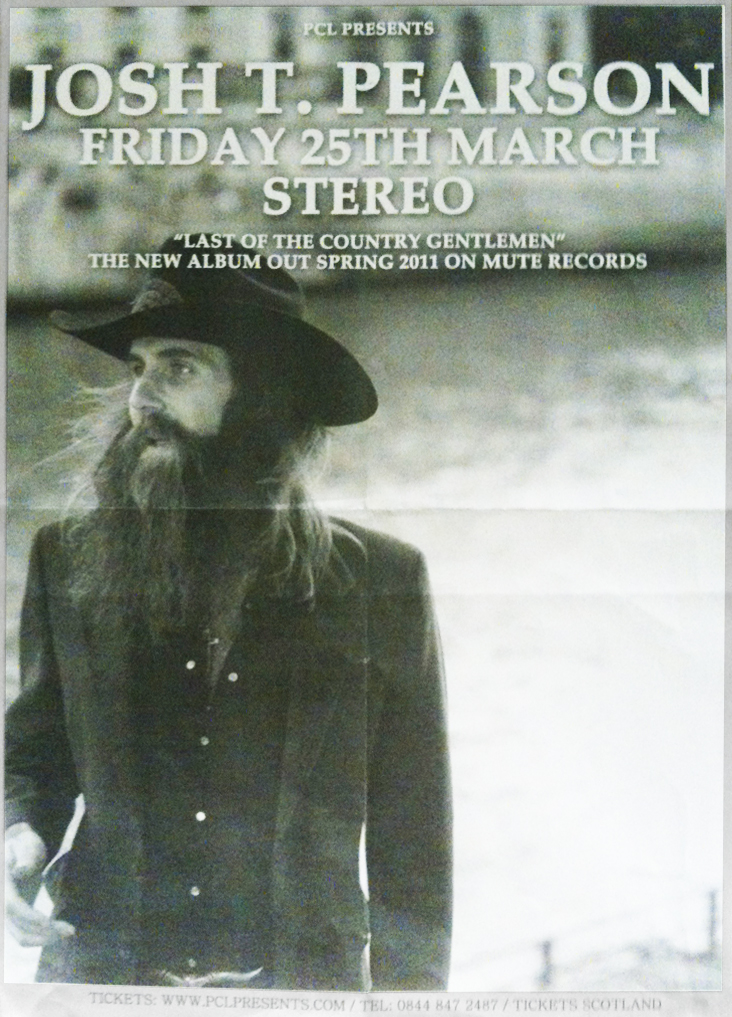
On 25 March 2011, Pearson’s ‘Last of the Country Gentlemen Tour’ made its way through Glasgow.  Fortunately for us here at LITC, we were in Glasgow at the time.  In fact, we had booked our tickets well in advance and Greg had travelled thousands of miles from America to meet Elijah at his home in Scotland for a week of adventure leading up to the gig.

Stereo, Glasgow, 25 March 2011

Greg got his hands on this advert from Stereo

At the show Pearson was selling an eleven-track live CD (seven of which are actual songs, while the rest are exclusively stage banter, all on a classy Imation-brand CD-R with a carefully photocopied portrait of Pearson, shown below), To Hull and Back.

(This isn’t shoddy cropping on our part – it came at that angle, cut this way.)

The show’s opener, a British solo act whose name will remain unmentioned here, was dreadful:  faux Americana, interminable roots/’blues’ compositions with lyrics that tried to conjure up images of railroad tracks and the devil at crossroads and all manner of rough & tumble, down-on-their-luck outlaw clichés.  Let us just say that it was ultimately a Bizarro World version of Josh T. Pearson…

The sick taste of that experience was immediately washed away when Pearson shambled onto the small stage in Stereo’s basement, looking like a heartbroken Jesus on methadone and whiskey, nodding and uttering a low ‘How y’all doin’?’  When a local yelled out, ‘Welcome back, Josh!’ Pearson replied, ‘I hope your years were better than mine…’  During his sound check, he told the audience that they’d need to ‘be super quiet or they’re going to go upstairs [to the restaurant]’ which he reinforced during the show by stopping a song in the middle when some idiots started to talk and only resuming when there was absolute silence.  Though this may seem like pedantry, Pearson’s songs often fell to a bare whisper and light strum, so an absolutely quiet environment was the only way we would actually be able to hear the songs as they were meant to be experienced.

Pearson began his set with what he said was a cover of a song by Boney M (we’d never heard of them, but apparently they were a reggae/disco group from the late 70s put together by Frank Farian, who would later go on to create Milli Vanilli), but Pearson made the song beautifully his own.  At the last second, Greg took out his iPhone and recorded the song, ‘Rivers of Babylon’ onto the voice memos app—here is a link to the recording, which turned out surprisingly polished:

Rivers of Babylon‘ (Boney M cover) – Josh T. Pearson

In this song, Pearson sang, ‘Let the words of my mouth and the meditations of my heart be acceptable in your eyes tonight’ as he gazed up soulfully.  It was as if he was dedicating the set to God, offering the pain and brokenness and loss that his songs contained not ultimately to us, the concertgoers, but to a divine audience.  Many of his songs speak about God or Jesus:  in ‘Country Dumb,’ he says that his kind of people are ‘failures each and every one, we’re the kind who will always need a savior’ and and in ‘Sweetheart, I Ain’t Your Christ,’ he sings to his woman: ‘you don’t need a lover or a friend, you need a God and not a mortal man.  Woman, you need born again, again–you need a savior and I just am not him.’  Yet many of his songs also speak of his own inability to control outbursts of anger or drinking (‘Woman, When I’ve Raised Hell’) or rein in his adulterous desire (‘Honeymoon Is Great, I Wish You Were Her’).  Pearson is the quintessential sinner looking for redemption while laying drunk in the gutter–if only more Christians could see their own moral failure and need for salvation as clearly as he does…

During his performance, despite several awkward false starts in reaction to the audience’s noise level (space which was occupied with Pearson telling some pretty wretched jokes), Pearson proved incredibly moving.  Indeed, his lengthy and intensely personal tunes demanded the full attention of the audience.  We here at LITC have come to the consensus that Pearson’s performance was in fact the best solo performance we had ever seen (at one point, I [Greg] even found myself choking up and with watery eyes in a mixture of joy and sadness at the beauty and despair of his set).  You really ought to pick up his record from your local record store and catch him live if he ever comes your way.

Time Capsule – 2001

Music has been very close to my heart since I took up violin and heard Weezer’s first record both at age 8.  And my listmaking obsession dates back just as far.  In this post (which may become a series if Greg wouldn’t mind sharing his 2001 ‘Time Capsule’), I’d like to reflect upon some of the music I loved according to a list from 2001, embarrassing admissions and all.

The Beta Band’s Hot Shots II, Bonnie ‘Prince’ Billy’s Ease Down the Road, Andrew Bird’s The Swimming Hour, Björk’s Vespertine, Bob Dylan’s “Love and Theft”, Fugazi’s The Argument, Lift to Experience’s The Texas-Jerusalem Crossroads, Mogwai’s Rock Music, Pinback’s Blue Screen Life, Spiritualized’s Let It Come Down and Spoon’s Girls Can Tell are just some of the many great records released in 2001 that I was completely unaware of at the time.  I will say that I frankly disliked The Strokes, Modest Mouse and the Yeah Yeah Yeahs at the time and I still wouldn’t consider myself a fan.  Sorry.

Alien Ant Farm ANThology — Since I’m listing these in alphabetical order, I suppose it’s good that I can get the most pathetic pick out of the way immediately.  Fourteen was a fortunate age for me: I had outgrown Blink-182’s Enema of the State and Incubus’ Make Yourself, and had not yet given myself entirely over to ‘screamo’ (let alone ‘Christian screamo’).  But I was unable to escape a love for Alien Ant Farm.  This record made sense to me at age fourteen for the following reasons:

  • I loved the album’s packaging – great designs and Photoshopped images of the band members in various historical settings, like a historical ANThology!
  • The single ‘Movies‘ captivated my adolescent mind with its catchy chorus and entertaining music video: so many amazing film references (Ghostbusters, Willy Wonka and the Chocolate Factory, The Karate Kid and Edward Scissorhands) and a cameo with Mr Myagi!
  • Singer Dryden Mitchell (whose name I always romantically associated with NASA’s Dryden Flight Research Center) had an INVERTED MOHAWK.  HOW COULD I RESIST AN INVERTED MOHAWK???
  • I was in love with guitarist Terry Corso’s custom Schecter 006 guitar.

Despite all of these excellent reasons, I do not listen to them now.

Converge Jane Doe — 2001 had its lows, but it also had its highs!  Converge’s Jane Doe represents one of the highest of the highs.  This record revolutionised music for me and remains one of my absolute favourite albums.

Perhaps I found Jane Doe so palatable as a result of conditioning via hardcore and metal bands I was already listening to such as Black Flag, Minor Threat, Black Sabbath, Iron Maiden and Slayer listener.  Along with being my gateway to Converge (who is among my Top 20 Bands), Jane Doe spurned my interest in many other great metal/metalcore acts such as Botch, Coalesce, Curl Up & Die, Unearth, Cave In and Daughters.  Do I listen to them now?  Yes.

The Hives Veni Vidi Vicious — ‘Hate to Say I Told You So’ was the first Hives song I ever heard.  It’s simplicity and raw energy enlivened my spirit.  Upon further inspection I discovered Veni Vidi Vicious, as well as The Hives’ previous record, Barely Legal.

The Hives were able to channel something primal about rock-and-roll while giving us something accessible and new, and they did it with exquisite pomp and style, complete with matching wardrobes and an excellent stage presence.  Their 2004 record Tyrannosaurus Hives demonstrated a great progression, and while 2007’s The Black and While Album proved less strong, it is still a highly enjoyable record.  Do I listen to them now?  Yes.

Jimmy Eat World Bleed American — ‘Bleed American’ was the first track I heard from this record, and after purchasing the record I found every track to be incredibly enjoyable (especially ‘Sweetness’ and it’s quiet/loud alternation).

After this record (and after seeing the band open for Weezer that year) I developed a great appreciation for their previous records: Jimmy Eat World (1994), Static Prevails (1996) and Clarity (1999).  But alas, by the time of their 2004 release, Futures, I had lost interest.  Do I listen to them now?  No.

Ozma Rock and Roll Part Three — On the coattails of Weezer I happened upon Ozma, a band named after L. Frank Baum’s Princess Ozma from his children’s fantasy novels.  Ozma captialised on Weezer’s pioneering geek-rock style and added some Casio, musical complexity and yet-more-wicked guitar licks (compare Rock and Roll with Weezer’s self-titled record from the same year [also known as The Green Album] and you’ll hear a striking difference).

They have since retained a special place in my heart due to their persistence as a pop-rock goldmine with the release of The Double Donkey Disc (2001/2002), Spending Time on the Borderline (2003) and (after a brief hiatus) Pasadena (2007).  Do I listen to them now?  Yes.

Radiohead Kid A/Amnesiac — For everyone who reached adolescence in the late 90s, ‘Karma Police’ from 1997’s OK Computer was the pinnacle of song, yet Kid A somehow managed to blow that all out of the water.  I remember when I first heard ‘Optimistic’ on the radio, which compelled me to buy the record.

I had no idea what I was in store for, considering ‘Optimistic’ would prove to be one of the weaker (though still incredible) tracks on the record.  Radiohead’s production had become more complex and experimental and Kid A would come to completely change the way I appreciate, experience and create music from thereon out.  This record is still a frequent listen and certainly one of my all-time favourites.

Saves the Day Stay What You Are — As with most other albums on this list, my purchase of Stay What You Are was inspired by the single ‘At Your Funeral’.

Saves the Day’s previous record, Through Being Cool, appealed to my emo and pop-punk tendencies, so it seemed like a good idea to investigate their new record.  Upon my first listen I wasn’t very pleased with half of the record, but over time it grew on me and became one of my high school favourites.  Their follow-up to Stay What You Are, In Reverie, proved to be more poppy less ambitious and I began to fall out of love with the band before their return to a more pop-punk sound.  Do I listen to them now?  Occasionally.

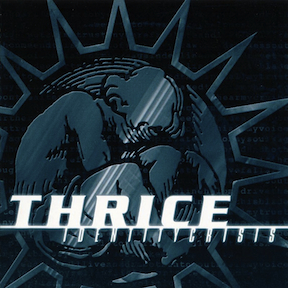
Thrice Identity Crisis — Unlike many other albums on this list (the only exceptions being the Converge and Ozma records), I did not learn about Identity Crisis from the radio.  In 2001 Thrice was still very much a local act, and fortunately for me, some of my friends had recently seen Thrice in concert.  I was told that they were ‘melodic hardcore’, and when I purchased this record I fell deeply in love with their music.

My love for Thrice was only intensified with the 2002 release of Illusion of Safety, which I considered a massive step forward for the band.  Unfortunately it was only a matter of time before Thrice would gain radio play, and in 2003 they released The Artist in the Ambulance and my heart was broken upon hearing the single ‘All That’s Left’ on a popular radio station.  Thrice had lost their edge and sounded like a dull rock band (though I want to take care not to lower them to the ranks of acts like Nickelback).  After Illusion of Safety I never bought another Thrice record and have had a difficult time ‘getting into’ their latest records.  While Identity Crisis was groundbreaking to me at the time (and along with Illusion of Safety has a few tracks that I still consider quite good), I no longer consider myself a fan and I do not recall the last time I was hankerin’ for a listen.

Thursday Full Collapse — Ah Full Collapse…thus began my high school interest in ‘screamo’.  What could be better than combining the genres of hardcore and emo?  Well, many things, and while I was an avid listener to ‘cultured’ bands like Radiohead, screamo occupied another place in my heart and mind.  Thursday was at the top of the screamo food chain, and there was certainly something special to me about hearing the screams from ‘Cross Out the Eyes’ playing on MTV in the morning before school.

My fascination with Thursday and screamo didn’t end at Full Collapse.  It wasn’t until some point between 2003’s War All the Time (which I loved) and 2006’s A City by the Light Divided (which I had no interest in) that the genre had totally dropped out of my listening queue.  Do I listen to them now?  No.

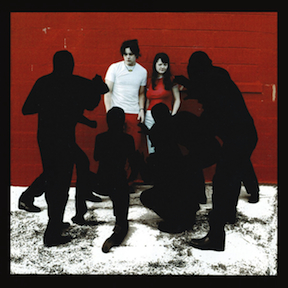
The White Stripes White Blood Cells — I recall hearing the track ‘Hello Operator’ from the White Stripes album De Stijl at some point in 2000, but it wasn’t until I heard ‘Fell in Love with a Girl’ that I felt this great compulsion to buy a White Stripes record.

White Blood Cells proved to be an excellent investment, with all of its garage-rock-revival sloppiness (and what Meg White lacked in percussive skill she made up for in keeping time).  Every record they produced (as they have officially announced their breakup this year) contained a bit of this genius, the sort of quality that can give us hope in the future of popular music.  Do I listen to them now?  Yes.

+++++

I stand by 60% of these albums now – I wonder whether that is a good or bad sign.

What were your favourite bands/albums in 2001?  How have they fared a decade later?

Has Arcade Fire taken over the world? No, but that was never the plan.

By now this is old news, but we’ll just say I was very busy on St Valentine’s Day (I had a date with Karl Barth).  Arcade Fire’s album The Suburbs, which Greg and I placed at numbers three and six in our respective Best Albums of 2010 lists, won Album of the Year at the 53rd Grammy Awards, one of the record industry’s highest honours.  Arcade Fire beat out industrial giants Eminem, Lady Antebellum, Lady Gaga and Katy Perry (I’m so tempted to just write ‘Lady Eminem, Lady Antebellum, Lady Gaga and Lady Perry’…) to take their seven little gramophone trophies home.

The indie blogosphere (as well as some very interesting backlash from those who had never heard of Arcade Fire before the 53rd Grammy Awards) has been set ablaze by the news, with the A.V. Club’s Steven Hyden writing,

Who cares about the Grammys?  It’s probably the least respected of all the major entertainment awards—which means it’s in the running for least respected institution anywhere—and yet a lot of people are going to be attaching a lot of significance to Arcade Fire winning album of the year honors for The Suburbs Sunday night. […] Does this signify the full-scale “arrival” of indie rock at the center of mainstream music?  Has Arcade Fire officially taken over the mantle as this generation’s defining rock band?  Does this mean that “we” won?  Be prepared to read all kinds of ruminations on these questions and many more in the days ahead.

It’s not my goal to have any groundbreaking things to say about this award, but I do think it’s interesting to point out that The Suburb‘s record sales were not what we may consider modest.  They reached number 1 on several international charts, including album charts in Belgium (Vlaanderen), their ‘native’ Canada, Ireland, Norway, Portugal, the UK and America (Billboard 200).  In recent history, several independent records have been performing well on the charts (namely Radiohead’s In Rainbows, Vampire Weekend’s Contra and The Decemberists The King is Dead), which gives some hope to those wishing to provide an affirmative answer to the question, ‘Does this mean that [the independent music scene] won?’

But the reality is that at the end of the day Arcade Fire and these other independent bands are selling a lot less music than the other nominees for Album of the Year (Lady Gaga’s The Fame Monster went platinum in 11 countries, eight of which were multi-platinum, and diamond in Poland), which does seem to indicate that the ‘war’ between independent and the mainstream is far from over.  But record sales are not the driving force behind independent music, which exists largely in reaction against the massive record industry.  There is no war, and as Arcade Fire bandleader and singer Win Butler said in his acceptance speech before the band performed ‘Ready to Start’, ‘We’re going to play another song because we like music.’  Arcade Fire won Album of the Year at the Grammys – that’s wonderful!  I’m sure that this will inspire more people to invest in their music, which is a great thing.  But in the end, music is about what we like and dare I say, what we love, which has absolutely nothing to do with Grammy Awards.

Here’s a brief Q & A time with the band after the show (via Tom Breihan at Pitchfork):